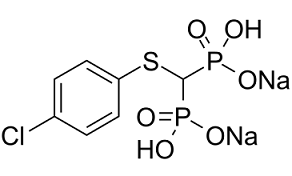
Tiludronate (Tiludronate disodium; Tiludronic Acid disodium) is a novel and potent bisphosphonate agent which prevents postmenopausal bone loss and is used for treatment of Paget's disease of bone (osteitis deformans) in human medicine. In veterinary medicine, tiludronic acid is used to treat navicular disease and bone spavin in horses. Its trade names are Tildren and Equidronate. It is approved for treatment of navicular disease and distal tarsal osteoarthritis in Europe, and was approved for treatment of navicular disease in the United States in 2014. Tiludronate is a non-nitrogenous bisphosphonate that inhibits osteoclasts, the primary cell responsible for the breakdown of bone required for bone remodeling.
Physicochemical Properties
| Molecular Formula | C7H7CLNA2O6P2S |
| Molecular Weight | 362.5719 |
| Exact Mass | 361.892 |
| CAS # | 149845-07-8 |
| Related CAS # | Tiludronate;89987-06-4;Tiludronate-d5 sodium |
| PubChem CID | 60936 |
| Appearance | White to off-white solid powder |
| Boiling Point | 600.7ºC at 760mmHg |
| Flash Point | 317.1ºC |
| Vapour Pressure | 2.79E-15mmHg at 25°C |
| LogP | 2.947 |
| Hydrogen Bond Donor Count | 2 |
| Hydrogen Bond Acceptor Count | 7 |
| Rotatable Bond Count | 4 |
| Heavy Atom Count | 19 |
| Complexity | 320 |
| Defined Atom Stereocenter Count | 0 |
| InChi Key | SKUHWSDHMJMHIW-UHFFFAOYSA-L |
| InChi Code | InChI=1S/C7H9ClO6P2S.2Na/c8-5-1-3-6(4-2-5)17-7(15(9,10)11)16(12,13)14/h1-4,7H,(H2,9,10,11)(H2,12,13,14)/q2*+1/p-2 |
| Chemical Name | [(4-chlorophenyl)sulfanyl-[hydroxy(oxido)phosphoryl]methyl]-hydroxyphosphinate disodium |
| Synonyms | Tiludronate disodium Tiludronic Acid disodium Tiludronic acid Skelid Tildren Equidronate. |
| HS Tariff Code | 2934.99.9001 |
| Storage |
Powder-20°C 3 years 4°C 2 years In solvent -80°C 6 months -20°C 1 month Note: Please store this product in a sealed and protected environment, avoid exposure to moisture. |
| Shipping Condition | Room temperature (This product is stable at ambient temperature for a few days during ordinary shipping and time spent in Customs) |
Biological Activity
| ln Vitro | The inhibition of proton transport by tiludronate is 5-fold greater in nephrogenic vesicles (IC50=1.1 mM) and 10,000-fold more in vesicles produced from osteoclasts (IC50=466 nM). Additionally, tiludronate efficiently suppresses the activity of pure yeast V-ATPase and inhibits proton transport in yeast microsomal preparations (IC50=3.5 microM). Tiludronate quickly and reversibly inhibits the proton transport process mediated by osteoclast V-ATPase, subject to pH variations [3]. |
| ln Vivo | Tiludronate inhibits bone resorption in a dose-dependent manner. Mature osteoclasts can be affected by tiludronate by decreased proton secretion into the resorption space and increased osteoclast dissociation from the bone matrix. Several models of osteoporosis have also been used to test teludronate. Tiladronate sodium (5–200 mg/kg; oral) reduced the loss of bone mass in a male ovariectomized rat model. This was measured chemically by evaluating the calcium and phosphate content or physically by assessing bone weight and density[3]. |
| References |
[1]. Prevention of postmenopausal bone loss by tiludronate. Lancet. 1989 Dec 23-30;2(8678-8679):1469-71. [2]. Effects of local administration of tiludronic acid on experimental periodontitis in diabetic rats. J Periodontol. 2018 Jan;89(1):105-116. [3]. Tiludronate: bone pharmacology and safety. Bone. 1995;17(5 Suppl):473S-477S. [4]. The bisphosphonate tiludronate is a potent inhibitor of the osteoclast vacuolar H(+)-ATPase. J Bone Miner Res. 1996;11(10):1498-1507. |
| Additional Infomation | Tiludronate Disodium is the disodium salt form of tiludronate, a first-generation, non-nitrogenous bisphosphonate analogue of endogenous pyrophosphate. Tiludronate adsorbs to hydroxyapatite cells, and although the exact mechanism through which this bisphosphonate exerts its effect has yet to be fully elucidated, tiludronate appears to inhibit protein-tyrosine-phosphatase (PTP) in osteoclasts, thereby disrupting the cytoskeletal ring structure and suppressing the bone resorbing activity of osteoclasts. In addition, tiludronate appears to inhibit the vacuolar-type proton ATPase (V-ATPase) in osteoclasts. Altogether, this may reduce the number of osteoclasts, inhibit abnormal bone resorption and reduce bone turnover. |
Solubility Data
| Solubility (In Vitro) | H2O : ~62.5 mg/mL (~172.38 mM) |
| Solubility (In Vivo) |
Note: Listed below are some common formulations that may be used to formulate products with low water solubility (e.g. < 1 mg/mL), you may test these formulations using a minute amount of products to avoid loss of samples. Injection Formulations (e.g. IP/IV/IM/SC) Injection Formulation 1: DMSO : Tween 80: Saline = 10 : 5 : 85 (i.e. 100 μL DMSO stock solution → 50 μL Tween 80 → 850 μL Saline) *Preparation of saline: Dissolve 0.9 g of sodium chloride in 100 mL ddH ₂ O to obtain a clear solution. Injection Formulation 2: DMSO : PEG300 :Tween 80 : Saline = 10 : 40 : 5 : 45 (i.e. 100 μL DMSO → 400 μLPEG300 → 50 μL Tween 80 → 450 μL Saline) Injection Formulation 3: DMSO : Corn oil = 10 : 90 (i.e. 100 μL DMSO → 900 μL Corn oil) Example: Take the Injection Formulation 3 (DMSO : Corn oil = 10 : 90) as an example, if 1 mL of 2.5 mg/mL working solution is to be prepared, you can take 100 μL 25 mg/mL DMSO stock solution and add to 900 μL corn oil, mix well to obtain a clear or suspension solution (2.5 mg/mL, ready for use in animals). Injection Formulation 4: DMSO : 20% SBE-β-CD in saline = 10 : 90 [i.e. 100 μL DMSO → 900 μL (20% SBE-β-CD in saline)] *Preparation of 20% SBE-β-CD in Saline (4°C,1 week): Dissolve 2 g SBE-β-CD in 10 mL saline to obtain a clear solution. Injection Formulation 5: 2-Hydroxypropyl-β-cyclodextrin : Saline = 50 : 50 (i.e. 500 μL 2-Hydroxypropyl-β-cyclodextrin → 500 μL Saline) Injection Formulation 6: DMSO : PEG300 : castor oil : Saline = 5 : 10 : 20 : 65 (i.e. 50 μL DMSO → 100 μLPEG300 → 200 μL castor oil → 650 μL Saline) Injection Formulation 7: Ethanol : Cremophor : Saline = 10: 10 : 80 (i.e. 100 μL Ethanol → 100 μL Cremophor → 800 μL Saline) Injection Formulation 8: Dissolve in Cremophor/Ethanol (50 : 50), then diluted by Saline Injection Formulation 9: EtOH : Corn oil = 10 : 90 (i.e. 100 μL EtOH → 900 μL Corn oil) Injection Formulation 10: EtOH : PEG300:Tween 80 : Saline = 10 : 40 : 5 : 45 (i.e. 100 μL EtOH → 400 μLPEG300 → 50 μL Tween 80 → 450 μL Saline) Oral Formulations Oral Formulation 1: Suspend in 0.5% CMC Na (carboxymethylcellulose sodium) Oral Formulation 2: Suspend in 0.5% Carboxymethyl cellulose Example: Take the Oral Formulation 1 (Suspend in 0.5% CMC Na) as an example, if 100 mL of 2.5 mg/mL working solution is to be prepared, you can first prepare 0.5% CMC Na solution by measuring 0.5 g CMC Na and dissolve it in 100 mL ddH2O to obtain a clear solution; then add 250 mg of the product to 100 mL 0.5% CMC Na solution, to make the suspension solution (2.5 mg/mL, ready for use in animals). Oral Formulation 3: Dissolved in PEG400 Oral Formulation 4: Suspend in 0.2% Carboxymethyl cellulose Oral Formulation 5: Dissolve in 0.25% Tween 80 and 0.5% Carboxymethyl cellulose Oral Formulation 6: Mixing with food powders Note: Please be aware that the above formulations are for reference only. InvivoChem strongly recommends customers to read literature methods/protocols carefully before determining which formulation you should use for in vivo studies, as different compounds have different solubility properties and have to be formulated differently. (Please use freshly prepared in vivo formulations for optimal results.) |
| Preparing Stock Solutions | 1 mg | 5 mg | 10 mg | |
| 1 mM | 2.7581 mL | 13.7904 mL | 27.5809 mL | |
| 5 mM | 0.5516 mL | 2.7581 mL | 5.5162 mL | |
| 10 mM | 0.2758 mL | 1.3790 mL | 2.7581 mL |