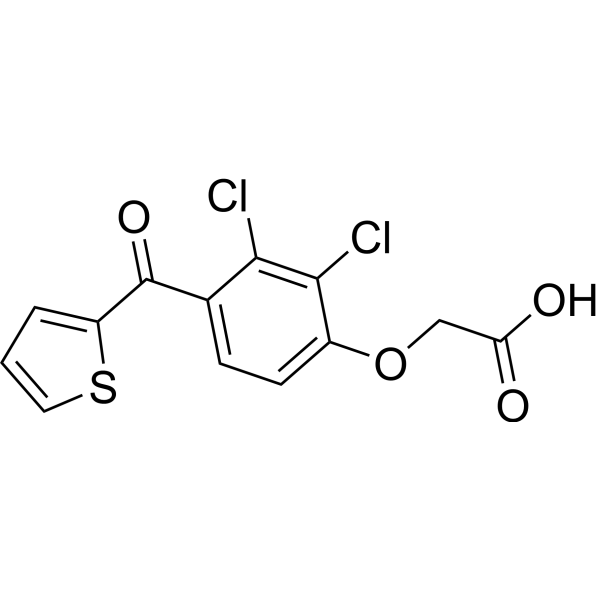
Physicochemical Properties
| Molecular Formula | C13H8O4SCL2.C4H11NO3 |
| Molecular Weight | 452.30626 |
| Exact Mass | 329.952 |
| CAS # | 40180-04-9 |
| PubChem CID | 38409 |
| Appearance | White to light yellow solid powder |
| Density | 1.5±0.1 g/cm3 |
| Boiling Point | 534.6±50.0 °C at 760 mmHg |
| Melting Point | 148-149ºC |
| Flash Point | 277.1±30.1 °C |
| Vapour Pressure | 0.0±1.5 mmHg at 25°C |
| Index of Refraction | 1.632 |
| LogP | 3.07 |
| Hydrogen Bond Donor Count | 1 |
| Hydrogen Bond Acceptor Count | 5 |
| Rotatable Bond Count | 5 |
| Heavy Atom Count | 20 |
| Complexity | 379 |
| Defined Atom Stereocenter Count | 0 |
| SMILES | C1=CSC(=C1)C(=O)C2=C(C(=C(C=C2)OCC(=O)O)Cl)Cl |
| InChi Key | AGHANLSBXUWXTB-UHFFFAOYSA-N |
| InChi Code | InChI=1S/C13H8Cl2O4S/c14-11-7(13(18)9-2-1-5-20-9)3-4-8(12(11)15)19-6-10(16)17/h1-5H,6H2,(H,16,17) |
| Chemical Name | 2-[2,3-dichloro-4-(thiophene-2-carbonyl)phenoxy]acetic acid |
| HS Tariff Code | 2934.99.9001 |
| Storage |
Powder-20°C 3 years 4°C 2 years In solvent -80°C 6 months -20°C 1 month Note: This product requires protection from light (avoid light exposure) during transportation and storage. |
| Shipping Condition | Room temperature (This product is stable at ambient temperature for a few days during ordinary shipping and time spent in Customs) |
Biological Activity
| ln Vivo | Tinic acid is found only in plasma, is eliminated through bile and fasting urine, and is found in various drugs that have slight variations. It is administered orally and intravenously in single doses (100 mg/lg in rats and mice, 5 mg/kg in pigs and dogs). creatures[2]. Tinic acid (0-480 mg/kg; oral; for 28 days) causes single-cell necrosis in small populations of hepatocytes and lowers blood pressure, serum, hemoglobin, uric acid, and S-GPT [3]. |
| Animal Protocol |
Animal/Disease Models: Rats, mice, pigs and dogs [2] Doses: rats and mice 100 mg/lg, pigs and dogs 5 mg/kg Route of Administration: oral and intravenous (iv) (iv)injection; single dose Experimental Results: plasma only Significant binding to plasma proteins found in Very small difference. Animal/Disease Models: Female and male SD (SD (Sprague-Dawley)) rats [3] Doses: 0, 30, 120 and 480 mg/kg Doses: po (po (oral gavage)) for 28 days Experimental Results: Blood pressure and serum uric acid diminished to 30 mg/kg; at 120 and 480 mg/kg, hemoglobin slightly diminished and S-GPT increased; the liver weight and serum magnesium concentration of male rats Dramatically increased, while the liver weight of female rats only increased slightly; in addition, it also induced Single cell necrosis of small groups of hepatocytes. |
| ADME/Pharmacokinetics |
Metabolism / Metabolites Ticrynafen has known human metabolites that include Tienilic acid-s-oxide and Thiophene-4,5-epoxide. |
| References | [1]. Takayoshi Nishiya, et al. Involvement of cytochrome P450-mediated metabolism in tienilic acid hepatotoxicity in rats. Toxicol Lett. 2008 Dec 15;183(1-3):81-9. |
| Additional Infomation |
Tienilic acid is an aromatic ketone that is 2,3-dichlorophenoxyacetic acid in which the hydrogen at position 4 on the benzene ring is replaced by a thiophenecarbonyl group. A loop diuretic used to treat hypertension, it was withdrawn from the market in 1982 due to links with hepatitis. It has a role as a loop diuretic, an antihypertensive agent and a hepatotoxic agent. It is a member of thiophenes, an aromatic ketone, an aromatic ether, a monocarboxylic acid and a dichlorobenzene. Tienilic acid, or ticrynafen, is a diuretic drug with uric acid-lowering action which was marketed for the treatment of hypertension. It was withdrawn in 1982 after case reports in the United States suggested a link between ticrynafen and hepatitis. (Manier et al., 1982) A novel diuretic with uricosuric action. It has been proposed as an antihypertensive agent. Drug Indication For the treatment of hypertension. |
Solubility Data
| Solubility (In Vitro) | DMSO : ~100 mg/mL (~301.96 mM) |
| Solubility (In Vivo) |
Note: Listed below are some common formulations that may be used to formulate products with low water solubility (e.g. < 1 mg/mL), you may test these formulations using a minute amount of products to avoid loss of samples. Injection Formulations (e.g. IP/IV/IM/SC) Injection Formulation 1: DMSO : Tween 80: Saline = 10 : 5 : 85 (i.e. 100 μL DMSO stock solution → 50 μL Tween 80 → 850 μL Saline) *Preparation of saline: Dissolve 0.9 g of sodium chloride in 100 mL ddH ₂ O to obtain a clear solution. Injection Formulation 2: DMSO : PEG300 :Tween 80 : Saline = 10 : 40 : 5 : 45 (i.e. 100 μL DMSO → 400 μLPEG300 → 50 μL Tween 80 → 450 μL Saline) Injection Formulation 3: DMSO : Corn oil = 10 : 90 (i.e. 100 μL DMSO → 900 μL Corn oil) Example: Take the Injection Formulation 3 (DMSO : Corn oil = 10 : 90) as an example, if 1 mL of 2.5 mg/mL working solution is to be prepared, you can take 100 μL 25 mg/mL DMSO stock solution and add to 900 μL corn oil, mix well to obtain a clear or suspension solution (2.5 mg/mL, ready for use in animals). Injection Formulation 4: DMSO : 20% SBE-β-CD in saline = 10 : 90 [i.e. 100 μL DMSO → 900 μL (20% SBE-β-CD in saline)] *Preparation of 20% SBE-β-CD in Saline (4°C,1 week): Dissolve 2 g SBE-β-CD in 10 mL saline to obtain a clear solution. Injection Formulation 5: 2-Hydroxypropyl-β-cyclodextrin : Saline = 50 : 50 (i.e. 500 μL 2-Hydroxypropyl-β-cyclodextrin → 500 μL Saline) Injection Formulation 6: DMSO : PEG300 : castor oil : Saline = 5 : 10 : 20 : 65 (i.e. 50 μL DMSO → 100 μLPEG300 → 200 μL castor oil → 650 μL Saline) Injection Formulation 7: Ethanol : Cremophor : Saline = 10: 10 : 80 (i.e. 100 μL Ethanol → 100 μL Cremophor → 800 μL Saline) Injection Formulation 8: Dissolve in Cremophor/Ethanol (50 : 50), then diluted by Saline Injection Formulation 9: EtOH : Corn oil = 10 : 90 (i.e. 100 μL EtOH → 900 μL Corn oil) Injection Formulation 10: EtOH : PEG300:Tween 80 : Saline = 10 : 40 : 5 : 45 (i.e. 100 μL EtOH → 400 μLPEG300 → 50 μL Tween 80 → 450 μL Saline) Oral Formulations Oral Formulation 1: Suspend in 0.5% CMC Na (carboxymethylcellulose sodium) Oral Formulation 2: Suspend in 0.5% Carboxymethyl cellulose Example: Take the Oral Formulation 1 (Suspend in 0.5% CMC Na) as an example, if 100 mL of 2.5 mg/mL working solution is to be prepared, you can first prepare 0.5% CMC Na solution by measuring 0.5 g CMC Na and dissolve it in 100 mL ddH2O to obtain a clear solution; then add 250 mg of the product to 100 mL 0.5% CMC Na solution, to make the suspension solution (2.5 mg/mL, ready for use in animals). Oral Formulation 3: Dissolved in PEG400 Oral Formulation 4: Suspend in 0.2% Carboxymethyl cellulose Oral Formulation 5: Dissolve in 0.25% Tween 80 and 0.5% Carboxymethyl cellulose Oral Formulation 6: Mixing with food powders Note: Please be aware that the above formulations are for reference only. InvivoChem strongly recommends customers to read literature methods/protocols carefully before determining which formulation you should use for in vivo studies, as different compounds have different solubility properties and have to be formulated differently. (Please use freshly prepared in vivo formulations for optimal results.) |
| Preparing Stock Solutions | 1 mg | 5 mg | 10 mg | |
| 1 mM | 2.2109 mL | 11.0544 mL | 22.1087 mL | |
| 5 mM | 0.4422 mL | 2.2109 mL | 4.4217 mL | |
| 10 mM | 0.2211 mL | 1.1054 mL | 2.2109 mL |