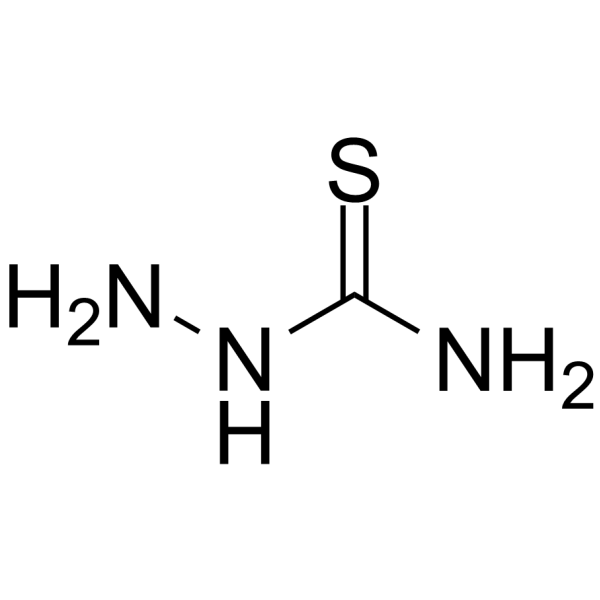
Physicochemical Properties
| Molecular Formula | CH5N3S |
| Molecular Weight | 91.1355 |
| Exact Mass | 91.02 |
| CAS # | 79-19-6 |
| Related CAS # | 4346-94-5 (mono-hydrochloride) |
| PubChem CID | 2723789 |
| Appearance | Off-white to yellow solid powder |
| Density | 1.4±0.1 g/cm3 |
| Boiling Point | 208.6±23.0 °C at 760 mmHg |
| Melting Point | 180-183 °C (dec.)(lit.) |
| Flash Point | 80.0±22.6 °C |
| Vapour Pressure | 0.2±0.4 mmHg at 25°C |
| Index of Refraction | 1.667 |
| LogP | -1.15 |
| Hydrogen Bond Donor Count | 3 |
| Hydrogen Bond Acceptor Count | 2 |
| Rotatable Bond Count | 0 |
| Heavy Atom Count | 5 |
| Complexity | 42.2 |
| Defined Atom Stereocenter Count | 0 |
| InChi Key | BRWIZMBXBAOCCF-UHFFFAOYSA-N |
| InChi Code | InChI=1S/CH5N3S/c2-1(5)4-3/h3H2,(H3,2,4,5) |
| Chemical Name | aminothiourea |
| HS Tariff Code | 2934.99.9001 |
| Storage |
Powder-20°C 3 years 4°C 2 years In solvent -80°C 6 months -20°C 1 month |
| Shipping Condition | Room temperature (This product is stable at ambient temperature for a few days during ordinary shipping and time spent in Customs) |
Biological Activity
| Toxicity/Toxicokinetics |
Toxicity Summary IDENTIFICATION AND USE: 1-Amino-2-thiourea is an odorless white crystalline powder or long needles from water. It is an intermediate for pesticides, especially herbicides, and pharmaceuticals; used in certain photographic and dye applications and used as a reagent for the detection of metals. HUMAN EXPOSURE AND TOXICITY: Thioureas are potential sensitizing accelerators and antioxidants used in the manufacture of rubber which may cause irritant contact dermatitis. ANIMAL STUDIES: Subcutaneous injections of thiosemicarbazide into postnatal mice caused convulsions in mice when treated on the day 7 or later but not on the days 1-5. The latent period of the 1st convulsion was 115 min in mice injected on the day 7. The convulsions were inhibited by pyridoxine-HCL, but not by pyridoxal phosphate. GABAergic antagonists (1-amino-2-thiourea) enhanced aggressive behavior and decreased the social behavior of mice. 1-amino-2-thiourea was noncarcinogenic in mice and rats. The agent was teratogenic in chick embryos when applied to the vascular area on the 3rd day of incubation at 0.5 to 1 mg it produced deformities of the wing and beak, but not harelip. ECOTOXICITY STUDIES: Exposure of Rana sylvatica tadpoles to 25 mg/L or more caused a curvature of digits, abnormal limb articulations, difficulty in swimming, and death. Wood frog (Rana sylvatica) tadpoles were exposed to 50 mg thiosemicarbazide (TSC)/L water for varying lengths of time and at different developmental stages. Short exposure periods (3 and 6 hr) resulted in no visible deformities. Exposure periods of 12 or more hr caused slight to severe abnormalities, with a direct relationship between length of exposure and degree of deformity. Tadpoles exposed to TSC from posthatching Days 24-30 were more seriously affected than were tadpoles exposed at an older age. Interactions The acute neurobehavioral toxicity of organochlorine pesticide, aldrin, has been studied at sublethal doses. A dose of 8.9 mg/kg (1/4 LD50) induced piloerection, tremors, convulsive excitement restlessness, augmented spontaneous motor activity and exploratory behavior in mice after 60 min, of i.p. administration indicating CNS stimulation. Blockade of specific neurotransmitter system by pretreatment with atropine (10 mg/kg), iproniazid (100 mg/kg) alpha-methyl-p-tyrosine (200 mg/kg), p-chlorophenylalanine (200 mg/kg) or thiosemicarbazide (5 mg/kg) significantly altered the neurotoxic symptoms induced by the pesticide indicating direct or indirect involvement of various neurotransmitter system in mediating CNS toxicity. Conditioned avoidance response in rats was not affected by the pesticide alone or in combination with either drug. Female CD1 mice given the contraceptive steroids mestranol and norethynodrel (1:10) in the diet (0.0033%) for 4 months had a growth reduction of 20% when compared with mice fed a normal diet, and had lower convulsive thresholds when tested with the vitamin B6 antagonists 2,4-dimethyl-5-methyl-hydroxypyrimidine and thiosemicarbazide. In conditioned avoidance response (CAR) tests, mice fed the steroid-containing diets showed a decreased acquisition performance during all six sessions; however, mice fed the same diet supplemented with vitamin B6 (0.04%) performed as well during the last three sessions of the CAR tests as mice fed the normal diet. Susceptibility to thiosemicarbazide was compared in 7 animal species together with the protective effect of vitamin B6 on the induction of convulsions. Susceptibility occurred generally with the phylogenetic development of the brain of vertebrates as well as invertebrates. Abnormal behavior analogous to running fits in rats and mice, which was thought to be a characteristic and activated form of locomotion, was also induced in every animal except the silkworm. Vitamin B6 arrested the induction of convulsions and abnormal behavior in guinea pigs and goldfish. GABA-/inhibitory/ agents (thiosemicarbazide) markedly decreased the effect of morphine, hydrocodone, and the enkephaline analogs: Tyr-D-Ala-Gly-Phe-NH2 and Tyr-D-Ala-Gly-Phe (NO2) NH2 /in experimental animals/. For more Interactions (Complete) data for 1-AMINO-2-THIOUREA (15 total), please visit the HSDB record page. Non-Human Toxicity Values LD50 Norway Rat adult oral 13 mg/kg LD50 Rat oral 9160 ug/kg LD50 Mouse ip 1 mg/kg LD50 Mouse sc 16,407 ug/kg For more Non-Human Toxicity Values (Complete) data for 1-AMINO-2-THIOUREA (8 total), please visit the HSDB record page. |
| References |
[1]. Yamashita J. Susceptibility to thiosemicarbazide (an antagonist of vitamin B6), and phylogenetic and ontogenetic development of brain. J Nutr Sci Vitaminol (Tokyo). 1974;20(2):113-9. [2]. Potential Anticancer Agents against Melanoma Cells Based on an As-Synthesized Thiosemicarbazide Derivative. Biomolecules. 2022 Jan 18;12(2):151. [3]. Reaction of thiosemicarbazide with some divalent ions: Synthesis, characterization, molecular modeling, and evaluation of the catalytic and biological activity of the complexes. Inorganic and Nano-Metal Chemistry, 2017, 47(7): 1070-1079. |
| Additional Infomation |
THIOSEMICARBAZIDE is a white crystalline powder and is odorless. This material is used as a reagent for ketones and certain metals, for photography and as a rodenticide. It is also effective for control of bacterial leaf blight of rice. Not a registered pesticide in the U.S. It is a chemical intermediate for herbicides and a reagent for detection of metals. (EPA, 1998) Hydrazinecarbothioamide is a member of the class of thioureas that is thiourea in which a hydrogen of one of the amino groups is replaced by an amino group. It is a member of hydrazines, a thiocarboxamide and a member of thioureas. Mechanism of Action Glutamic acid decarboxylase activity in mouse brain homogenates was reduced after pretreatment with thiosemicarbazide. |
Solubility Data
| Solubility (In Vitro) | DMSO : ~125 mg/mL (~1371.52 mM) |
| Solubility (In Vivo) |
Note: Listed below are some common formulations that may be used to formulate products with low water solubility (e.g. < 1 mg/mL), you may test these formulations using a minute amount of products to avoid loss of samples. Injection Formulations (e.g. IP/IV/IM/SC) Injection Formulation 1: DMSO : Tween 80: Saline = 10 : 5 : 85 (i.e. 100 μL DMSO stock solution → 50 μL Tween 80 → 850 μL Saline) *Preparation of saline: Dissolve 0.9 g of sodium chloride in 100 mL ddH ₂ O to obtain a clear solution. Injection Formulation 2: DMSO : PEG300 :Tween 80 : Saline = 10 : 40 : 5 : 45 (i.e. 100 μL DMSO → 400 μLPEG300 → 50 μL Tween 80 → 450 μL Saline) Injection Formulation 3: DMSO : Corn oil = 10 : 90 (i.e. 100 μL DMSO → 900 μL Corn oil) Example: Take the Injection Formulation 3 (DMSO : Corn oil = 10 : 90) as an example, if 1 mL of 2.5 mg/mL working solution is to be prepared, you can take 100 μL 25 mg/mL DMSO stock solution and add to 900 μL corn oil, mix well to obtain a clear or suspension solution (2.5 mg/mL, ready for use in animals). Injection Formulation 4: DMSO : 20% SBE-β-CD in saline = 10 : 90 [i.e. 100 μL DMSO → 900 μL (20% SBE-β-CD in saline)] *Preparation of 20% SBE-β-CD in Saline (4°C,1 week): Dissolve 2 g SBE-β-CD in 10 mL saline to obtain a clear solution. Injection Formulation 5: 2-Hydroxypropyl-β-cyclodextrin : Saline = 50 : 50 (i.e. 500 μL 2-Hydroxypropyl-β-cyclodextrin → 500 μL Saline) Injection Formulation 6: DMSO : PEG300 : castor oil : Saline = 5 : 10 : 20 : 65 (i.e. 50 μL DMSO → 100 μLPEG300 → 200 μL castor oil → 650 μL Saline) Injection Formulation 7: Ethanol : Cremophor : Saline = 10: 10 : 80 (i.e. 100 μL Ethanol → 100 μL Cremophor → 800 μL Saline) Injection Formulation 8: Dissolve in Cremophor/Ethanol (50 : 50), then diluted by Saline Injection Formulation 9: EtOH : Corn oil = 10 : 90 (i.e. 100 μL EtOH → 900 μL Corn oil) Injection Formulation 10: EtOH : PEG300:Tween 80 : Saline = 10 : 40 : 5 : 45 (i.e. 100 μL EtOH → 400 μLPEG300 → 50 μL Tween 80 → 450 μL Saline) Oral Formulations Oral Formulation 1: Suspend in 0.5% CMC Na (carboxymethylcellulose sodium) Oral Formulation 2: Suspend in 0.5% Carboxymethyl cellulose Example: Take the Oral Formulation 1 (Suspend in 0.5% CMC Na) as an example, if 100 mL of 2.5 mg/mL working solution is to be prepared, you can first prepare 0.5% CMC Na solution by measuring 0.5 g CMC Na and dissolve it in 100 mL ddH2O to obtain a clear solution; then add 250 mg of the product to 100 mL 0.5% CMC Na solution, to make the suspension solution (2.5 mg/mL, ready for use in animals). Oral Formulation 3: Dissolved in PEG400 Oral Formulation 4: Suspend in 0.2% Carboxymethyl cellulose Oral Formulation 5: Dissolve in 0.25% Tween 80 and 0.5% Carboxymethyl cellulose Oral Formulation 6: Mixing with food powders Note: Please be aware that the above formulations are for reference only. InvivoChem strongly recommends customers to read literature methods/protocols carefully before determining which formulation you should use for in vivo studies, as different compounds have different solubility properties and have to be formulated differently. (Please use freshly prepared in vivo formulations for optimal results.) |
| Preparing Stock Solutions | 1 mg | 5 mg | 10 mg | |
| 1 mM | 10.9721 mL | 54.8607 mL | 109.7213 mL | |
| 5 mM | 2.1944 mL | 10.9721 mL | 21.9443 mL | |
| 10 mM | 1.0972 mL | 5.4861 mL | 10.9721 mL |