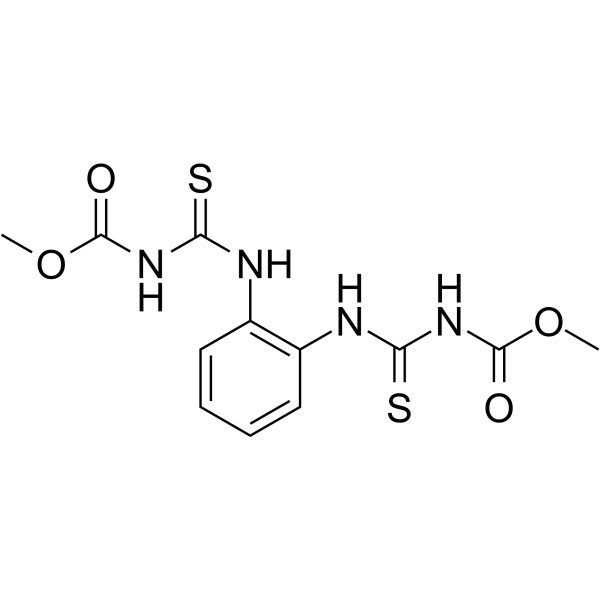
Physicochemical Properties
| Molecular Formula | C12H14N4O4S2 |
| Molecular Weight | 342.3940 |
| Exact Mass | 342.045 |
| CAS # | 23564-05-8 |
| Related CAS # | Thiophanate-methyl-d6;1398065-77-4 |
| PubChem CID | 3032791 |
| Appearance |
Colorless crystals Colorless prisms Colorless crystalline solid |
| Density | 1.5±0.1 g/cm3 |
| Boiling Point | 478.4ºC at 760 mmHg |
| Melting Point | 172°C |
| Vapour Pressure | 2.58E-09mmHg at 25°C |
| Index of Refraction | 1.709 |
| LogP | 1.16 |
| Hydrogen Bond Donor Count | 4 |
| Hydrogen Bond Acceptor Count | 6 |
| Rotatable Bond Count | 4 |
| Heavy Atom Count | 22 |
| Complexity | 407 |
| Defined Atom Stereocenter Count | 0 |
| SMILES | S=C(N([H])C(=O)OC([H])([H])[H])N([H])C1=C([H])C([H])=C([H])C([H])=C1N([H])C(N([H])C(=O)OC([H])([H])[H])=S |
| InChi Key | QGHREAKMXXNCOA-UHFFFAOYSA-N |
| InChi Code | InChI=1S/C12H14N4O4S2/c1-19-11(17)15-9(21)13-7-5-3-4-6-8(7)14-10(22)16-12(18)20-2/h3-6H,1-2H3,(H2,13,15,17,21)(H2,14,16,18,22) |
| Chemical Name | methyl N-[[2-(methoxycarbonylcarbamothioylamino)phenyl]carbamothioyl]carbamate |
| HS Tariff Code | 2934.99.9001 |
| Storage |
Powder-20°C 3 years 4°C 2 years In solvent -80°C 6 months -20°C 1 month |
| Shipping Condition | Room temperature (This product is stable at ambient temperature for a few days during ordinary shipping and time spent in Customs) |
Biological Activity
| ADME/Pharmacokinetics |
Absorption, Distribution and Excretion Nearly all thiophanate-methyl is eliminated from the body in 24 hr; that left in tissues after 24 hr is largely eliminated within 96 hr. Thiophanate-methyl was efficiently absorbed, and rapidly excreted. There was evidently some saturability of uptake processes and lengthening of elimination half-life at high dose levels or following sustained low dose exposures. Blood levels diminished quickly, and tissue levels were very low by day 4 (post-exposure) in all cases. Metabolism / Metabolites Studies in mice with four radioactive forms of the molecule (14C in the ring or as the thiourea carbon of the methyl carbon and 35S) showed that the C=S bond was cleaved to a great extent prior to absorption from the gastrointestinal tract. Some of the methyl carbon apparently is metabolized to carbon dioxide. The major urinary metabolites are carbendazim and its 6-hydroxy derivative; these are excreted as O- or N-glucuronides. A compound in which the two =S's of thiophanate-methyl are replaced by =O's is a minor metabolite. Some other metabolites detectable by thin-layer chromatography of radioactive material remain unidentified. ... Primary metabolic changes included hydrolysis of side chain extremities, closure of remaining side chain portions, and oxidation of the phenyl moiety, producing a methyl hydroxybenzimidazolyl carbamate. The primary urinary metabolite was conjugated with sulfate. Fecal residues were largely thiophanate-methyl and a phenyl ring hydroxylated product. |
| Toxicity/Toxicokinetics |
Toxicity Data LC50 (rat) = 1,700 mg/m3/4h Non-Human Toxicity Values LD50 Rat oral 6640 mg/kg LD50 Rat ip 1140 mg/kg LD50 Mouse oral 3400 mg/kg LD50 Mouse ip 790 mg/kg For more Non-Human Toxicity Values (Complete) data for THIOPHANATE METHYL (21 total), please visit the HSDB record page. |
| Additional Infomation |
Thiophanate Methyl can cause female reproductive toxicity and male reproductive toxicity according to The Environmental Protection Agency (EPA). Thiophanate-methyl appears as colorless crystals or light brown powder. (NTP, 1992) Thiophanate-methyl is a member of the class of thioureas that is the dimethyl ester of (1,2-phenylenedicarbamothioyl)biscarbamic acid. A fungicide effective against a broad spectrum of diseases in fruit, vegetables, turf and other crops including eyespot, scab, powdery mildew and grey mould. It has a role as an antifungal agrochemical. It is a member of thioureas, a carbamate ester, a benzimidazole precursor fungicide and a carbamate fungicide. It is functionally related to a 1,2-phenylenediamine. Thiophanate-Methyl (TM) is a systemic fungicide. It was first registered to be used as a fungicide by the EPA in 1973. It is effective against a wide range of fungal pathogens including: eyespot and other diseases of cereals; scab on apples and pears; Monilia disease and Gloeosporim rot on apples; Monilia app. On stone fruit; Canker on fruit trees; powdery mildews on pome fruit, stone fruit, vegetables, cucurbits, strawberries, vines, roses. Thiophanate methyl is also used on almonds, pecans, tea, coffee, peanuts, soya beans, tobacco, chestnuts, sugar cane, citrus fruit, figs, hops, mulberries, and many other crops. Nematocide used in livestock; also has fungicidal properties. Mechanism of Action As a class of compounds, thiocarbamates do not produce consistent cholinesterase inhibition patterns. In the rat subchronic toxicity study, serum cholinesterase activity was increased in males by 22-38% relative to controls but decreased in females by 25-28% at >/= 293.2 mg/kg/day. In the rat chronic toxicity/carcinogenicity study, males showed increases in serum ChE at 280.6 mg/kg/day (HDT) at 6 and 12 months (41-42%) whereas at 24 months, it was decreased (-38%). ChE activity in females was slightly decreased (18035%) at 6 and 12 months at >/= 63.5 mg/kg/day ... /thiocarbamates/ In order to characterize the mechanism of thyroid tumorigenesis, a series of short term studies were undertaken to determine whether TM had antithyroid activity. These studies demonstrated that TM caused liver and thyroid enlargement, increased circulating TSH and decreased T3/T4 after 2 to 8 days' treatment with TM at 6000 ppm (equivalent to the HDT in the rat chronic toxicity/carcinogenicity study). Some liver microsomal enzymes, including UDP-glucuronosyltransferase, were increased. The effects on liver and thyroid weight were reversible, but reversibility of the alterations in circulating hormone levels and on microscopic effects were not evaluated. Supplementation of treated animals with T4 prevented thyroid enlargement and increased TSH but did not prevent liver enlargement. TM also appeared to have a mild inhibitory effect on microsomal thyroid peroxidase. These data were considered necessary to adequately support this mechanism. |
Solubility Data
| Solubility (In Vitro) | DMSO : ~300 mg/mL (~876.19 mM) |
| Solubility (In Vivo) |
Solubility in Formulation 1: ≥ 2.5 mg/mL (7.30 mM) (saturation unknown) in 10% DMSO + 40% PEG300 + 5% Tween80 + 45% Saline (add these co-solvents sequentially from left to right, and one by one), clear solution. For example, if 1 mL of working solution is to be prepared, you can add 100 μL of 25.0 mg/mL clear DMSO stock solution to 400 μL PEG300 and mix evenly; then add 50 μL Tween-80 to the above solution and mix evenly; then add 450 μL normal saline to adjust the volume to 1 mL. Preparation of saline: Dissolve 0.9 g of sodium chloride in 100 mL ddH₂ O to obtain a clear solution. Solubility in Formulation 2: ≥ 2.5 mg/mL (7.30 mM) (saturation unknown) in 10% DMSO + 90% Corn Oil (add these co-solvents sequentially from left to right, and one by one), clear solution. For example, if 1 mL of working solution is to be prepared, you can add 100 μL of 25.0 mg/mL clear DMSO stock solution to 900 μL of corn oil and mix evenly. (Please use freshly prepared in vivo formulations for optimal results.) |
| Preparing Stock Solutions | 1 mg | 5 mg | 10 mg | |
| 1 mM | 2.9206 mL | 14.6032 mL | 29.2065 mL | |
| 5 mM | 0.5841 mL | 2.9206 mL | 5.8413 mL | |
| 10 mM | 0.2921 mL | 1.4603 mL | 2.9206 mL |