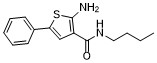
Physicochemical Properties
| Molecular Formula | C15H18N2OS |
| Molecular Weight | 274.381222248077 |
| Exact Mass | 274.11 |
| Elemental Analysis | C, 65.66; H, 6.61; N, 10.21; O, 5.83; S, 11.68 |
| CAS # | 1202193-89-2 |
| PubChem CID | 53383638 |
| Appearance | Off-white to light yellow solid powder |
| Hydrogen Bond Donor Count | 2 |
| Hydrogen Bond Acceptor Count | 3 |
| Rotatable Bond Count | 5 |
| Heavy Atom Count | 19 |
| Complexity | 292 |
| Defined Atom Stereocenter Count | 0 |
| SMILES | C1(N)SC(C2=CC=CC=C2)=CC=1C(NCCCC)=O |
| InChi Key | QWWMJRJCSZMXHZ-UHFFFAOYSA-N |
| InChi Code | InChI=1S/C15H18N2OS/c1-2-3-9-17-15(18)12-10-13(19-14(12)16)11-7-5-4-6-8-11/h4-8,10H,2-3,9,16H2,1H3,(H,17,18) |
| Chemical Name | 2-amino-N-butyl-5-phenylthiophene-3-carboxamide |
| Synonyms | ThioLox, |
| HS Tariff Code | 2934.99.9001 |
| Storage |
Powder-20°C 3 years 4°C 2 years In solvent -80°C 6 months -20°C 1 month |
| Shipping Condition | Room temperature (This product is stable at ambient temperature for a few days during ordinary shipping and time spent in Customs) |
Biological Activity
| ln Vitro | ThioLox responds to the active site of 15-LOX-1 non-covalently by exhibiting competitive inhibition [1]. In precision-cut lung slices (PCLS), ThioLox (50 μM; 24 h) reduces interleukin (IL). In neuronal cells, ThioLox (10 μM; 16 h) inhibits mitochondrial peroxidation and mitochondrial superoxide expression [1]. ThioLox (5–20 μM; 14–16 h) dramatically lowers neuronal cell death while shielding HT-22 cell scaffolds from glutathione toxicity[1]. |
| ln Vivo | ThioLox has a logP value of 3 and the measured numerical predictive power crosses the blood-brain barrier [1]. |
| Cell Assay |
RT-PCR[1] Cell Types: Precision- Formation[1]. Lung Sections (PCLS) Tested Concentrations: 1, 5, 10, 25 and 50 μM Incubation Duration: 20 hrs (hours) mixed with 10 μM linoleic acid and stimulated with 10 ng/mL LPS for the last 4 hrs (hours). Experimental Results: At 50 μM, the pro-inflammatory gene IL- The expression of 1β, IL-6, IL-8, IL-12b, TNFα and iNOS was inhibited by nearly 50%. Cell viability assay[1] Cell Types: Neuronal HT-22 Cell Tested Concentrations: 5, 10 and 20 μM Incubation Duration: 14-16 hrs (hours) Experimental Results: Neuronal cell death was Dramatically diminished in response to glutamate toxicity. |
| References |
[1]. Design of a novel thiophene inhibitor of 15-lipoxygenase-1 with both anti-inflammatory and neuroprotective properties. Eur J Med Chem. 2016 Oct 21;122:786-801. |
Solubility Data
| Solubility (In Vitro) | DMSO : ~100 mg/mL (~364.46 mM) |
| Solubility (In Vivo) |
Solubility in Formulation 1: ≥ 2.5 mg/mL (9.11 mM) (saturation unknown) in 10% DMSO + 40% PEG300 + 5% Tween80 + 45% Saline (add these co-solvents sequentially from left to right, and one by one), clear solution. For example, if 1 mL of working solution is to be prepared, you can add 100 μL of 25.0 mg/mL clear DMSO stock solution to 400 μL PEG300 and mix evenly; then add 50 μL Tween-80 to the above solution and mix evenly; then add 450 μL normal saline to adjust the volume to 1 mL. Preparation of saline: Dissolve 0.9 g of sodium chloride in 100 mL ddH₂ O to obtain a clear solution. Solubility in Formulation 2: 2.5 mg/mL (9.11 mM) in 10% DMSO + 90% Corn Oil (add these co-solvents sequentially from left to right, and one by one), suspension solution; with ultrasonication. For example, if 1 mL of working solution is to be prepared, you can add 100 μL of 25.0 mg/mL clear DMSO stock solution to 900 μL of corn oil and mix evenly. (Please use freshly prepared in vivo formulations for optimal results.) |
| Preparing Stock Solutions | 1 mg | 5 mg | 10 mg | |
| 1 mM | 3.6446 mL | 18.2229 mL | 36.4458 mL | |
| 5 mM | 0.7289 mL | 3.6446 mL | 7.2892 mL | |
| 10 mM | 0.3645 mL | 1.8223 mL | 3.6446 mL |