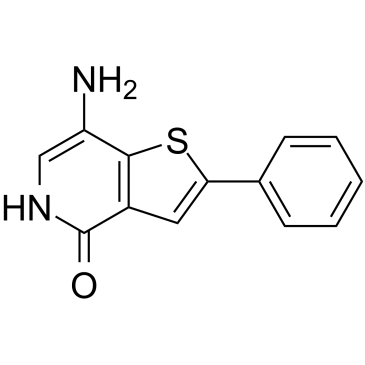
Thienopyridone is a novel and potent phosphatase of regenerating liver (PRL) phosphatase inhibitor with anticancer effects. It inhibits PRL with IC50s of 173 nM, 277 nM and 128 nM for PRL-1, PRL-2, and PRL-3, respectively.
Physicochemical Properties
| Molecular Formula | C13H10N2OS |
| Molecular Weight | 242.296301364899 |
| Exact Mass | 242.051 |
| CAS # | 1018454-97-1 |
| PubChem CID | 91383855 |
| Appearance | Yellow to brown solid powder |
| LogP | 1.7 |
| Hydrogen Bond Donor Count | 2 |
| Hydrogen Bond Acceptor Count | 3 |
| Rotatable Bond Count | 1 |
| Heavy Atom Count | 17 |
| Complexity | 349 |
| Defined Atom Stereocenter Count | 0 |
| SMILES | C1(=O)NC=C(N)C2SC(C3=CC=CC=C3)=CC1=2 |
| InChi Key | FBVOPOZVLBHOHR-UHFFFAOYSA-N |
| InChi Code | InChI=1S/C13H10N2OS/c14-10-7-15-13(16)9-6-11(17-12(9)10)8-4-2-1-3-5-8/h1-7H,14H2,(H,15,16) |
| Chemical Name | 7-amino-2-phenyl-5H-thieno[3,2-c]pyridin-4-one |
| HS Tariff Code | 2934.99.9001 |
| Storage |
Powder-20°C 3 years 4°C 2 years In solvent -80°C 6 months -20°C 1 month |
| Shipping Condition | Room temperature (This product is stable at ambient temperature for a few days during ordinary shipping and time spent in Customs) |
Biological Activity
| ln Vitro | In soft agar, tumor anchorage-independent cell growth was significantly inhibited by thinopyridones. HT-29 and RKO cells exhibit thienopyridone's EC50 values of 3.05 μM and 3.29 μM, respectively[1]. In HeLa cells, thienopyridone (1-75 μM; 24 hours) treatment resulted in a dose-dependent rise in total p130Cas. Thienopyridones cause FAK and p130Cas, which results in caspase-mediated bladder cancer. The caspase-8 and PARP pathways are activated by thienopyridone [1]. HUVEC migration is considerably inhibited, but not proliferation, by thinopyridones (3.75-30 μM; 24 hours) [1]. |
| Cell Assay |
Cell Viability Assay[1] Cell Types: RKO and HT-29 cells Tested Concentrations: 0.5 μM, 1.67 μM, 5 μM, 8.33 μM Incubation Duration: 14 days Experimental Results: Measured by colony number or colony size, independent of cancer cell adhesion Demonstrated dose-dependent inhibition of sexual growth. Western Blot Analysis[1] Cell Types: HeLa Cell Tested Concentrations: 1 μM, 5 μM, 10 μM, 25 μM, 50 μM, 75 μM Incubation Duration: 24 hrs (hours) Experimental Results: A dose-dependent downregulation of total p130Cas was observed. |
| References |
[1]. A selective phosphatase of regenerating liver phosphatase inhibitor suppresses tumor cell anchorage-independent growth by a novel mechanism involving p130Cas cleavage. Cancer Res. 2008 Feb 15;68(4):1162-9. |
Solubility Data
| Solubility (In Vitro) | DMSO : ~5 mg/mL (~20.64 mM) |
| Solubility (In Vivo) |
Solubility in Formulation 1: ≥ 2.08 mg/mL (8.58 mM) (saturation unknown) in 10% DMSO + 90% (20% SBE-β-CD in Saline) (add these co-solvents sequentially from left to right, and one by one), clear solution. For example, if 1 mL of working solution is to be prepared, you can add 100 μL of 20.8 mg/mL clear DMSO stock solution to 900 μL of 20% SBE-β-CD physiological saline solution and mix evenly. Preparation of 20% SBE-β-CD in Saline (4°C,1 week): Dissolve 2 g SBE-β-CD in 10 mL saline to obtain a clear solution. (Please use freshly prepared in vivo formulations for optimal results.) |
| Preparing Stock Solutions | 1 mg | 5 mg | 10 mg | |
| 1 mM | 4.1271 mL | 20.6356 mL | 41.2712 mL | |
| 5 mM | 0.8254 mL | 4.1271 mL | 8.2542 mL | |
| 10 mM | 0.4127 mL | 2.0636 mL | 4.1271 mL |