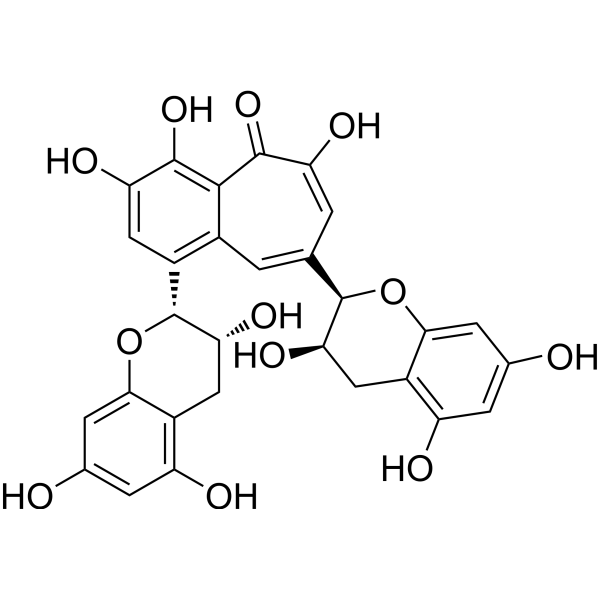
Physicochemical Properties
| Molecular Formula | C29H24O12 |
| Molecular Weight | 564.4937 |
| Exact Mass | 564.126 |
| CAS # | 4670-05-7 |
| PubChem CID | 135403798 |
| Appearance | Brown to reddish brown solid powder |
| Density | 1.6±0.1 g/cm3 |
| Boiling Point | 926.2±65.0 °C at 760 mmHg |
| Melting Point | 240 °C |
| Flash Point | 314.3±27.8 °C |
| Vapour Pressure | 0.0±0.3 mmHg at 25°C |
| Index of Refraction | 1.760 |
| LogP | 1.61 |
| Hydrogen Bond Donor Count | 9 |
| Hydrogen Bond Acceptor Count | 12 |
| Rotatable Bond Count | 2 |
| Heavy Atom Count | 41 |
| Complexity | 1060 |
| Defined Atom Stereocenter Count | 4 |
| SMILES | C1[C@H]([C@H](OC2=CC(=CC(=C21)O)O)C3=CC4=C(C(=C(C=C4[C@@H]5[C@@H](CC6=C(C=C(C=C6O5)O)O)O)O)O)C(=O)C(=C3)O)O |
| InChi Key | IPMYMEWFZKHGAX-ZKSIBHASSA-N |
| InChi Code | InChI=1S/C29H24O12/c30-11-3-17(32)15-8-21(36)28(40-23(15)5-11)10-1-13-14(7-20(35)27(39)25(13)26(38)19(34)2-10)29-22(37)9-16-18(33)4-12(31)6-24(16)41-29/h1-7,21-22,28-33,35-37,39H,8-9H2,(H,34,38)/t21-,22-,28-,29-/m1/s1 |
| Chemical Name | 3,4,6-trihydroxy-1,8-bis[(2R,3R)-3,5,7-trihydroxy-3,4-dihydro-2H-chromen-2-yl]benzo[7]annulen-5-one |
| HS Tariff Code | 2934.99.9001 |
| Storage |
Powder-20°C 3 years 4°C 2 years In solvent -80°C 6 months -20°C 1 month |
| Shipping Condition | Room temperature (This product is stable at ambient temperature for a few days during ordinary shipping and time spent in Customs) |
Biological Activity
| Targets |
- Theaflavin targets the neuraminidase (NA) protein of Influenza A (H1N1) virus (binding energy: -6.8 kcal/mol) [1] |
| ln Vitro |
Green tea's theaflavins were shown to have the lowest docking energy and to block the H1N1 NA protein very potently. Plant-based compounds called theaflavins have long been used to treat influenza infections. Flavonoids and other polyphenolic chemicals are concentrated in green tea. By creating hydrogen bonds, theaflavins have reportedly been demonstrated to match to the amino acid residues of NA, including Arg118, Asp151, Asp152, Arg193, Asp199, Asn344, and Arg430 [1]. - Theaflavin was computationally screened against the H1N1 neuraminidase active site using AutoDock Vina. It formed hydrogen bonds with key residues (Glu119, Arg152, Asp151) in the NA active pocket, suggesting potential inhibitory activity [1] |
| Enzyme Assay |
- The crystal structure of H1N1 neuraminidase (PDB ID: 3BKD) was prepared by removing water molecules and ligands. Theaflavin (SMILES: C29H24O12) was modeled using ChemBio3D Ultra 14.0 and docked into the NA active site with AutoDock Vina. Grid box dimensions were set to 20 × 20 × 20 Å (centered on catalytic residues), and the top-ranked pose had a binding energy of -6.8 kcal/mol (forming hydrogen bonds to Glu119 and Arg152) [1] |
| References |
[1]. Identification of Suitable Natural Inhibitor against Influenza A (H1N1) Neuraminidase Protein by Molecular Docking. Genomics Inform. 2016 Sep;14(3):96-103. |
| Additional Infomation |
Theaflavin is a biflavonoid that is 3,4,5-trihydroxybenzocyclohepten-6-one which is substituted at positions 1 and 8 by (2R,3R)-3,5,7-trihydroxy-3,4-dihydro-2H-chromen-2-yl groups. It is the main red pigment in black tea. It has a role as an antioxidant, a chelator, a plant metabolite, a radiation protective agent and an antibacterial agent. It is a polyphenol and a biflavonoid. - Theaflavin is a natural polyphenolic compound derived from black tea (Camellia sinensis) [1] - This study identified Theaflavin as a potential lead compound for H1N1 neuraminidase inhibition [1] |
Solubility Data
| Solubility (In Vitro) |
DMSO : ~50 mg/mL (~88.58 mM) H2O : ~2 mg/mL (~3.54 mM) |
| Solubility (In Vivo) |
Solubility in Formulation 1: 3 mg/mL (5.31 mM) in 10% DMSO + 40% PEG300 + 5% Tween80 + 45% Saline (add these co-solvents sequentially from left to right, and one by one), clear solution; with sonication. For example, if 1 mL of working solution is to be prepared, you can add 100 μL of 30.0 mg/mL clear DMSO stock solution to 400 μL PEG300 and mix evenly; then add 50 μL Tween-80 to the above solution and mix evenly; then add 450 μL normal saline to adjust the volume to 1 mL. Preparation of saline: Dissolve 0.9 g of sodium chloride in 100 mL ddH₂ O to obtain a clear solution. Solubility in Formulation 2: 3 mg/mL (5.31 mM) in 10% DMSO + 90% (20% SBE-β-CD in Saline) (add these co-solvents sequentially from left to right, and one by one), clear solution; with ultrasonication. For example, if 1 mL of working solution is to be prepared, you can add 100 μL of 30.0 mg/mL clear DMSO stock solution to 900 μL of 20% SBE-β-CD physiological saline solution and mix evenly. Preparation of 20% SBE-β-CD in Saline (4°C,1 week): Dissolve 2 g SBE-β-CD in 10 mL saline to obtain a clear solution. Solubility in Formulation 3: 3 mg/mL (5.31 mM) in 10% DMSO + 90% Corn Oil (add these co-solvents sequentially from left to right, and one by one), suspension solution; with ultrasonication. For example, if 1 mL of working solution is to be prepared, you can add 100 μL of 30.0 mg/mL clear DMSO stock solution to 900 μL of corn oil and mix evenly. (Please use freshly prepared in vivo formulations for optimal results.) |
| Preparing Stock Solutions | 1 mg | 5 mg | 10 mg | |
| 1 mM | 1.7715 mL | 8.8576 mL | 17.7151 mL | |
| 5 mM | 0.3543 mL | 1.7715 mL | 3.5430 mL | |
| 10 mM | 0.1772 mL | 0.8858 mL | 1.7715 mL |