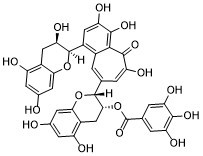
Physicochemical Properties
| Molecular Formula | C₃₆H₂₈O₁₆ |
| Molecular Weight | 716.60 |
| Exact Mass | 716.137 |
| CAS # | 30462-34-1 |
| Appearance | Brown to reddish brown solid powder |
| Density | 1.8±0.1 g/cm3 |
| Boiling Point | 1202.8±65.0 °C at 760 mmHg |
| Flash Point | 382.0±27.8 °C |
| Vapour Pressure | 0.0±0.3 mmHg at 25°C |
| Index of Refraction | 1.830 |
| LogP | 2.45 |
| Synonyms | TF2A Theaflavin Monogallate A Theaflavin-3-gallate |
| HS Tariff Code | 2934.99.9001 |
| Storage |
Powder-20°C 3 years 4°C 2 years In solvent -80°C 6 months -20°C 1 month Note: This product requires protection from light (avoid light exposure) during transportation and storage. |
| Shipping Condition | Room temperature (This product is stable at ambient temperature for a few days during ordinary shipping and time spent in Customs) |
Biological Activity
| ln Vitro |
Theaflavin-3-gallate exhibits prooxidant properties in vitro, inducing reactive oxygen species (ROS) generation in a concentration-dependent manner (10-100 μM) in HepG2, HeLa, and Caco-2 cells[1] Theaflavin-3-gallate depletes intracellular glutathione (GSH) levels in HepG2 cells, with a 40% reduction observed at 50 μM after 24 hours of incubation; this GSH depletion is associated with enhanced lipid peroxidation, as indicated by increased thiobarbituric acid reactive substances (TBARS) levels[1] Theaflavin-3-gallate exerts cytotoxic effects on cancer cell lines (HepG2, HeLa, Caco-2) with IC₅₀ values ranging from 45 to 68 μM (24-hour incubation), and the cytotoxicity is iron-dependent—chelating iron ions abolishes its prooxidant and cytotoxic effects[1] Theaflavin-3-gallate induces apoptotic cell death in HepG2 cells, characterized by DNA fragmentation, increased caspase-3 activity, and phosphatidylserine externalization detected via Annexin V-FITC staining[1] |
| Enzyme Assay |
For ROS generation assay: Culture target cells in 96-well plates; load cells with DCFH-DA probe (10 μM) for 30 minutes at 37°C; treat cells with Theaflavin-3-gallate (10-100 μM) for 24 hours; measure fluorescence intensity using a microplate reader (excitation 485 nm, emission 535 nm) to quantify ROS levels[1] For GSH detection assay: Lyse HepG2 cells treated with Theaflavin-3-gallate (10-80 μM) for 24 hours; add GSH detection reagent to the cell lysate, incubate at room temperature for 15 minutes; measure absorbance at 405 nm to determine GSH concentration[1] For lipid peroxidation assay: Collect cells treated with Theaflavin-3-gallate (30-100 μM) for 48 hours; homogenize cells and mix with TBARS reagent; heat the mixture at 95°C for 60 minutes; cool to room temperature and measure absorbance at 532 nm to quantify TBARS levels[1] |
| Cell Assay |
For cytotoxicity assay: Seed HepG2, HeLa, and Caco-2 cells in 96-well plates (5×10³ cells/well); treat cells with Theaflavin-3-gallate (10-100 μM) for 24-72 hours; add MTT reagent and incubate for 4 hours; dissolve formazan crystals with DMSO; measure absorbance at 570 nm to calculate cell viability and IC₅₀ values[1] For iron-dependent prooxidant assay: Divide HepG2 cells into two groups; pre-treat one group with iron chelator (100 μM) for 1 hour, then treat both groups with Theaflavin-3-gallate (50 μM) for 24 hours; measure ROS levels via DCFH-DA staining and cell viability via MTT assay to compare the effects with and without iron chelation[1] For apoptosis assay: Treat HepG2 cells with Theaflavin-3-gallate (40-80 μM) for 48 hours; isolate genomic DNA and analyze fragmentation via agarose gel electrophoresis; detect caspase-3 activity using a colorimetric assay kit; assess phosphatidylserine externalization via Annexin V-FITC/PI double-staining flow cytometry[1] |
| Toxicity/Toxicokinetics |
Theaflavin-3-gallate shows selective cytotoxicity towards cancer cell lines (HepG2, HeLa, Caco-2) with minimal toxicity to normal human fibroblasts (IC₅₀ > 100 μM after 24 hours)[1] The prooxidant and cytotoxic effects of Theaflavin-3-gallate are strictly iron-dependent, requiring the presence of transition metal ions to mediate ROS generation and cellular damage[1] |
| References |
[1]. Theaflavin-3-gallate and theaflavin-3'-gallate, polyphenols in black tea with prooxidant properties. Basic Clin Pharmacol Toxicol. 2008 Jul;103(1):66-74. |
| Additional Infomation |
Theaflavin-3-gallate is a natural polyphenol belonging to the theaflavin family, predominantly found in black tea (Camellia sinensis) as a product of catechin oxidation during fermentation[1] Its prooxidant mechanism involves redox cycling with transition metal ions (e.g., iron), leading to the formation of ROS that disrupt intracellular redox homeostasis (GSH depletion, lipid peroxidation) and induce apoptotic cell death[1] Unlike many other tea polyphenols with antioxidant properties, Theaflavin-3-gallate primarily exerts biological effects through prooxidant activity, which contributes to its cytotoxicity against cancer cells[1] |
Solubility Data
| Solubility (In Vitro) | DMSO : ~50 mg/mL (~69.77 mM) |
| Solubility (In Vivo) |
Solubility in Formulation 1: ≥ 2.5 mg/mL (3.49 mM) (saturation unknown) in 10% DMSO + 90% (20% SBE-β-CD in Saline) (add these co-solvents sequentially from left to right, and one by one), clear solution. For example, if 1 mL of working solution is to be prepared, you can add 100 μL of 25.0 mg/mL clear DMSO stock solution to 900 μL of 20% SBE-β-CD physiological saline solution and mix evenly. Preparation of 20% SBE-β-CD in Saline (4°C,1 week): Dissolve 2 g SBE-β-CD in 10 mL saline to obtain a clear solution. (Please use freshly prepared in vivo formulations for optimal results.) |
| Preparing Stock Solutions | 1 mg | 5 mg | 10 mg | |
| 1 mM | 1.3955 mL | 6.9774 mL | 13.9548 mL | |
| 5 mM | 0.2791 mL | 1.3955 mL | 2.7910 mL | |
| 10 mM | 0.1395 mL | 0.6977 mL | 1.3955 mL |