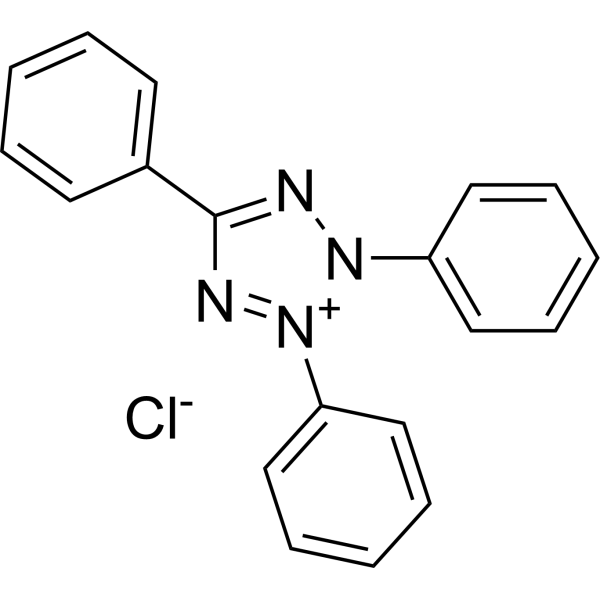
Physicochemical Properties
| Molecular Formula | C19H15CLN4 |
| Molecular Weight | 334.8022 |
| Exact Mass | 334.098 |
| Elemental Analysis | C, 68.16; H, 4.52; Cl, 10.59; N, 16.73 |
| CAS # | 298-96-4 |
| Related CAS # | 902-00-1 (Parent) |
| PubChem CID | 9283 |
| Appearance | White to light yellow solid powder |
| Boiling Point | >360 |
| Melting Point | 250 °C(lit.) |
| Flash Point | 91.7ºC |
| Vapour Pressure | 0.0615mmHg at 25°C |
| LogP | 0.215 |
| Hydrogen Bond Donor Count | 0 |
| Hydrogen Bond Acceptor Count | 3 |
| Rotatable Bond Count | 3 |
| Heavy Atom Count | 24 |
| Complexity | 330 |
| Defined Atom Stereocenter Count | 0 |
| SMILES | C1=CC=C(C=C1)C2=NN([N+](=N2)C3=CC=CC=C3)C4=CC=CC=C4.[Cl-] |
| InChi Key | PKDBCJSWQUOKDO-UHFFFAOYSA-M |
| InChi Code | InChI=1S/C19H15N4.ClH/c1-4-10-16(11-5-1)19-20-22(17-12-6-2-7-13-17)23(21-19)18-14-8-3-9-15-18;/h1-15H;1H/q+1;/p-1 |
| Chemical Name | 2,3,5-triphenyltetrazol-2-ium;chloride |
| Synonyms | 2,3,5-Triphenyltetrazolium chloride; 298-96-4; Red tetrazolium; Uroscreen; Vitastain; Urocheck; TRIPHENYLTETRAZOLIUM CHLORIDE; Tetrzolium chloride; TPTZ; TTC |
| HS Tariff Code | 2934.99.9001 |
| Storage |
Powder-20°C 3 years 4°C 2 years In solvent -80°C 6 months -20°C 1 month Note: Please store this product in a sealed and protected environment (e.g. under nitrogen), avoid exposure to moisture and light. |
| Shipping Condition | Room temperature (This product is stable at ambient temperature for a few days during ordinary shipping and time spent in Customs) |
Biological Activity
| Targets |
TTC is reduced by mitochondrial dehydrogenases (specifically in viable cells) to formazan, serving as a metabolic marker for cellular viability; no affinity constants reported.[1] |
| ln Vitro |
TTC is reduced by mitochondrial dehydrogenases (specifically in viable cells) to formazan, serving as a metabolic marker for cellular viability; no affinity constants reported.[1] |
| ln Vivo |
In adult CD1/Thy1-YFP mice with hypoxia-ischemia (HI)-induced stroke, in vivo TTC perfusion staining (post-mannitol BBB opening) delineates infarcted regions (white) from viable tissue (red), correlating with loss of neuronal markers (DARPP32, MAP2) and HSP70 upregulation in injured areas. In neonatal P10 mice, TTC staining quantifies LPS-sensitized HI injury, showing 3.2-fold larger infarction (26.8% vs. 8.4% in controls; p<0.05) after 72h LPS pretreatment, contrasting adult neuroprotection.[1] In adult macaques with middle cerebral artery occlusion (MCAO)-induced stroke, immersion staining with 2% TTC for 30 min at 37°C accurately demarcates infarcted regions (unstained) at 6h post-ischemia, showing 100% spatial correlation with loss of SDH/CCO enzyme activity (confirmed by histochemistry). Quantitative analysis reveals no significant difference in infarct volume between TTC staining (28.4±3.7%) and mitochondrial enzyme assays (27.1±3.5%), validating TTC as an early (6h) infarction detector in primates.[2] |
| Animal Protocol |
Mannitol pretreatment: IP injection of 1.4 M mannitol (0.1 ml/g for adults; 0.125 ml/g for neonates) 30 min before TTC perfusion to disrupt BBB. TTC perfusion: Transcardial perfusion with 10 ml of 2% TTC (in PBS) under avertin/isoflurane anesthesia; brains harvested 10 min post-perfusion for fixation or biochemical analysis. Terminal procedure: Animals deeply anesthetized before perfusion due to TTC systemic toxicity; brains sectioned (0.8 mm slices) or processed for protein/RNA extraction.[1] Stroke model: Adult macaques subjected to permanent MCAO via transorbital approach under ketamine anesthesia. TTC staining: Brains harvested 6h post-MCAO, sliced coronally (2mm thickness), and immersed in 2% TTC in PBS (pH 7.4) at 37°C for 30 min in the dark. Analysis: Slices fixed in 4% formalin; infarct area (unstained) quantified via digitized planimetry; adjacent sections processed for SDH/CCO histochemistry.[2] |
| Toxicity/Toxicokinetics |
Systemic TTC (2% solution) is rapidly lethal in mice via intracardiac/IA injection, likely due to mitochondrial aerobic oxidation inhibition; no LD50 reported. Osmotic BBB disruption with high-dose mannitol may cause irreversible BBB damage and distress, requiring dose adjustment in severely injured animals.[1] |
| References |
[1]. Mannitol-facilitated perfusion staining with 2,3,5-triphenyltetrazolium chloride (TTC) for detection of experimental cerebral infarction and biochemical analysis. J Neurosci Methods. 2012 Jan 15;203(1):122-9. [2]. Human umbilical mesenchymal stem cells promote recovery after ischemic stroke. Stroke. 2011 Jul;42(7):2045-53. |
| Additional Infomation |
2,3,5-triphenyltetrazolium chloride is an organic chloride salt having 2,3,5-triphenyltetrazolium as the counterion. It has a role as an indicator and a dye. It contains a 2,3,5-triphenyltetrazolium. TTC (colorless) is reduced to red formazan by mitochondrial enzymes in viable cells, enabling infarction detection; its small size (334.8 g/mol) limits BBB penetration without osmotic opening. Mechanism: Acts as an electron acceptor in mitochondrial respiratory chain, reduced by NADH-dependent dehydrogenases to insoluble formazan. Applications: Essential for quantifying cerebral infarction in edematous/neonatal brains; compatible with IHC, RT-PCR, immunoblotting, and zymography for penumbra analysis.[1] TTC reduction requires intact mitochondrial electron transport chain (ETC) function; its white→red color change specifically identifies metabolically active tissue. Mechanism: Acts as an electron acceptor for NADH-dependent dehydrogenases (mainly SDH in Complex II), forming insoluble red formazan in viable cells. Applications: Gold standard for early infarction detection (≥6h) in preclinical stroke models; compatible with mitochondrial enzyme assays for validation.[2] |
Solubility Data
| Solubility (In Vitro) |
H2O : ~50 mg/mL (~149.34 mM) DMSO : ~16.67 mg/mL (~49.79 mM) |
| Solubility (In Vivo) |
Solubility in Formulation 1: ≥ 1.67 mg/mL (4.99 mM) (saturation unknown) in 10% DMSO + 40% PEG300 + 5% Tween80 + 45% Saline (add these co-solvents sequentially from left to right, and one by one), clear solution. For example, if 1 mL of working solution is to be prepared, you can add 100 μL of 16.7 mg/mL clear DMSO stock solution to 400 μL PEG300 and mix evenly; then add 50 μL Tween-80 to the above solution and mix evenly; then add 450 μL normal saline to adjust the volume to 1 mL. Preparation of saline: Dissolve 0.9 g of sodium chloride in 100 mL ddH₂ O to obtain a clear solution. Solubility in Formulation 2: ≥ 1.67 mg/mL (4.99 mM) (saturation unknown) in 10% DMSO + 90% (20% SBE-β-CD in Saline) (add these co-solvents sequentially from left to right, and one by one), clear solution. For example, if 1 mL of working solution is to be prepared, you can add 100 μL of 16.7 mg/mL clear DMSO stock solution to 900 μL of 20% SBE-β-CD physiological saline solution and mix evenly. Preparation of 20% SBE-β-CD in Saline (4°C,1 week): Dissolve 2 g SBE-β-CD in 10 mL saline to obtain a clear solution. Solubility in Formulation 3: ≥ 1.67 mg/mL (4.99 mM) (saturation unknown) in 10% DMSO + 90% Corn Oil (add these co-solvents sequentially from left to right, and one by one), clear solution. For example, if 1 mL of working solution is to be prepared, you can add 100 μL of 16.7 mg/mL clear DMSO stock solution to 900 μL of corn oil and mix evenly. Solubility in Formulation 4: 25 mg/mL (74.67 mM) in PBS (add these co-solvents sequentially from left to right, and one by one), clear solution; with ultrasonication. (Please use freshly prepared in vivo formulations for optimal results.) |
| Preparing Stock Solutions | 1 mg | 5 mg | 10 mg | |
| 1 mM | 2.9869 mL | 14.9343 mL | 29.8686 mL | |
| 5 mM | 0.5974 mL | 2.9869 mL | 5.9737 mL | |
| 10 mM | 0.2987 mL | 1.4934 mL | 2.9869 mL |