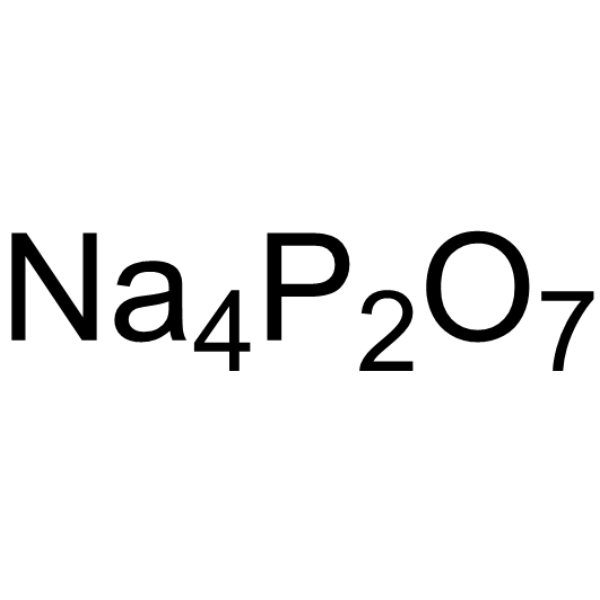
Physicochemical Properties
| Molecular Formula | NA4O7P2 |
| Molecular Weight | 265.90 |
| Exact Mass | 265.871 |
| CAS # | 7722-88-5 |
| Related CAS # | 10042-91-8 (unspecified hydrochloride salt);13472-36-1 (tetra-hydrochloride salt decahydrate);14691-80-6 (tri-hydrochloride salt);7758-16-9 (di-hydrochloride salt) |
| PubChem CID | 24403 |
| Appearance |
CRYSTALS COLORLESS, TRANSPARENT CRYSTALS OR WHITE POWDER White powder or granules. |
| Density | 2.53 g/mL at 25 °C(lit.) |
| Boiling Point | 93.8 °C |
| Melting Point | 80 °C |
| LogP | 0.941 |
| Hydrogen Bond Donor Count | 0 |
| Hydrogen Bond Acceptor Count | 7 |
| Rotatable Bond Count | 0 |
| Heavy Atom Count | 13 |
| Complexity | 124 |
| Defined Atom Stereocenter Count | 0 |
| SMILES | P(=O)([O-])([O-])OP(=O)([O-])[O-].[Na+].[Na+].[Na+].[Na+] |
| InChi Key | FQENQNTWSFEDLI-UHFFFAOYSA-J |
| InChi Code | InChI=1S/4Na.H4O7P2/c;;;;1-8(2,3)7-9(4,5)6/h;;;;(H2,1,2,3)(H2,4,5,6)/q4*+1;/p-4 |
| Chemical Name | tetrasodium;phosphonato phosphate |
| Synonyms | Sodium pyrophosphate |
| HS Tariff Code | 2934.99.9001 |
| Storage |
Powder-20°C 3 years 4°C 2 years In solvent -80°C 6 months -20°C 1 month Note: Please store this product in a sealed and protected environment, avoid exposure to moisture. |
| Shipping Condition | Room temperature (This product is stable at ambient temperature for a few days during ordinary shipping and time spent in Customs) |
Biological Activity
| ADME/Pharmacokinetics |
Metabolism / Metabolites Pyrophosphate is hydrolyzed to the orthophosphate in the gut. |
| Toxicity/Toxicokinetics |
Toxicity Summary IDENTIFICATION AND USE: This chemical is a colorless, transparent crystals or white powder or granules. It is odorless; slightly soluble in water; insoluble in alcohol and ammonia. This chemical is used as a cleaning compound; oil well drilling; water treatment, cheese emulsification; as a general sequestering agent, to remove rust stains; as am ingredient of one fluid ink eradicators, in electrodeposition of metals. It is used in textile dyeing; scouring of wool; buffer; food additive; detergent builder; water softener and dispersant. HUMAN EXPOSURE AND TOXICITY: Alkaline and irritating. Nausea, vomiting and diarrhea are probable after ingestion. Medical reports of acute exposures show mild to moderate dermal and ocular responses. ANIMAL STUDIES: Tetrasodium pyrophosphate when added to the diets of rats in high concentrations it caused kidney damage. This chemical caused teratogenic effects in chicken embryos. Acute studies show that direct contact causes severe irritation and corneal injury in the rabbit eye and that it may be irritating to skin. This chemical can be considered moderately toxic on ingestion, inducing metabolic acidosis, and hypocalcemia. Interactions ... Sodium pyrophosphate inhibits both the deposition of calcium salts and the formation of a calcifiable matrix in the aorta of rats treated with large doses of vitamin D. |
| References |
[1]. Biochemical reagents[M]//Methods of Enzymatic Analysis. Academic Press, 1965: 967-1037. |
| Additional Infomation |
Tetrasodium pyrophosphate appears as odorless, white powder or granules. mp: 995 °C. Density: 2.53 g/cm3. Solubility in water: 3.16 g/100 mL (cold water); 40.26 g/100 mL boiling water. Used as a wool de-fatting agent, in bleaching operations, as a food additive. The related substance tetrasodium pyrophosphate decahydrate (Na4P2O7*10H2O) occurs as colorless transparent crystals. Loses its water when heated to 93.8 °C. Sodium diphosphate is an inorganic sodium salt comprised of a diphosphate(4-) anion and four sodium(1+) cations. More commonly known as tetrasodium pyrophosphate, it finds much use in the food industry as an emulsifier and in dental hygiene as a calcium-chelating salt. It has a role as a food emulsifier, a chelator and a food thickening agent. It contains a diphosphate(4-). See also: Pyrophosphoric acid (has active moiety); Silicon dioxide; sodium pyrophosphate (component of) ... View More ... Mechanism of Action ARSONIC ACID HERBICIDES ARE NOT GROWTH REGULATORS IN SENSE OF PLANT HORMONES. THEY ... ACT THROUGH ENZYME SYSTEMS TO INHIBIT GROWTH. THEY KILL ... SLOWLY; FIRST SYMPTOMS ARE ... CHLOROSIS, CESSATION OF GROWTH, & GRADUAL YELLOWING, THEN BROWNING FOLLOWED BY DEHYDRATION & DEATH. /ORGANOARSENICAL HERBICIDES/ |
Solubility Data
| Solubility (In Vitro) | May dissolve in DMSO (in most cases), if not, try other solvents such as H2O, Ethanol, or DMF with a minute amount of products to avoid loss of samples |
| Solubility (In Vivo) |
Note: Listed below are some common formulations that may be used to formulate products with low water solubility (e.g. < 1 mg/mL), you may test these formulations using a minute amount of products to avoid loss of samples. Injection Formulations (e.g. IP/IV/IM/SC) Injection Formulation 1: DMSO : Tween 80: Saline = 10 : 5 : 85 (i.e. 100 μL DMSO stock solution → 50 μL Tween 80 → 850 μL Saline) *Preparation of saline: Dissolve 0.9 g of sodium chloride in 100 mL ddH ₂ O to obtain a clear solution. Injection Formulation 2: DMSO : PEG300 :Tween 80 : Saline = 10 : 40 : 5 : 45 (i.e. 100 μL DMSO → 400 μLPEG300 → 50 μL Tween 80 → 450 μL Saline) Injection Formulation 3: DMSO : Corn oil = 10 : 90 (i.e. 100 μL DMSO → 900 μL Corn oil) Example: Take the Injection Formulation 3 (DMSO : Corn oil = 10 : 90) as an example, if 1 mL of 2.5 mg/mL working solution is to be prepared, you can take 100 μL 25 mg/mL DMSO stock solution and add to 900 μL corn oil, mix well to obtain a clear or suspension solution (2.5 mg/mL, ready for use in animals). Injection Formulation 4: DMSO : 20% SBE-β-CD in saline = 10 : 90 [i.e. 100 μL DMSO → 900 μL (20% SBE-β-CD in saline)] *Preparation of 20% SBE-β-CD in Saline (4°C,1 week): Dissolve 2 g SBE-β-CD in 10 mL saline to obtain a clear solution. Injection Formulation 5: 2-Hydroxypropyl-β-cyclodextrin : Saline = 50 : 50 (i.e. 500 μL 2-Hydroxypropyl-β-cyclodextrin → 500 μL Saline) Injection Formulation 6: DMSO : PEG300 : castor oil : Saline = 5 : 10 : 20 : 65 (i.e. 50 μL DMSO → 100 μLPEG300 → 200 μL castor oil → 650 μL Saline) Injection Formulation 7: Ethanol : Cremophor : Saline = 10: 10 : 80 (i.e. 100 μL Ethanol → 100 μL Cremophor → 800 μL Saline) Injection Formulation 8: Dissolve in Cremophor/Ethanol (50 : 50), then diluted by Saline Injection Formulation 9: EtOH : Corn oil = 10 : 90 (i.e. 100 μL EtOH → 900 μL Corn oil) Injection Formulation 10: EtOH : PEG300:Tween 80 : Saline = 10 : 40 : 5 : 45 (i.e. 100 μL EtOH → 400 μLPEG300 → 50 μL Tween 80 → 450 μL Saline) Oral Formulations Oral Formulation 1: Suspend in 0.5% CMC Na (carboxymethylcellulose sodium) Oral Formulation 2: Suspend in 0.5% Carboxymethyl cellulose Example: Take the Oral Formulation 1 (Suspend in 0.5% CMC Na) as an example, if 100 mL of 2.5 mg/mL working solution is to be prepared, you can first prepare 0.5% CMC Na solution by measuring 0.5 g CMC Na and dissolve it in 100 mL ddH2O to obtain a clear solution; then add 250 mg of the product to 100 mL 0.5% CMC Na solution, to make the suspension solution (2.5 mg/mL, ready for use in animals). Oral Formulation 3: Dissolved in PEG400 Oral Formulation 4: Suspend in 0.2% Carboxymethyl cellulose Oral Formulation 5: Dissolve in 0.25% Tween 80 and 0.5% Carboxymethyl cellulose Oral Formulation 6: Mixing with food powders Note: Please be aware that the above formulations are for reference only. InvivoChem strongly recommends customers to read literature methods/protocols carefully before determining which formulation you should use for in vivo studies, as different compounds have different solubility properties and have to be formulated differently. (Please use freshly prepared in vivo formulations for optimal results.) |
| Preparing Stock Solutions | 1 mg | 5 mg | 10 mg | |
| 1 mM | 3.7608 mL | 18.8041 mL | 37.6081 mL | |
| 5 mM | 0.7522 mL | 3.7608 mL | 7.5216 mL | |
| 10 mM | 0.3761 mL | 1.8804 mL | 3.7608 mL |