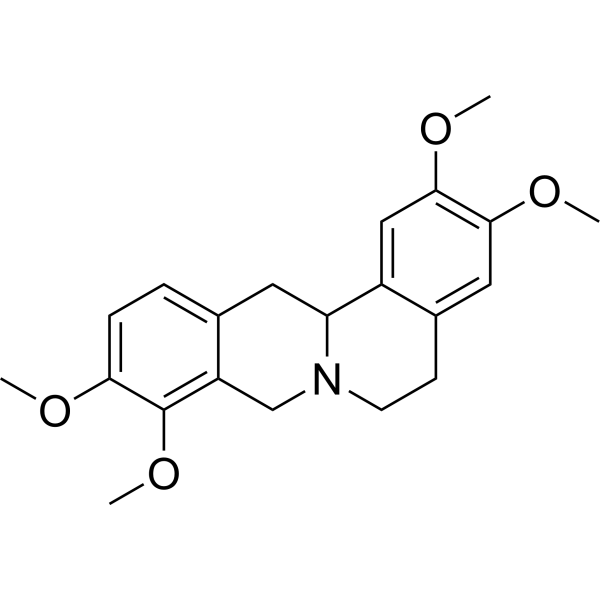
Physicochemical Properties
| Molecular Formula | C21H25NO4 |
| Molecular Weight | 355.4275 |
| Exact Mass | 355.178 |
| CAS # | 2934-97-6 |
| Related CAS # | Rotundine;483-14-7;Tetrahydropalmatine hydrochloride;6024-85-7 |
| PubChem CID | 5417 |
| Appearance | White to off-white solid powder |
| Density | 1.2±0.1 g/cm3 |
| Boiling Point | 482.9±45.0 °C at 760 mmHg |
| Melting Point | 155℃ |
| Flash Point | 138.7±25.9 °C |
| Vapour Pressure | 0.0±1.2 mmHg at 25°C |
| Index of Refraction | 1.609 |
| LogP | 3.7 |
| Hydrogen Bond Donor Count | 0 |
| Hydrogen Bond Acceptor Count | 5 |
| Rotatable Bond Count | 4 |
| Heavy Atom Count | 26 |
| Complexity | 475 |
| Defined Atom Stereocenter Count | 0 |
| InChi Key | AEQDJSLRWYMAQI-UHFFFAOYSA-N |
| InChi Code | InChI=1S/C21H25NO4/c1-23-18-6-5-13-9-17-15-11-20(25-3)19(24-2)10-14(15)7-8-22(17)12-16(13)21(18)26-4/h5-6,10-11,17H,7-9,12H2,1-4H3 |
| Chemical Name | 2,3,9,10-tetramethoxy-6,8,13,13a-tetrahydro-5H-isoquinolino[2,1-b]isoquinoline |
| HS Tariff Code | 2934.99.9001 |
| Storage |
Powder-20°C 3 years 4°C 2 years In solvent -80°C 6 months -20°C 1 month |
| Shipping Condition | Room temperature (This product is stable at ambient temperature for a few days during ordinary shipping and time spent in Customs) |
Biological Activity
| Targets |
- Amygdaloid dopamine release [1] |
| ln Vivo |
The Chinese herbal remedy Corydalis tetrahydraceae has an active component called tetrahydropyridine (THP), which has analgesic properties. The following activity measures were significantly impacted by picrotoxin treatment alone: freezing times (Financial Times), clockwise and counterclockwise rotations (CT and ACT), increases in horizontal movement times (HMT and VMT), and decreases in freezing times. HMT, VMT, and total distance traveled (TDT) decreased with tetrahydrolate treatment alone, although FT increased. Tetrahydrocyridine injections intraperitoneally at doses of 10 mg/kg or 15 mg/kg; the augmentation of HMT, VMT, CT, ACT, and TDT and the decrease in FT caused by picrotoxin were significantly separated by dose impairment. Eight animals were set aside in each of the six groups that were created by randomly short-circuiting the remaining 48 traps while they were sedated with ethyl benzoate. Dopamine (DA) amygdala release was enhanced by subcutaneous injection of picrotoxin, but there was no discernible change in DA amygdala release following intraperitoneal injection of 10 mg/kg tetrahydrocyridine. Similarly, giving tetrahydropyridine half an hour prior to subcutaneous injection of picrotoxin virtually eliminated increases in DA amygdala release caused by picrotoxin [1]. - Tetrahydropalmatine (DL-form) exhibited anticonvulsant activity in pentylenetetrazol (PTZ)-induced epileptic rats. Intraperitoneal (i.p.) administration of 5, 10, and 20 mg/kg Tetrahydropalmatine significantly reduced the incidence and duration of epileptic seizures. The seizure incidence was decreased by 25%, 45%, and 68% at 5, 10, and 20 mg/kg, respectively, compared to the model group [1] - Microdialysis combined with high-performance liquid chromatography (HPLC) analysis showed that Tetrahydropalmatine (20 mg/kg i.p.) inhibited dopamine release in the amygdala of epileptic rats. The extracellular dopamine concentration in the amygdala was reduced by 52.3% compared to the PTZ-induced model group [1] - The anticonvulsant effect of Tetrahydropalmatine was dose-dependent, with the highest inhibition of epileptic attacks observed at 20 mg/kg i.p. [1] |
| Animal Protocol |
- PTZ-induced epileptic model and anticonvulsant activity assay: Male Sprague-Dawley rats (200–250 g) were randomly divided into control group (saline i.p.), model group (PTZ 60 mg/kg i.p.), and Tetrahydropalmatine treatment groups (5, 10, 20 mg/kg i.p.). The treatment groups received Tetrahydropalmatine 30 minutes before PTZ administration. The incidence, latency, and duration of epileptic seizures were observed and recorded for 30 minutes after PTZ injection [1] - Amygdaloid dopamine release detection assay: Rats were anesthetized and implanted with a microdialysis probe into the amygdala. After recovery for 24 hours, the model group was injected with PTZ (60 mg/kg i.p.), and the treatment group was injected with Tetrahydropalmatine (20 mg/kg i.p.) 30 minutes before PTZ administration. Dialysates were collected at 20-minute intervals for 120 minutes after PTZ injection. Dopamine concentration in the dialysates was quantified by HPLC with electrochemical detection [1] |
| References |
[1]. DL-Tetrahydropalmatine may act through inhibition of amygdaloid release of dopamine to inhibit an epileptic attack in rats. Neurosci Lett. 2001 Jul 20;307(3):163-6. |
| Additional Infomation |
2,3,9,10-tetramethoxy-6,8,13,13a-tetrahydro-5H-isoquinolino[2,1-b]isoquinoline is an alkaloid. Tetrahydropalmatine is under investigation in clinical trial NCT02118610 (Treatment of Schizophrenia With L-tetrahydropalmatine (l-THP): a Novel Dopamine Antagonist With Anti-inflammatory and Antiprotozoal Activity). Rotundine has been reported in Stephania tetrandra, Stephania delavayi, and other organisms with data available. - Tetrahydropalmatine (DL-form) is an alkaloid compound with potential anticonvulsant activity [1] - The anticonvulsant mechanism of Tetrahydropalmatine involves the inhibition of dopamine release in the amygdala, which is associated with the regulation of epileptic activity [1] - The amygdala is a key brain region involved in the modulation of epileptic seizures, and the inhibition of dopamine release in this region contributes to the anticonvulsant effect of Tetrahydropalmatine [1] |
Solubility Data
| Solubility (In Vitro) | DMSO : ~6.67 mg/mL (~18.77 mM) |
| Solubility (In Vivo) |
Solubility in Formulation 1: ≥ 0.67 mg/mL (1.89 mM) (saturation unknown) in 10% DMSO + 40% PEG300 +5% Tween-80 + 45% Saline (add these co-solvents sequentially from left to right, and one by one), clear solution. For example, if 1 mL of working solution is to be prepared, you can add 100 μL of 6.7 mg/mL clear DMSO stock solution to 400 μL PEG300 and mix evenly; then add 50 μL Tween-80 + to the above solution and mix evenly; then add 450 μL normal saline to adjust the volume to 1 mL. Preparation of saline: Dissolve 0.9 g of sodium chloride in 100 mL ddH₂ O to obtain a clear solution. (Please use freshly prepared in vivo formulations for optimal results.) |
| Preparing Stock Solutions | 1 mg | 5 mg | 10 mg | |
| 1 mM | 2.8135 mL | 14.0675 mL | 28.1349 mL | |
| 5 mM | 0.5627 mL | 2.8135 mL | 5.6270 mL | |
| 10 mM | 0.2813 mL | 1.4067 mL | 2.8135 mL |