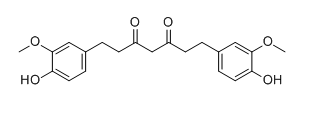
Tetrahydrocurcumin (THC; HZIV-812; HZIV81-2), a major curcumin metabolite, is a partially reduced derivative of curcumin, which is a naturally occurring compound found in turmeric (Curcuma longa). It exhibited anticancer activities against human breast cancer MCF-7 cells by the induction of mitochondrial apoptosis and cell cycle arrest in G2/M phase through the activation of p38 MAPK. Tetrahydrocurcumin is superior to curcumin in terms of water solubility, chemical stability, bioavailability, and anti-oxidative activity.
Physicochemical Properties
| Molecular Formula | C₂₁H₂₄O₆ |
| Molecular Weight | 372.41 |
| Exact Mass | 372.157 |
| CAS # | 36062-04-1 |
| Related CAS # | Tetrahydrocurcumin-d6;1794898-13-7 |
| PubChem CID | 124072 |
| Appearance | White to off-white solid powder |
| Density | 1.2±0.1 g/cm3 |
| Boiling Point | 564.1±45.0 °C at 760 mmHg |
| Melting Point | 95-97ºC |
| Flash Point | 196.2±22.2 °C |
| Vapour Pressure | 0.0±1.6 mmHg at 25°C |
| Index of Refraction | 1.575 |
| LogP | 2.13 |
| Hydrogen Bond Donor Count | 2 |
| Hydrogen Bond Acceptor Count | 6 |
| Rotatable Bond Count | 10 |
| Heavy Atom Count | 27 |
| Complexity | 437 |
| Defined Atom Stereocenter Count | 0 |
| InChi Key | LBTVHXHERHESKG-UHFFFAOYSA-N |
| InChi Code | InChI=1S/C21H24O6/c1-26-20-11-14(5-9-18(20)24)3-7-16(22)13-17(23)8-4-15-6-10-19(25)21(12-15)27-2/h5-6,9-12,24-25H,3-4,7-8,13H2,1-2H3 |
| Chemical Name | 1,7-bis(4-hydroxy-3-methoxyphenyl)heptane-3,5-dione |
| Synonyms | HZIV 81-2HZIV-81-2HZIV81-2 |
| HS Tariff Code | 2934.99.9001 |
| Storage |
Powder-20°C 3 years 4°C 2 years In solvent -80°C 6 months -20°C 1 month |
| Shipping Condition | Room temperature (This product is stable at ambient temperature for a few days during ordinary shipping and time spent in Customs) |
Biological Activity
| ln Vitro | Tetrahydrocurcumin (THC) may be better than curcumin because it contains a lot of desirable qualities that curcumin does not. At as low as 1 μM, tetrahydrocurcumin inhibits lipoxygenase. The inhibitory properties of tetrahydrocurcumin against CYP2C9, CYP3A4, CYP1A2, and CYP2D6 was evaluated. Tetrahydrocurcumin inhibits CYP2C9 and, to a lesser extent, CYP3A4 in a dose-dependent manner. The greatest inhibitory effects of tetrahydrocurcumin on CYP2C9 and CYP3A4 occur at 50 to 100 μM. Throughout the concentration range examined, tetrahydrocurcumin did not consistently inhibit CYP1A2 or CYP2D6 in response to dosage. In certain instances, the proportion of inhibition surpasses 100%. assessing how tetrahydrocurcumin affects the viability of cancer cells. Tetrahydrocurcumin was used to treat Sup-T1 cells (T-cell lymphoblastic lymphoma cells), and the MTS test was used to measure the drug's ability to induce growth suppression. The IC50 values for the drug were found to be in the mid-to-high micromolar range [1]. |
| ln Vivo | More than one absorption and distribution phase can be seen in serum tetrahydrocurcumin (THC) concentration versus time plots. First, a quick elimination phase was noticed, which was followed by a fast absorption phase with a mean Tmax of 6.8 μg/mL at one hour. Two redistributions with two smaller tetrahydrocurcumin maxima at six and twenty-four hours later, this was followed. The maximum values of both redistribution stages are comparable, at about 1 μg/mL. Urine can discharge up to 8 μg of unaltered tetrahydrocurcumin in a 24-hour period [1]. |
| References |
[1]. Disposition, Metabolism and Histone Deacetylase and Acetyltransferase Inhibition Activity of Tetrahydrocurcumin and Other Curcuminoids. Pharmaceutics. 2017 Oct 12;9(4). pii: E45. |
| Additional Infomation |
Tetrahydrocurcumin is a beta-diketone that is curcumin in which both of the double bonds have been reduced to single bonds. It has a role as a metabolite. It is a beta-diketone, a polyphenol and a diarylheptanoid. It is functionally related to a curcumin. Tetrahydrocurcumin is a metabolite found in or produced by Escherichia coli (strain K12, MG1655). Tetrahydrocurcumin has been reported in Curcuma longa with data available. |
Solubility Data
| Solubility (In Vitro) | DMSO : ~100 mg/mL (~268.52 mM) |
| Solubility (In Vivo) |
Solubility in Formulation 1: ≥ 2.5 mg/mL (6.71 mM) (saturation unknown) in 10% DMSO + 40% PEG300 + 5% Tween80 + 45% Saline (add these co-solvents sequentially from left to right, and one by one), clear solution. For example, if 1 mL of working solution is to be prepared, you can add 100 μL of 25.0 mg/mL clear DMSO stock solution to 400 μL PEG300 and mix evenly; then add 50 μL Tween-80 to the above solution and mix evenly; then add 450 μL normal saline to adjust the volume to 1 mL. Preparation of saline: Dissolve 0.9 g of sodium chloride in 100 mL ddH₂ O to obtain a clear solution. Solubility in Formulation 2: ≥ 2.5 mg/mL (6.71 mM) (saturation unknown) in 10% DMSO + 90% Corn Oil (add these co-solvents sequentially from left to right, and one by one), clear solution. For example, if 1 mL of working solution is to be prepared, you can add 100 μL of 25.0 mg/mL clear DMSO stock solution to 900 μL of corn oil and mix evenly. (Please use freshly prepared in vivo formulations for optimal results.) |
| Preparing Stock Solutions | 1 mg | 5 mg | 10 mg | |
| 1 mM | 2.6852 mL | 13.4261 mL | 26.8521 mL | |
| 5 mM | 0.5370 mL | 2.6852 mL | 5.3704 mL | |
| 10 mM | 0.2685 mL | 1.3426 mL | 2.6852 mL |