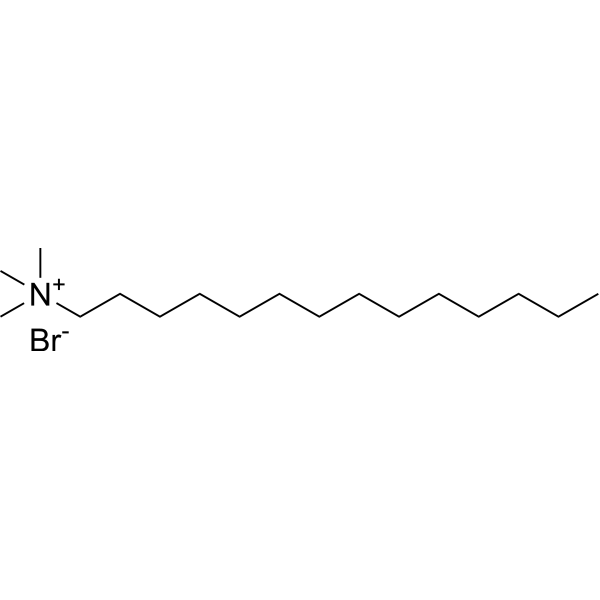
Physicochemical Properties
| Molecular Formula | C17H38BRN |
| Molecular Weight | 336.39 |
| Exact Mass | 335.218 |
| CAS # | 1119-97-7 |
| Related CAS # | Tetradecyltrimethylammonium-d29 bromide;95523-73-2;Tetradecyltrimethylammonium-d38 bromide;95523-72-1 |
| PubChem CID | 14250 |
| Appearance | White to off-white solid powder |
| Melting Point | 245-250 °C(lit.) |
| LogP | 6.351 |
| Hydrogen Bond Donor Count | 0 |
| Hydrogen Bond Acceptor Count | 1 |
| Rotatable Bond Count | 13 |
| Heavy Atom Count | 19 |
| Complexity | 158 |
| Defined Atom Stereocenter Count | 0 |
| InChi Key | CXRFDZFCGOPDTD-UHFFFAOYSA-M |
| InChi Code | InChI=1S/C17H38N.BrH/c1-5-6-7-8-9-10-11-12-13-14-15-16-17-18(2,3)4;/h5-17H2,1-4H3;1H/q+1;/p-1 |
| Chemical Name | trimethyl(tetradecyl)azanium;bromide |
| HS Tariff Code | 2934.99.9001 |
| Storage |
Powder-20°C 3 years 4°C 2 years In solvent -80°C 6 months -20°C 1 month Note: Please store this product in a sealed and protected environment (e.g. under nitrogen), avoid exposure to moisture and light. |
| Shipping Condition | Room temperature (This product is stable at ambient temperature for a few days during ordinary shipping and time spent in Customs) |
Biological Activity
| ln Vitro | In capillary electrophoresis, tetradecyltrimethylammonium bromide (TTAB; TTABr) is being used more frequently as a surface active aid to help separate anionic species derived from acids. For optimal effects, tetradecyltrimethylammonium bromide has been found to need a minimum concentration of about 0.4 mM. This concentration has been selected because it is near the critical micelle concentration (CMC), which is thought to be necessary for the formation of "hemimicelles" on the capillary inner wall[3]. |
| References |
[1]. The effect of molecular structure on the surface properties of selected quaternary ammonium salts. J Colloid Interface Sci. 2008;321(1):220-226. [2]. Mixtures of Nonionic and Ionic Surfactants. The Effect of Counterion Binding in Mixtures of Tetradecyldimethylamine Oxide and Tetradecyltrimethylammonium Bromide. Langmuir 1994, 10, 8, 2594-2603. [3]. The surface properties of tetradecyltrimethylammonium bromide observed by capillary electrophoresis. J Chromatogr Sci. 2002;40(4):187-190. |
| Additional Infomation | Cetrimide is an organic molecular entity. |
Solubility Data
| Solubility (In Vitro) | H2O: 125 mg/mL (371.59 mM) |
| Solubility (In Vivo) |
Solubility in Formulation 1: 50 mg/mL (148.64 mM) in PBS (add these co-solvents sequentially from left to right, and one by one), clear solution; with sonication. (Please use freshly prepared in vivo formulations for optimal results.) |
| Preparing Stock Solutions | 1 mg | 5 mg | 10 mg | |
| 1 mM | 2.9727 mL | 14.8637 mL | 29.7274 mL | |
| 5 mM | 0.5945 mL | 2.9727 mL | 5.9455 mL | |
| 10 mM | 0.2973 mL | 1.4864 mL | 2.9727 mL |