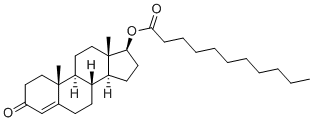
Testosterone undecanoate is an ester form of Testosterone. It may be used in androgen replacement therapy during the treatment of male hypogonadism, and also has the potential to be used as a male contraceptive.
Physicochemical Properties
| Molecular Formula | C30H48O3 |
| Molecular Weight | 456.7003 |
| Exact Mass | 456.36 |
| Elemental Analysis | C, 78.90; H, 10.59; O, 10.51 |
| CAS # | 5949-44-0 |
| PubChem CID | 65157 |
| Appearance | Typically exists as solid at room temperature |
| Density | 1.0±0.1 g/cm3 |
| Boiling Point | 550.7±50.0 °C at 760 mmHg |
| Melting Point | 39-42 °C(lit.) |
| Flash Point | 230.3±30.2 °C |
| Vapour Pressure | 0.0±1.5 mmHg at 25°C |
| Index of Refraction | 1.522 |
| LogP | 9.15 |
| Hydrogen Bond Donor Count | 0 |
| Hydrogen Bond Acceptor Count | 3 |
| Rotatable Bond Count | 11 |
| Heavy Atom Count | 33 |
| Complexity | 739 |
| Defined Atom Stereocenter Count | 6 |
| SMILES | O(C(C([H])([H])C([H])([H])C([H])([H])C([H])([H])C([H])([H])C([H])([H])C([H])([H])C([H])([H])C([H])([H])C([H])([H])[H])=O)[C@@]1([H])C([H])([H])C([H])([H])[C@@]2([H])[C@]3([H])C([H])([H])C([H])([H])C4=C([H])C(C([H])([H])C([H])([H])[C@]4(C([H])([H])[H])[C@@]3([H])C([H])([H])C([H])([H])[C@@]21C([H])([H])[H])=O |
| InChi Key | UDSFVOAUHKGBEK-CNQKSJKFSA-N |
| InChi Code | InChI=1S/C30H48O3/c1-4-5-6-7-8-9-10-11-12-28(32)33-27-16-15-25-24-14-13-22-21-23(31)17-19-29(22,2)26(24)18-20-30(25,27)3/h21,24-27H,4-20H2,1-3H3/t24-,25-,26-,27-,29-,30-/m0/s1 |
| Chemical Name | [(8R,9S,10R,13S,14S,17S)-10,13-dimethyl-3-oxo-1,2,6,7,8,9,11,12,14,15,16,17-dodecahydrocyclopenta[a]phenanthren-17-yl] undecanoate |
| Synonyms | Testosterone undecanoate; 5949-44-0; Andriol; Testosterone undecylate; Nebido; Undestor; Pantestone; Restandol; Jatenzo; T undecanoate; BRN 3176734; BRN-3176734; BRN3176734; |
| HS Tariff Code | 2934.99.9001 |
| Storage |
Powder-20°C 3 years 4°C 2 years In solvent -80°C 6 months -20°C 1 month |
| Shipping Condition | Room temperature (This product is stable at ambient temperature for a few days during ordinary shipping and time spent in Customs) |
Biological Activity
| Targets | Testosterone metabolite; androgen; male hormonal contraception |
| ln Vitro | Testosterone Undecanoate is the undecanoate ester form of the androgen testosterone, with gonadotropin-secretory inhibiting and hormone replacement activity. As testosterone inhibits the secretion of gonadotropins from the pituitary gland, administration of testosterone decreases the secretion of luteinizing hormone (LH). By inhibiting LH secretion, the growth of Leydig cells, which are normally stimulated by LH to produce testosterone, may be suppressed. In addition, this agent promotes the maintenance of male sex characteristics and can be used for testosterone replacement in hypogonadal males. |
| ln Vivo | This study evaluates the efficacy of vas ligation in enhancing sperm retrieval in nonobstructive azoospermia cases, by accumulating intratesticular spermatozoa. Fifty-six mature male rats with equally sized testes were included in this study. Forty-six were in the study group, and 10 were in the control group. Bilateral testicular fine needle aspiration was performed for all, to confirm presence of spermatozoa in all testes. Nonobstructive azoospermia was induced in all 56 rats, using Dienogest (40 mg/kg) + Testosterone Undecanoate (25 mg/kg) every month for three months. Monthly aspirations confirmed nonobstructive azoospermia from all rats, within the three months treatment. This was followed by unilateral vas ligation and was performed for 46 rats of the study group, with no ligation performed in the control group. After a further period of 90 days (2 spermatogenic cycles) with the same medical treatment maintained, bilateral testicular sperm extraction was performed. Sperm retrieval was evaluated, comparing the outcome of vas-ligated testicles to the nonligated. Upon evaluation, spermatozoa were found in 14/46 of the vas-ligated testes (30.4%), compared to none of the nonligated (0/66), p = .0005. Ligation of the vas deferens in rats with nonobstructive azoospermia may enhance the results of sperm retrieval via sperm accumulation.[1] |
| Animal Protocol | Forty-six rats were randomised into the study group and 10 to the control group. Nonobstructive azoospermia was induced in all 56 rats, by monthly intramuscular injection of Dienogest (40 mg/kg) + Testosterone Undecanoate (25 mg/kg), as per Meena et al. (Meena et al., 2013). Monthly FNA's were performed until NOA was confirmed from all rats. This occurred at variable time points within the third month of the treatment course.[1] |
| ADME/Pharmacokinetics |
Absorption, Distribution and Excretion Testosterone undecanoate is a lipophilic molecule that is absorbed into the intestinal lymphatic system after oral administration. It is then released into the general blood circulation by the thoracic duct, thereby bypassing the portal circulation and first-pass metabolism in the liver, unlike endogenous testosterone. Following oral administration of 237 mg twice per day in males with hypogonadism, the mean (SD) Cmax was 1008 (581) ng/dL. Tmax is about five hours following oral administration. Decreased testosterone exposure was observed when administered without food. Following intramuscular administration of 750 mg testosterone undecanoate, serum testosterone concentrations reached a maximum after a median of seven days (range of four to 42 days), which then slowly declined. The mean (SD) Cmax was about 90.9 (68.8) ng/dL on the fourth day following injection of testosterone undecanoate. Steady-state serum testosterone concentration was achieved with the third injection at 14 weeks. At 42 days following the injection, testosterone undecanoate was nearly undetectable. About 90% of a testosterone dose given intramuscularly is excreted in the urine as glucuronic and sulfuric acid-conjugates of testosterone or as metabolites. About 6% of a dose is excreted in the feces, mostly in the unconjugated form. Inactivation of testosterone occurs primarily in the liver. There is no information available. While there is limited information available, an earlier study reports a metabolic clearance rate of 24.5 mL/min/kg for testosterone following oral administration of 25 mg testosterone and 40 mg testosterone undecanoate in women. Metabolism / Metabolites Testosterone undecanoate can be reduced to dihydrotestosterone undecanoate via 5α-reductase. In the circulation, the ester bond linking testosterone to the undecanoic acid is cleaved by endogenous non-specific esterases. Like all fatty acids, the undecanoic side chain undergoes β-oxidation to form acetyl coenzyme A (CoA) and, finally, propionyl CoA. Testosterone is metabolized to various 17-keto steroids through two different pathways to form major active metabolites, estradiol and dihydrotestosterone (DHT). Biological Half-Life The elimination half-life of testosterone undecanoate is approximately two hours. Once testosterone is formed from testosterone undecanoate, the half life of testosterone can vary and the reported values in the literature remain inconsistent, ranging from 10 to to 100 minutes. Testosterone undecanoate in castor oil for intramuscular injection had a half life of 33.9 days, allowing it to maintain serum levels in the normal range for over 6 weeks. |
| Toxicity/Toxicokinetics |
Protein Binding About 40% of circulating testosterone is bound to sex hormone-binding globulin (SHBG) and about 2% of the drug remains unbound to plasma proteins. The rest is loosely bound to albumin and other plasma proteins. |
| References | [1]. Effect of vas ligation on testicular sperm extraction results in nonobstructive azoospermic rats: Shaeer's lock-in technique. Andrologia. 2021 Oct;53(9):e14170. |
| Additional Infomation |
Pharmacodynamics Once in circulation, testosterone undecanoate is cleaved to release testosterone, which mediates a range of biological actions. Testosterone is an endogenous male hormone that plays a key role in male sexual differentiation: it is involved in the regulation of hematopoiesis, body composition, and bone metabolism. As a hormone replacement therapy, testosterone undecanoate is an exogenous source of testosterone in males with hypogonadism. Testosterone therapy aims to improve symptoms and signs of testosterone deficiency including decreased libido, erectile dysfunction, and loss of muscle and bone mass. Testosterone has a controlled substance in the US due to the abuse potential by athletes and bodybuilders. The use of testosterone at higher doses than recommended can lead to withdrawal symptoms lasting for weeks or months. Withdrawal symptoms include depressed mood, major depression, fatigue, craving, restlessness, irritability, anorexia, insomnia, decreased libido, and hypogonadotropic hypogonadism. Testosterone can cause hirsutism, virilization, deepening of the voice, clitoral enlargement, breast atrophy, male-pattern baldness, and menstrual irregularities when administered to women. The use in adolescents can lead to the premature closure of bony epiphyses with termination of growth and precocious puberty. |
Solubility Data
| Solubility (In Vitro) | May dissolve in DMSO (in most cases), if not, try other solvents such as H2O, Ethanol, or DMF with a minute amount of products to avoid loss of samples |
| Solubility (In Vivo) |
Note: Listed below are some common formulations that may be used to formulate products with low water solubility (e.g. < 1 mg/mL), you may test these formulations using a minute amount of products to avoid loss of samples. Injection Formulations (e.g. IP/IV/IM/SC) Injection Formulation 1: DMSO : Tween 80: Saline = 10 : 5 : 85 (i.e. 100 μL DMSO stock solution → 50 μL Tween 80 → 850 μL Saline) *Preparation of saline: Dissolve 0.9 g of sodium chloride in 100 mL ddH ₂ O to obtain a clear solution. Injection Formulation 2: DMSO : PEG300 :Tween 80 : Saline = 10 : 40 : 5 : 45 (i.e. 100 μL DMSO → 400 μLPEG300 → 50 μL Tween 80 → 450 μL Saline) Injection Formulation 3: DMSO : Corn oil = 10 : 90 (i.e. 100 μL DMSO → 900 μL Corn oil) Example: Take the Injection Formulation 3 (DMSO : Corn oil = 10 : 90) as an example, if 1 mL of 2.5 mg/mL working solution is to be prepared, you can take 100 μL 25 mg/mL DMSO stock solution and add to 900 μL corn oil, mix well to obtain a clear or suspension solution (2.5 mg/mL, ready for use in animals). Injection Formulation 4: DMSO : 20% SBE-β-CD in saline = 10 : 90 [i.e. 100 μL DMSO → 900 μL (20% SBE-β-CD in saline)] *Preparation of 20% SBE-β-CD in Saline (4°C,1 week): Dissolve 2 g SBE-β-CD in 10 mL saline to obtain a clear solution. Injection Formulation 5: 2-Hydroxypropyl-β-cyclodextrin : Saline = 50 : 50 (i.e. 500 μL 2-Hydroxypropyl-β-cyclodextrin → 500 μL Saline) Injection Formulation 6: DMSO : PEG300 : castor oil : Saline = 5 : 10 : 20 : 65 (i.e. 50 μL DMSO → 100 μLPEG300 → 200 μL castor oil → 650 μL Saline) Injection Formulation 7: Ethanol : Cremophor : Saline = 10: 10 : 80 (i.e. 100 μL Ethanol → 100 μL Cremophor → 800 μL Saline) Injection Formulation 8: Dissolve in Cremophor/Ethanol (50 : 50), then diluted by Saline Injection Formulation 9: EtOH : Corn oil = 10 : 90 (i.e. 100 μL EtOH → 900 μL Corn oil) Injection Formulation 10: EtOH : PEG300:Tween 80 : Saline = 10 : 40 : 5 : 45 (i.e. 100 μL EtOH → 400 μLPEG300 → 50 μL Tween 80 → 450 μL Saline) Oral Formulations Oral Formulation 1: Suspend in 0.5% CMC Na (carboxymethylcellulose sodium) Oral Formulation 2: Suspend in 0.5% Carboxymethyl cellulose Example: Take the Oral Formulation 1 (Suspend in 0.5% CMC Na) as an example, if 100 mL of 2.5 mg/mL working solution is to be prepared, you can first prepare 0.5% CMC Na solution by measuring 0.5 g CMC Na and dissolve it in 100 mL ddH2O to obtain a clear solution; then add 250 mg of the product to 100 mL 0.5% CMC Na solution, to make the suspension solution (2.5 mg/mL, ready for use in animals). Oral Formulation 3: Dissolved in PEG400 Oral Formulation 4: Suspend in 0.2% Carboxymethyl cellulose Oral Formulation 5: Dissolve in 0.25% Tween 80 and 0.5% Carboxymethyl cellulose Oral Formulation 6: Mixing with food powders Note: Please be aware that the above formulations are for reference only. InvivoChem strongly recommends customers to read literature methods/protocols carefully before determining which formulation you should use for in vivo studies, as different compounds have different solubility properties and have to be formulated differently. (Please use freshly prepared in vivo formulations for optimal results.) |
| Preparing Stock Solutions | 1 mg | 5 mg | 10 mg | |
| 1 mM | 2.1896 mL | 10.9481 mL | 21.8962 mL | |
| 5 mM | 0.4379 mL | 2.1896 mL | 4.3792 mL | |
| 10 mM | 0.2190 mL | 1.0948 mL | 2.1896 mL |