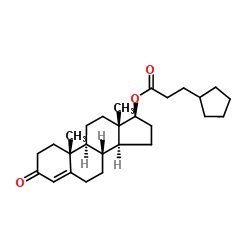
Testosterone cypionate is the ester prodrug of Testosterone which is an endogenous hormone. It may be used for elevating testosterone levels.
Physicochemical Properties
| Molecular Formula | C27H40O3 |
| Molecular Weight | 412.61 |
| Exact Mass | 412.297 |
| CAS # | 58-20-8 |
| PubChem CID | 441404 |
| Appearance | Typically exists as solid at room temperature |
| Density | 1.1±0.1 g/cm3 |
| Boiling Point | 525.9±50.0 °C at 760 mmHg |
| Melting Point | 98 - 104ºC |
| Flash Point | 223.9±30.2 °C |
| Vapour Pressure | 0.0±1.4 mmHg at 25°C |
| Index of Refraction | 1.546 |
| LogP | 6.93 |
| Hydrogen Bond Donor Count | 0 |
| Hydrogen Bond Acceptor Count | 3 |
| Rotatable Bond Count | 5 |
| Heavy Atom Count | 30 |
| Complexity | 732 |
| Defined Atom Stereocenter Count | 6 |
| SMILES | C[C@@]12CCC(=O)C=C2CC[C@H]3[C@@H]4CC[C@@H]([C@@]4(C)CC[C@@H]31)OC(=O)CCC5CCCC5 |
| HS Tariff Code | 2934.99.9001 |
| Storage |
Powder-20°C 3 years 4°C 2 years In solvent -80°C 6 months -20°C 1 month |
| Shipping Condition | Room temperature (This product is stable at ambient temperature for a few days during ordinary shipping and time spent in Customs) |
Biological Activity
| ADME/Pharmacokinetics |
Absorption, Distribution and Excretion Testosterone cypionate is an esterified anabolic which allows it to present a greater degree of solubility in fats and thus, the release and absorption occur in a slow rate compare to homologous molecules. Intramuscular administration of 200 mg of testosterone cypionate produced a mean supratherapeutic Cmax of 1122 ng/dl which occurred 4-5 days post-injection. After the fifth day, the levels of testosterone cypionate in plasma went down reaching an average of 400 ng/dl. About 90% of a dose of testosterone given intramuscularly is excreted in the urine as glucuronic and sulfuric acid conjugates of testosterone and its metabolites; about 6% of a dose is excreted in the feces, mostly in the unconjugated form. The volume of distribution following intravenous administration of testosterone is of approximately 1 L/kg. Testosterone cypionate presents a lower clearance rate after intramuscular administration compared to other analogs of testosterone. Metabolism / Metabolites To start its activity, testosterone cypionate has to be processed by enzymes in the bloodstream. These enzymes will break the bond between the cypionate ester moiety and the testosterone. Once separated, testosterone is metabolized to 17-keto steroids through two different pathways. The major active metabolites are estradiol and dihydrotestosterone (DHT). Testosterone is metabolized to DHT by steroid 5α-reductase in skin, liver and urogenital tract. In reproductive tissues DHT is further metabolized to androstanediol. Biological Half-Life The half-life of testosterone cypionate is one of the longest, being approximately of 8 days. |
| Toxicity/Toxicokinetics |
Protein Binding Testosterone cypionate, following conversion into testosterone, is approximately 98% protein-bound to sex hormone-binding globulin in plasma. |
| Additional Infomation |
Testosterone Cypionate can cause developmental toxicity according to state or federal government labeling requirements. Testosterone cypionate is a sterol ester. It is functionally related to a 3-cyclopentylpropionic acid and a testosterone. Testosterone cypionate is a synthetic derivative of testosterone in the form of an oil-soluble 17 (beta)-cyclopentylpropionate ester. Its benefit compared to other testosterone derivatives is the slow rate of release after injection and longer half-life. It was developed by the company Pharmacia and Upjohn and FDA approved on July 25, 1979. Testosterone Cypionate is an eight-carbon ester form of Testosterone. The number of ester carbon atoms correlate with the half-life of the prodrug. Testosterone inhibits gonadotropin secretion from the pituitary gland and ablates estrogen production in the ovaries, thereby decreasing endogenous estrogen levels. In addition, this agent promotes the maintenance of male sex characteristics and is indicated for testosterone replacement in hypogonadal males. (NCI04) See also: Testosterone (has active moiety); Estradiol cypionate; testosterone cypionate (component of). Drug Indication Testosterone cypionate is used in males that present conditions derived from a deficiency or absence of endogenous testosterone. These conditions are 1) primary hypogonadism, defined as the testicular failure due to cryptorchidism, bilateral torsion, orchitis, vanishing testis syndrome or orchidectomy; and 2) hypogonadotropic hypogonadism characterized by idiopathic gonadotropin, LHRH deficiency or pituitary-hypothalamic injury from tumors, trauma or radiation. FDA Label Mechanism of Action The effects of testosterone in humans and other vertebrates occur by way of two main mechanisms: by activation of the androgen receptor (directly or as DHT), and by conversion to estradiol and activation of certain estrogen receptors. Free testosterone (T) is transported into the cytoplasm of target tissue cells, where it can bind to the androgen receptor, or can be reduced to 5-alpha-dihydrotestosterone (DHT) by the cytoplasmic enzyme 5-alpha-reductase. DHT binds to the same androgen receptor even more strongly than T, so that its androgenic potency is about 2.5 times that of T. The T-receptor or DHT-receptor complex undergoes a structural change that allows it to move into the cell nucleus and bind directly to specific nucleotide sequences of the chromosomal DNA. The areas of binding are called hormone response elements (HREs), and influence transcriptional activity of certain genes, producing the androgen effects. Pharmacodynamics Administration of ester derivatives of testosterone as testosterone cypionate generates an increase in serum testosterone to levels reaching 400% from the baseline within 24 hours of administration. These androgen levels remain elevated for 3-5 days after initial administration. The continuous variation in plasma testosterone after intramuscular administration of testosterone cypionate results in fluctuations in mood and libido as well as some local inflammation. |
Solubility Data
| Solubility (In Vitro) | May dissolve in DMSO (in most cases), if not, try other solvents such as H2O, Ethanol, or DMF with a minute amount of products to avoid loss of samples |
| Solubility (In Vivo) |
Note: Listed below are some common formulations that may be used to formulate products with low water solubility (e.g. < 1 mg/mL), you may test these formulations using a minute amount of products to avoid loss of samples. Injection Formulations (e.g. IP/IV/IM/SC) Injection Formulation 1: DMSO : Tween 80: Saline = 10 : 5 : 85 (i.e. 100 μL DMSO stock solution → 50 μL Tween 80 → 850 μL Saline) *Preparation of saline: Dissolve 0.9 g of sodium chloride in 100 mL ddH ₂ O to obtain a clear solution. Injection Formulation 2: DMSO : PEG300 :Tween 80 : Saline = 10 : 40 : 5 : 45 (i.e. 100 μL DMSO → 400 μLPEG300 → 50 μL Tween 80 → 450 μL Saline) Injection Formulation 3: DMSO : Corn oil = 10 : 90 (i.e. 100 μL DMSO → 900 μL Corn oil) Example: Take the Injection Formulation 3 (DMSO : Corn oil = 10 : 90) as an example, if 1 mL of 2.5 mg/mL working solution is to be prepared, you can take 100 μL 25 mg/mL DMSO stock solution and add to 900 μL corn oil, mix well to obtain a clear or suspension solution (2.5 mg/mL, ready for use in animals). Injection Formulation 4: DMSO : 20% SBE-β-CD in saline = 10 : 90 [i.e. 100 μL DMSO → 900 μL (20% SBE-β-CD in saline)] *Preparation of 20% SBE-β-CD in Saline (4°C,1 week): Dissolve 2 g SBE-β-CD in 10 mL saline to obtain a clear solution. Injection Formulation 5: 2-Hydroxypropyl-β-cyclodextrin : Saline = 50 : 50 (i.e. 500 μL 2-Hydroxypropyl-β-cyclodextrin → 500 μL Saline) Injection Formulation 6: DMSO : PEG300 : castor oil : Saline = 5 : 10 : 20 : 65 (i.e. 50 μL DMSO → 100 μLPEG300 → 200 μL castor oil → 650 μL Saline) Injection Formulation 7: Ethanol : Cremophor : Saline = 10: 10 : 80 (i.e. 100 μL Ethanol → 100 μL Cremophor → 800 μL Saline) Injection Formulation 8: Dissolve in Cremophor/Ethanol (50 : 50), then diluted by Saline Injection Formulation 9: EtOH : Corn oil = 10 : 90 (i.e. 100 μL EtOH → 900 μL Corn oil) Injection Formulation 10: EtOH : PEG300:Tween 80 : Saline = 10 : 40 : 5 : 45 (i.e. 100 μL EtOH → 400 μLPEG300 → 50 μL Tween 80 → 450 μL Saline) Oral Formulations Oral Formulation 1: Suspend in 0.5% CMC Na (carboxymethylcellulose sodium) Oral Formulation 2: Suspend in 0.5% Carboxymethyl cellulose Example: Take the Oral Formulation 1 (Suspend in 0.5% CMC Na) as an example, if 100 mL of 2.5 mg/mL working solution is to be prepared, you can first prepare 0.5% CMC Na solution by measuring 0.5 g CMC Na and dissolve it in 100 mL ddH2O to obtain a clear solution; then add 250 mg of the product to 100 mL 0.5% CMC Na solution, to make the suspension solution (2.5 mg/mL, ready for use in animals). Oral Formulation 3: Dissolved in PEG400 Oral Formulation 4: Suspend in 0.2% Carboxymethyl cellulose Oral Formulation 5: Dissolve in 0.25% Tween 80 and 0.5% Carboxymethyl cellulose Oral Formulation 6: Mixing with food powders Note: Please be aware that the above formulations are for reference only. InvivoChem strongly recommends customers to read literature methods/protocols carefully before determining which formulation you should use for in vivo studies, as different compounds have different solubility properties and have to be formulated differently. (Please use freshly prepared in vivo formulations for optimal results.) |
| Preparing Stock Solutions | 1 mg | 5 mg | 10 mg | |
| 1 mM | 2.4236 mL | 12.1180 mL | 24.2360 mL | |
| 5 mM | 0.4847 mL | 2.4236 mL | 4.8472 mL | |
| 10 mM | 0.2424 mL | 1.2118 mL | 2.4236 mL |