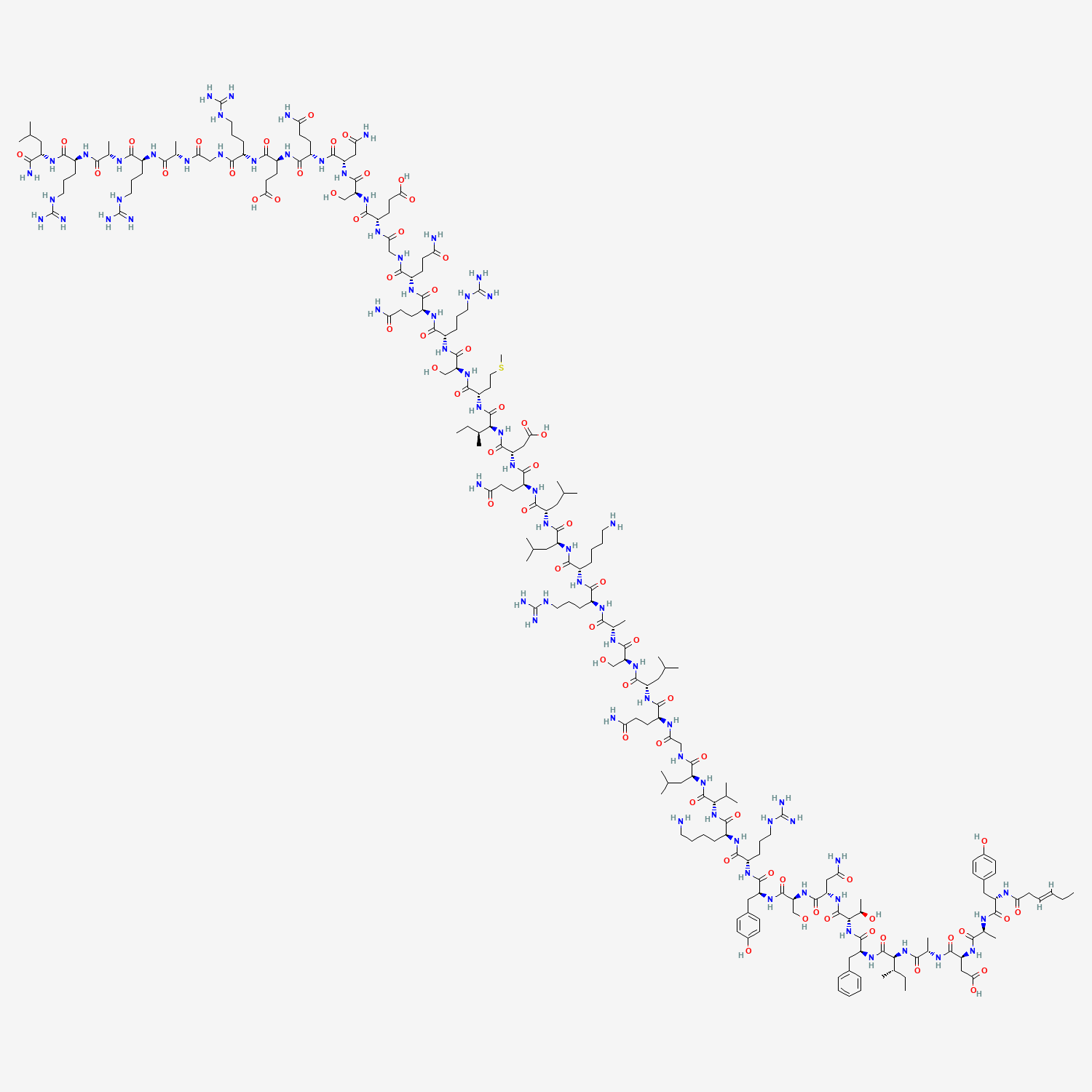
Physicochemical Properties
| Molecular Formula | C221H366N72O67S |
| Molecular Weight | 5135.77798604965 |
| Exact Mass | 5134.723 |
| CAS # | 218949-48-5 |
| PubChem CID | 16137828 |
| Sequence | Unk-Tyr - Ala -Asp- Ala - Ile - Phe- Thr -Asn- Ser - Tyr- Arg-Lys-Val-Leu-Gly-Gin-Leu-Ser-Ala-Arg- Lys -Leu-Leu-GIn-Asp- lle -Met- Ser-Arg-GIn- GIn-Gly一Glu-Ser-Asn-GIn-Glu-Arg-Gly一Ala- Arg - Ala - Arg -Leu-NH2 |
| SequenceShortening | YADAIFTNSYRKVLGQLSARKLLQDIMSRQQGESNQERGARARL |
| Appearance | Typically exists as solid at room temperature |
| LogP | -23.3 |
| Hydrogen Bond Donor Count | 83 |
| Hydrogen Bond Acceptor Count | 76 |
| Rotatable Bond Count | 187 |
| Heavy Atom Count | 361 |
| Complexity | 12800 |
| Defined Atom Stereocenter Count | 44 |
| SMILES | CC/C=C/CC(=O)N[C@@H](CC1=CC=C(C=C1)O)C(=O)N[C@@H](C)C(=O)N[C@@H](CC(=O)O)C(=O)N[C@@H](C)C(=O)N[C@@H]([C@@H](C)CC)C(=O)N[C@@H](CC2=CC=CC=C2)C(=O)N[C@@H]([C@@H](C)O)C(=O)N[C@@H](CC(=O)N)C(=O)N[C@@H](CO)C(=O)N[C@@H](CC3=CC=C(C=C3)O)C(=O)N[C@@H](CCCNC(=N)N)C(=O)N[C@@H](CCCCN)C(=O)N[C@@H](C(C)C)C(=O)N[C@@H](CC(C)C)C(=O)NCC(=O)N[C@@H](CCC(=O)N)C(=O)N[C@@H](CC(C)C)C(=O)N[C@@H](CO)C(=O)N[C@@H](C)C(=O)N[C@@H](CCCNC(=N)N)C(=O)N[C@@H](CCCCN)C(=O)N[C@@H](CC(C)C)C(=O)N[C@@H](CC(C)C)C(=O)N[C@@H](CCC(=O)N)C(=O)N[C@@H](CC(=O)O)C(=O)N[C@@H]([C@@H](C)CC)C(=O)N[C@@H](CCSC)C(=O)N[C@@H](CO)C(=O)N[C@@H](CCCNC(=N)N)C(=O)N[C@@H](CCC(=O)N)C(=O)N[C@@H](CCC(=O)N)C(=O)NCC(=O)N[C@@H](CCC(=O)O)C(=O)N[C@@H](CO)C(=O)N[C@@H](CC(=O)N)C(=O)N[C@@H](CCC(=O)N)C(=O)N[C@@H](CCC(=O)O)C(=O)N[C@@H](CCCNC(=N)N)C(=O)NCC(=O)N[C@@H](C)C(=O)N[C@@H](CCCNC(=N)N)C(=O)N[C@@H](C)C(=O)N[C@@H](CCCNC(=N)N)C(=O)N[C@@H](CC(C)C)C(=O)N |
| InChi Key | QBEPNUQJQWDYKU-BMGKTWPMSA-N |
| InChi Code | InChI=1S/C221H366N72O67S/c1-25-28-30-53-163(308)260-145(92-120-54-58-122(299)59-55-120)198(343)255-116(21)179(324)276-150(96-169(316)317)199(344)256-117(22)180(325)291-172(111(16)26-2)214(359)284-147(91-119-43-31-29-32-44-119)206(351)293-174(118(23)298)215(360)285-149(95-162(230)307)205(350)289-155(104-297)210(355)280-146(93-121-56-60-123(300)61-57-121)203(348)267-130(51-41-83-248-220(240)241)186(331)266-126(46-34-36-78-223)197(342)290-171(110(14)15)212(357)283-141(87-106(6)7)183(328)252-100-166(311)258-133(63-70-157(225)302)190(335)278-144(90-109(12)13)202(347)288-152(101-294)208(353)257-115(20)178(323)262-128(49-39-81-246-218(236)237)185(330)265-125(45-33-35-77-222)189(334)277-143(89-108(10)11)201(346)279-142(88-107(8)9)200(345)272-137(66-73-160(228)305)195(340)282-151(97-170(318)319)207(352)292-173(112(17)27-3)213(358)274-139(76-85-361-24)196(341)287-153(102-295)209(354)268-131(52-42-84-249-221(242)243)187(332)270-135(64-71-158(226)303)192(337)269-132(62-69-156(224)301)182(327)251-99-165(310)259-134(67-74-167(312)313)191(336)286-154(103-296)211(356)281-148(94-161(229)306)204(349)273-136(65-72-159(227)304)193(338)271-138(68-75-168(314)315)194(339)264-124(47-37-79-244-216(232)233)181(326)250-98-164(309)253-113(18)176(321)261-127(48-38-80-245-217(234)235)184(329)254-114(19)177(322)263-129(50-40-82-247-219(238)239)188(333)275-140(175(231)320)86-105(4)5/h28-32,43-44,54-61,105-118,124-155,171-174,294-300H,25-27,33-42,45-53,62-104,222-223H2,1-24H3,(H2,224,301)(H2,225,302)(H2,226,303)(H2,227,304)(H2,228,305)(H2,229,306)(H2,230,307)(H2,231,320)(H,250,326)(H,251,327)(H,252,328)(H,253,309)(H,254,329)(H,255,343)(H,256,344)(H,257,353)(H,258,311)(H,259,310)(H,260,308)(H,261,321)(H,262,323)(H,263,322)(H,264,339)(H,265,330)(H,266,331)(H,267,348)(H,268,354)(H,269,337)(H,270,332)(H,271,338)(H,272,345)(H,273,349)(H,274,358)(H,275,333)(H,276,324)(H,277,334)(H,278,335)(H,279,346)(H,280,355)(H,281,356)(H,282,340)(H,283,357)(H,284,359)(H,285,360)(H,286,336)(H,287,341)(H,288,347)(H,289,350)(H,290,342)(H,291,325)(H,292,352)(H,293,351)(H,312,313)(H,314,315)(H,316,317)(H,318,319)(H4,232,233,244)(H4,234,235,245)(H4,236,237,246)(H4,238,239,247)(H4,240,241,248)(H4,242,243,249)/b30-28+/t111-,112-,113-,114-,115-,116-,117-,118+,124-,125-,126-,127-,128-,129-,130-,131-,132-,133-,134-,135-,136-,137-,138-,139-,140-,141-,142-,143-,144-,145-,146-,147-,148-,149-,150-,151-,152-,153-,154-,155-,171-,172-,173-,174-/m0/s1 |
| Chemical Name | (4S)-4-[[2-[[(2S)-5-amino-2-[[(2S)-5-amino-2-[[(2S)-2-[[(2S)-2-[[(2S)-2-[[(2S,3S)-2-[[(2S)-2-[[(2S)-5-amino-2-[[(2S)-2-[[(2S)-2-[[(2S)-6-amino-2-[[(2S)-2-[[(2S)-2-[[(2S)-2-[[(2S)-2-[[(2S)-5-amino-2-[[2-[[(2S)-2-[[(2S)-2-[[(2S)-6-amino-2-[[(2S)-2-[[(2S)-2-[[(2S)-2-[[(2S)-4-amino-2-[[(2S,3R)-2-[[(2S)-2-[[(2S,3S)-2-[[(2S)-2-[[(2S)-3-carboxy-2-[[(2S)-2-[[(2S)-2-[[(E)-hex-3-enoyl]amino]-3-(4-hydroxyphenyl)propanoyl]amino]propanoyl]amino]propanoyl]amino]propanoyl]amino]-3-methylpentanoyl]amino]-3-phenylpropanoyl]amino]-3-hydroxybutanoyl]amino]-4-oxobutanoyl]amino]-3-hydroxypropanoyl]amino]-3-(4-hydroxyphenyl)propanoyl]amino]-5-carbamimidamidopentanoyl]amino]hexanoyl]amino]-3-methylbutanoyl]amino]-4-methylpentanoyl]amino]acetyl]amino]-5-oxopentanoyl]amino]-4-methylpentanoyl]amino]-3-hydroxypropanoyl]amino]propanoyl]amino]-5-carbamimidamidopentanoyl]amino]hexanoyl]amino]-4-methylpentanoyl]amino]-4-methylpentanoyl]amino]-5-oxopentanoyl]amino]-3-carboxypropanoyl]amino]-3-methylpentanoyl]amino]-4-methylsulfanylbutanoyl]amino]-3-hydroxypropanoyl]amino]-5-carbamimidamidopentanoyl]amino]-5-oxopentanoyl]amino]-5-oxopentanoyl]amino]acetyl]amino]-5-[[(2S)-1-[[(2S)-4-amino-1-[[(2S)-5-amino-1-[[(2S)-1-[[(2S)-1-[[2-[[(2S)-1-[[(2S)-1-[[(2S)-1-[[(2S)-1-[[(2S)-1-amino-4-methyl-1-oxopentan-2-yl]amino]-5-carbamimidamido-1-oxopentan-2-yl]amino]-1-oxopropan-2-yl]amino]-5-carbamimidamido-1-oxopentan-2-yl]amino]-1-oxopropan-2-yl]amino]-2-oxoethyl]amino]-5-carbamimidamido-1-oxopentan-2-yl]amino]-4-carboxy-1-oxobutan-2-yl]amino]-1,5-dioxopentan-2-yl]amino]-1,4-dioxobutan-2-yl]amino]-3-hydroxy-1-oxopropan-2-yl]amino]-5-oxopentanoic acid |
| Synonyms | Tesamorelin; 218949-48-5; TH9507; MQG94M5EEO; DTXSID00583207; |
| HS Tariff Code | 2934.99.9001 |
| Storage |
Powder-20°C 3 years 4°C 2 years In solvent -80°C 6 months -20°C 1 month |
| Shipping Condition | Room temperature (This product is stable at ambient temperature for a few days during ordinary shipping and time spent in Customs) |
Biological Activity
| Targets | GHRH |
| ln Vitro |
Tesamorelin is a Growth Hormone Releasing Factor Analog. The physiologic effect of tesamorelin is by means of Increased GHRH Activity. Tesamorelin stimulates growth hormone secretion, and subsequently increases IGF-1 and IGFBP-3 levels. By acting on the pituitary cells in the brain, tesamorelin stimulates production and release of the endogenous hormone (hGRF). Tesamorelin therapy predisposes the patient to glucose intolerance and can also increase the risk of type 2 diabetes, so the drug is contraindicated in pregnancy. |
| ln Vivo | Tesamorelin is a synthetic growth hormone releasing hormone analogue used in the treatment of visceral adiposity in human immunodeficiency virus (HIV) infected patients with lipodystrophy. Tesamorelin is given subcutaneously and has major effects on glucose and lipid metabolism, but has not been linked to serum aminotransferase elevations during therapy or to instances of clinically apparent acute liver injury. a peptide; a stabilized analogue of the growth hormone releasing factor; aimed at reducing excess abdominal fat or VAT in lipodystrophy and HIV patients |
| ADME/Pharmacokinetics |
Absorption The absolute bioavailability was determined to be less than 4% in healthy adult subjects following a 2 mg subcutaneous dose. Volume of Distribution 9.4±3.1 L/kg in healthy subjects. 10.5±6.1 L/kg in HIV-infected patients. Metabolism / Metabolites No formal metabolism studies have been performed in humans. Biological Half-Life 26 and 38 minutes in healthy subjects and HIV-infected patients, respectively. |
| Toxicity/Toxicokinetics |
Hepatotoxicity
In clinical trials in patients with HIV-associated lipodystrophy, tesamorelin therapy was not associated with de novo elevations in serum enzymes and, in some studies, was associated with decreases in preexisting ALT elevations, possibly mediated by improvements in nonalcoholic fatty liver. Instances of clinically apparent liver injury attributable to tesamorelin use have not been reported. Likelihood score: E (unlikely cause of clinically apparent liver injury). |
| References | [1]. https://pubchem.ncbi.nlm.nih.gov/compound/16137828 |
| Additional Infomation |
Tesamorelin acetate is a synthetic analogue of human hypothalamic Growth Hormone Releasing Factor (hGRF) indicated to induce and maintain a reduction of excess abdominal fat in HIV-infected patients with lipodystrophy.
Tesamorelin is a synthetic growth hormone releasing hormone analogue used in the treatment of visceral adiposity in human immunodeficiency virus (HIV) infected patients with lipodystrophy. Tesamorelin is given subcutaneously and has major effects on glucose and lipid metabolism, but has not been linked to serum aminotransferase elevations during therapy or to instances of clinically apparent acute liver injury. |
Solubility Data
| Solubility (In Vitro) | May dissolve in DMSO (in most cases), if not, try other solvents such as H2O, Ethanol, or DMF with a minute amount of products to avoid loss of samples |
| Solubility (In Vivo) |
Note: Listed below are some common formulations that may be used to formulate products with low water solubility (e.g. < 1 mg/mL), you may test these formulations using a minute amount of products to avoid loss of samples. Injection Formulations (e.g. IP/IV/IM/SC) Injection Formulation 1: DMSO : Tween 80: Saline = 10 : 5 : 85 (i.e. 100 μL DMSO stock solution → 50 μL Tween 80 → 850 μL Saline) *Preparation of saline: Dissolve 0.9 g of sodium chloride in 100 mL ddH ₂ O to obtain a clear solution. Injection Formulation 2: DMSO : PEG300 :Tween 80 : Saline = 10 : 40 : 5 : 45 (i.e. 100 μL DMSO → 400 μLPEG300 → 50 μL Tween 80 → 450 μL Saline) Injection Formulation 3: DMSO : Corn oil = 10 : 90 (i.e. 100 μL DMSO → 900 μL Corn oil) Example: Take the Injection Formulation 3 (DMSO : Corn oil = 10 : 90) as an example, if 1 mL of 2.5 mg/mL working solution is to be prepared, you can take 100 μL 25 mg/mL DMSO stock solution and add to 900 μL corn oil, mix well to obtain a clear or suspension solution (2.5 mg/mL, ready for use in animals). Injection Formulation 4: DMSO : 20% SBE-β-CD in saline = 10 : 90 [i.e. 100 μL DMSO → 900 μL (20% SBE-β-CD in saline)] *Preparation of 20% SBE-β-CD in Saline (4°C,1 week): Dissolve 2 g SBE-β-CD in 10 mL saline to obtain a clear solution. Injection Formulation 5: 2-Hydroxypropyl-β-cyclodextrin : Saline = 50 : 50 (i.e. 500 μL 2-Hydroxypropyl-β-cyclodextrin → 500 μL Saline) Injection Formulation 6: DMSO : PEG300 : castor oil : Saline = 5 : 10 : 20 : 65 (i.e. 50 μL DMSO → 100 μLPEG300 → 200 μL castor oil → 650 μL Saline) Injection Formulation 7: Ethanol : Cremophor : Saline = 10: 10 : 80 (i.e. 100 μL Ethanol → 100 μL Cremophor → 800 μL Saline) Injection Formulation 8: Dissolve in Cremophor/Ethanol (50 : 50), then diluted by Saline Injection Formulation 9: EtOH : Corn oil = 10 : 90 (i.e. 100 μL EtOH → 900 μL Corn oil) Injection Formulation 10: EtOH : PEG300:Tween 80 : Saline = 10 : 40 : 5 : 45 (i.e. 100 μL EtOH → 400 μLPEG300 → 50 μL Tween 80 → 450 μL Saline) Oral Formulations Oral Formulation 1: Suspend in 0.5% CMC Na (carboxymethylcellulose sodium) Oral Formulation 2: Suspend in 0.5% Carboxymethyl cellulose Example: Take the Oral Formulation 1 (Suspend in 0.5% CMC Na) as an example, if 100 mL of 2.5 mg/mL working solution is to be prepared, you can first prepare 0.5% CMC Na solution by measuring 0.5 g CMC Na and dissolve it in 100 mL ddH2O to obtain a clear solution; then add 250 mg of the product to 100 mL 0.5% CMC Na solution, to make the suspension solution (2.5 mg/mL, ready for use in animals). Oral Formulation 3: Dissolved in PEG400 Oral Formulation 4: Suspend in 0.2% Carboxymethyl cellulose Oral Formulation 5: Dissolve in 0.25% Tween 80 and 0.5% Carboxymethyl cellulose Oral Formulation 6: Mixing with food powders Note: Please be aware that the above formulations are for reference only. InvivoChem strongly recommends customers to read literature methods/protocols carefully before determining which formulation you should use for in vivo studies, as different compounds have different solubility properties and have to be formulated differently. (Please use freshly prepared in vivo formulations for optimal results.) |
| Preparing Stock Solutions | 1 mg | 5 mg | 10 mg | |
| 1 mM | 0.1947 mL | 0.9736 mL | 1.9471 mL | |
| 5 mM | 0.0389 mL | 0.1947 mL | 0.3894 mL | |
| 10 mM | 0.0195 mL | 0.0974 mL | 0.1947 mL |