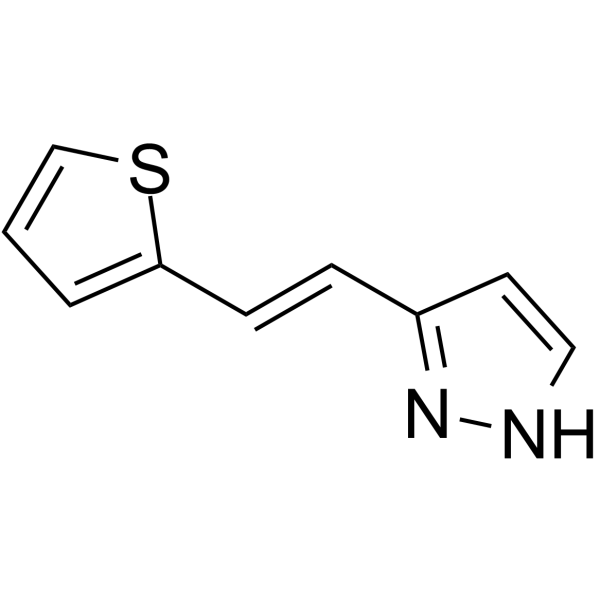
Physicochemical Properties
| Molecular Formula | C9H8N2S |
| Molecular Weight | 176.24 |
| Exact Mass | 180.072 |
| CAS # | 1070881-42-3 |
| PubChem CID | 5714038 |
| Appearance | White to light brown solid powder |
| Density | 1.2±0.1 g/cm3 |
| Boiling Point | 288.0±29.0 °C at 760 mmHg |
| Flash Point | 128.0±24.3 °C |
| Vapour Pressure | 0.0±0.6 mmHg at 25°C |
| Index of Refraction | 1.681 |
| LogP | 1.31 |
| Hydrogen Bond Donor Count | 1 |
| Hydrogen Bond Acceptor Count | 2 |
| Rotatable Bond Count | 2 |
| Heavy Atom Count | 12 |
| Complexity | 170 |
| Defined Atom Stereocenter Count | 0 |
| SMILES | C1=CSC(=C1)/C=C/C2=CC=NN2 |
| InChi Key | FOHWAQGURRYJFK-ONEGZZNKSA-N |
| InChi Code | InChI=1S/C9H8N2S/c1-2-9(12-7-1)4-3-8-5-6-10-11-8/h1-7H,(H,10,11)/b4-3+ |
| Chemical Name | 5-[(E)-2-thiophen-2-ylethenyl]-1H-pyrazole |
| HS Tariff Code | 2934.99.9001 |
| Storage |
Powder-20°C 3 years 4°C 2 years In solvent -80°C 6 months -20°C 1 month |
| Shipping Condition | Room temperature (This product is stable at ambient temperature for a few days during ordinary shipping and time spent in Customs) |
Biological Activity
| ln Vitro | Terevalefim (ANG-3777) at concentrations of 0–10 μM strongly prevents HUVEC from proliferating [2]. |
| ln Vivo | Terevalefim (ANG-3777) inhibits cell engraftment, enhances proliferation, and promotes organ repair and function in animal models [1]. Terevalefim (ANG-3777, 40 mg/kg, IP) phosphorylates c-Met receptor [2]. |
| Cell Assay |
Cell viability assay [2] Cell Types: human umbilical vein epithelial cells (HUVEC). Tested Concentrations: 0.44, 1.78 and 7.1 μM. Incubation Duration: 24 to 48 hrs (hours). Experimental Results: Dose-dependent inhibition of cell proliferation. |
| Animal Protocol |
Animal/Disease Models: SD rat[2]. Doses: 40 mg/kg. Management: IP injection, once. Experimental Results: Selective phosphorylation of c-Met receptor but not other growth factor receptors. |
| References |
[1]. Renal Function Improvement Following ANG-3777 Treatment in Patients at High Risk for Delayed Graft Function After Kidney Transplantation. Transplantation. 2021 Feb 1;105(2):443-450. [2]. The Effect of ANG-3777 on Hepatocyte Growth Factor Receptor, c-MET Signaling. American Transplant Society. |
| Additional Infomation |
Terevalefim is under investigation in clinical trial NCT02474667 (Reduce the Severity of DGF in Recipients of a Deceased Donor Kidney). Mechanism of Action Terevalefim, a small molecule developed by Angion Biomedica Corp., mimics the activity of hepatocyte growth factor (HGF). Through its actions, it activates the c-Met cascade, exhibits c-Met dependence and c-Met receptor activation. As it is able to activate repair pathways, it has been tested in clinical trials for acute kidney injury and in delayed graft function. As of July 2020, Angion has announced a Phase 2 proof-of-concept trial to invesigate terevalefim on preventing and mitigating lung injury in patients with COVID-19 (NCT04459676). |
Solubility Data
| Solubility (In Vitro) | DMSO : ~100 mg/mL (~567.41 mM) |
| Solubility (In Vivo) |
Solubility in Formulation 1: ≥ 2.5 mg/mL (14.19 mM) (saturation unknown) in 10% DMSO + 40% PEG300 + 5% Tween80 + 45% Saline (add these co-solvents sequentially from left to right, and one by one), clear solution. For example, if 1 mL of working solution is to be prepared, you can add 100 μL of 25.0 mg/mL clear DMSO stock solution to 400 μL PEG300 and mix evenly; then add 50 μL Tween-80 to the above solution and mix evenly; then add 450 μL normal saline to adjust the volume to 1 mL. Preparation of saline: Dissolve 0.9 g of sodium chloride in 100 mL ddH₂ O to obtain a clear solution. Solubility in Formulation 2: ≥ 2.5 mg/mL (14.19 mM) (saturation unknown) in 10% DMSO + 90% (20% SBE-β-CD in Saline) (add these co-solvents sequentially from left to right, and one by one), clear solution. For example, if 1 mL of working solution is to be prepared, you can add 100 μL of 25.0 mg/mL clear DMSO stock solution to 900 μL of 20% SBE-β-CD physiological saline solution and mix evenly. Preparation of 20% SBE-β-CD in Saline (4°C,1 week): Dissolve 2 g SBE-β-CD in 10 mL saline to obtain a clear solution. Solubility in Formulation 3: ≥ 2.5 mg/mL (14.19 mM) (saturation unknown) in 10% DMSO + 90% Corn Oil (add these co-solvents sequentially from left to right, and one by one), clear solution. For example, if 1 mL of working solution is to be prepared, you can add 100 μL of 25.0 mg/mL clear DMSO stock solution to 900 μL of corn oil and mix evenly. (Please use freshly prepared in vivo formulations for optimal results.) |
| Preparing Stock Solutions | 1 mg | 5 mg | 10 mg | |
| 1 mM | 5.6741 mL | 28.3704 mL | 56.7408 mL | |
| 5 mM | 1.1348 mL | 5.6741 mL | 11.3482 mL | |
| 10 mM | 0.5674 mL | 2.8370 mL | 5.6741 mL |