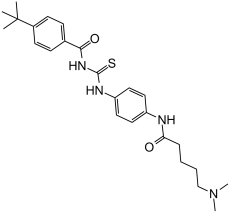
Tenovin-6 is an analog of tenovin-1 that is more water-soluble and may have anticancer properties. With IC50 values of 21 μM, 10 μM, and 67 μM, respectively, it works by inhibiting the protein deacetylase activities of SIRT1, SIRT2, and SIRT3. In contrast to inducing apoptosis in chronic lymphocytic leukemia cells, tenovin-6's cytotoxic effects are caused by the dysregulation of autophagy.
Physicochemical Properties
| Molecular Formula | C25H34N4O2S |
| Molecular Weight | 454.63 |
| Exact Mass | 454.24 |
| CAS # | 1011557-82-6 |
| Related CAS # | Tenovin-6 Hydrochloride;1011301-29-3 |
| PubChem CID | 24772043 |
| Appearance | White to off-white solid |
| Density | 1.2±0.1 g/cm3 |
| Index of Refraction | 1.617 |
| LogP | 3.64 |
| Hydrogen Bond Donor Count | 3 |
| Hydrogen Bond Acceptor Count | 4 |
| Rotatable Bond Count | 9 |
| Heavy Atom Count | 32 |
| Complexity | 616 |
| Defined Atom Stereocenter Count | 0 |
| SMILES | O=C(NC(NC1=CC=C(NC(CCCCN(C)C)=O)C=C1)=S)C2=CC=C(C(C)(C)C)C=C2 |
| InChi Key | BVJSXSQRIUSRCO-UHFFFAOYSA-N |
| InChi Code | InChI=1S/C25H34N4O2S/c1-25(2,3)19-11-9-18(10-12-19)23(31)28-24(32)27-21-15-13-20(14-16-21)26-22(30)8-6-7-17-29(4)5/h9-16H,6-8,17H2,1-5H3,(H,26,30)(H2,27,28,31,32) |
| Chemical Name | 4-tert-butyl-N-[[4-[5-(dimethylamino)pentanoylamino]phenyl]carbamothioyl]benzamide |
| Synonyms | Tenovin-6; Tenovin6; Tenovin 6 |
| HS Tariff Code | 2934.99.9001 |
| Storage |
Powder-20°C 3 years 4°C 2 years In solvent -80°C 6 months -20°C 1 month |
| Shipping Condition | Room temperature (This product is stable at ambient temperature for a few days during ordinary shipping and time spent in Customs) |
Biological Activity
| Targets | SIRT2 (IC50 = 10 μM); SIRT1 (IC50 = 21 μM); SIRT3 (IC50 = 67 μM); HDAC8; MDM-2/p53 | |||
| ln Vitro |
Tenovin-6, which is more toxic to yeast than the less water-soluble tenovin-1, has an IC50 of 30 μM and inhibits the growth of S. cerevisiae cultures. In MCF-7 cells, tenovin-6 significantly raises endogenous K382-Ac p53 levels[1]. Tenovin-6 (0 to 15 μM) dose dependently increases the level of LC3-II in diverse cell types, and the increase is ATG5/7 dependent. Additionally, the use of tenovin-6 prevents SQSTM1/p62 degradation caused by torin 1 and boosts the quantity and intensity of autophagic vesicles both with and without torin 1. The fusion between autophagosomes and lysosomes is unaffected by tenovin-6, but it does affect the acidification of autolysosomes and the hydrolytic activity of lysosomes. Tenovin-6 inhibits autophagy but not p53 activation, and sirtuin 1 inhibition by knockdown or knockout cannot mimic tenovin-6's effect on LC3B accumulation[3]. Tenovin-6 (0, 1, 2.5, 5 or 10 μM) potently inhibits cell proliferation in all OCI-Ly1, DHL-10, U2932, RIVA, HBL1 and OCI-Ly10 cell lines in a dose- and time-dependent manner. Tenovin-6 consistently raises the level of LC3B-II in DLBCL cell lines by inhibiting the traditional autophagy pathway without activating p53, and the rise is unrelated to SIRT1/2/3 and p53. Through the extrinsic cell-death pathway, tenovin-6 causes apoptosis[4]. Tenovin-6 inhibits the growth of UM cells, with IC50 values for 92.1, Mel 270, Omm 1 and Omm 2.3 cells of 12.8 μM, 11.0 μM, 14.58 μM and 9.62 μM, respectively[5]. |
|||
| ln Vivo | Tenovin-6 (50 mg/kg, i.p.) prevents tumor growth in mice[1]. | |||
| Enzyme Assay | In the Fluor de Lys Fluorescent Assay Systems, assays are conducted using purified components. Utilized are NAD+ at 1 mM and pertinent FdL substrates at 7 μM. The final DMSO concentration in the reaction is less than 0.25%, and tenovins are thuslylubilized in DMSO. In comparison to SirT2 and SirT3, SirT1 and HDAC8 each require one unit of enzyme, while SirT2 and SirT3 require five units. One hour of reactions is conducted at 37°C. | |||
| Cell Assay | The MTS assay is used to evaluate cell viability. In 96-well plates, UM cells are seeded into each well (5,000 cells/well), treated the following day with control or Tenovin-6 in increasing concentrations from 0 to 20 μM for 68 h, and then MTS is added at 20 μL/well to be read at a wave length of 490 nm. The IC50 is calculated by curve fitting the sigmoidal dose-response curve. | |||
| Animal Protocol |
|
|||
| References |
[1]. Discovery, in vivo activity, and mechanism of action of a small-molecule p53 activator. Cancer Cell. 2008 May;13(5):454-63. [2]. Exploitation of DHODH and p53 activation as therapeutic targets - a case study in polypharmacology [published online ahead of print, 2020 Sep 8]. J Biol Chem. 2020;jbc.RA119.012056. [3]. Class III-specific HDAC inhibitor Tenovin-6 induces apoptosis, suppresses migration and eliminates cancer stem cells in uveal melanoma. Sci Rep. 2016 Mar 4;6:22622. [4]. Tenovin-6 impairs autophagy by inhibiting autophagic flux. Cell Death Dis. 2017 Feb 9;8(2):e2608. [5]. Tenovin-6 inhibits proliferation and survival of diffuse large B-cell lymphoma cells by blocking autophagy. Oncotarget. 2017 Feb 28;8(9):14912-14924. |
|||
| Additional Infomation | Tenovin-6 is a monocarboxylic acid amide obtained by formal condensation of the carboxy group of 5-(dimethylamino)pentanoic acid with the aromatic amino group of N-[(4-aminophenyl)carbamothioyl]-4-tert-butylbenzamide. It has a role as an antineoplastic agent, a Sir2 inhibitor and a p53 activator. It is a monocarboxylic acid amide, a member of thioureas and a tertiary amino compound. |
Solubility Data
| Solubility (In Vitro) |
DMSO: ~98 mg/mL (~215.6 mM) Water: <1 mg/mL (slightly soluble or insoluble) Ethanol: <1 mg/mL (slightly soluble or insoluble) |
| Solubility (In Vivo) |
Solubility in Formulation 1: ≥ 2.5 mg/mL (5.50 mM) (saturation unknown) in 10% DMSO + 40% PEG300 + 5% Tween80 + 45% Saline (add these co-solvents sequentially from left to right, and one by one), clear solution. For example, if 1 mL of working solution is to be prepared, you can add 100 μL of 25.0 mg/mL clear DMSO stock solution to 400 μL PEG300 and mix evenly; then add 50 μL Tween-80 to the above solution and mix evenly; then add 450 μL normal saline to adjust the volume to 1 mL. Preparation of saline: Dissolve 0.9 g of sodium chloride in 100 mL ddH₂ O to obtain a clear solution. Solubility in Formulation 2: ≥ 2.5 mg/mL (5.50 mM) (saturation unknown) in 10% DMSO + 90% (20% SBE-β-CD in Saline) (add these co-solvents sequentially from left to right, and one by one), clear solution. For example, if 1 mL of working solution is to be prepared, you can add 100 μL of 25.0 mg/mL clear DMSO stock solution to 900 μL of 20% SBE-β-CD physiological saline solution and mix evenly. Preparation of 20% SBE-β-CD in Saline (4°C,1 week): Dissolve 2 g SBE-β-CD in 10 mL saline to obtain a clear solution. (Please use freshly prepared in vivo formulations for optimal results.) |
| Preparing Stock Solutions | 1 mg | 5 mg | 10 mg | |
| 1 mM | 2.1996 mL | 10.9980 mL | 21.9959 mL | |
| 5 mM | 0.4399 mL | 2.1996 mL | 4.3992 mL | |
| 10 mM | 0.2200 mL | 1.0998 mL | 2.1996 mL |