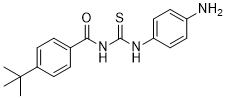
Tenovin-3 is a sirtuin inhibitor and a small molecule that activates p53 transcriptional activity. Human SirT1 and SirT2, two members of the sirtuin family's NAD+-dependent class III histone deacetylases, are inhibited by tenovins. Tenovins function by preventing SirT1 and SirT2, two crucial sirtuin family members, from deacetylating proteins. Tenovins are single agents that can inhibit tumor growth in vivo and are active on mammalian cells at concentrations of one-digit micromolar. This demonstrates the value of these substances as biological tools for the investigation of sirtuin function as well as the possibility of their therapeutic use.
Physicochemical Properties
| Molecular Formula | C18H21N3OS | |
| Molecular Weight | 327.44 | |
| Exact Mass | 327.14 | |
| Elemental Analysis | C, 66.03; H, 6.46; N, 12.83; O, 4.89; S, 9.79 | |
| CAS # | 1011301-27-1 | |
| Related CAS # |
|
|
| PubChem CID | 24772097 | |
| Appearance | White to off-white solid powder | |
| Density | 1.2±0.1 g/cm3 | |
| Index of Refraction | 1.662 | |
| LogP | 2.82 | |
| Hydrogen Bond Donor Count | 3 | |
| Hydrogen Bond Acceptor Count | 3 | |
| Rotatable Bond Count | 3 | |
| Heavy Atom Count | 23 | |
| Complexity | 417 | |
| Defined Atom Stereocenter Count | 0 | |
| SMILES | S=C(N([H])C1C([H])=C([H])C(=C([H])C=1[H])N([H])[H])N([H])C(C1C([H])=C([H])C(=C([H])C=1[H])C(C([H])([H])[H])(C([H])([H])[H])C([H])([H])[H])=O |
|
| InChi Key | NLAXTZPUTNGRDU-UHFFFAOYSA-N | |
| InChi Code | InChI=1S/C18H21N3OS/c1-18(2,3)13-6-4-12(5-7-13)16(22)21-17(23)20-15-10-8-14(19)9-11-15/h4-11H,19H2,1-3H3,(H2,20,21,22,23) | |
| Chemical Name | N-[(4-aminophenyl)carbamothioyl]-4-tert-butylbenzamide | |
| Synonyms |
|
|
| HS Tariff Code | 2934.99.9001 | |
| Storage |
Powder-20°C 3 years 4°C 2 years In solvent -80°C 6 months -20°C 1 month |
|
| Shipping Condition | Room temperature (This product is stable at ambient temperature for a few days during ordinary shipping and time spent in Customs) |
Biological Activity
| Targets | SIRT2; p53 | ||
| ln Vitro | Tenovin-3 downregulates both P-FAK and P-Src[2]. | ||
| ln Vivo |
|
||
| Enzyme Assay | Tenovin-3 is able to increase p53 levels, determined in MCF-7 cells treated for 6 hr at 10 μM. | ||
| Animal Protocol |
|
||
| References |
[1]. Discovery, in vivo activity, and mechanism of action of a small-molecule p53 activator. Cancer Cell. 2008 May;13(5):454-63. [2]. Nuclear HMGB1 promotes the phagocytic ability of macrophages. Exp Cell Res. 2020 Aug 1;393(1):112037. |
Solubility Data
| Solubility (In Vitro) |
|
|||
| Solubility (In Vivo) |
Solubility in Formulation 1: ≥ 2.5 mg/mL (7.63 mM) (saturation unknown) in 10% DMSO + 40% PEG300 + 5% Tween80 + 45% Saline (add these co-solvents sequentially from left to right, and one by one), clear solution. For example, if 1 mL of working solution is to be prepared, you can add 100 μL of 25.0 mg/mL clear DMSO stock solution to 400 μL PEG300 and mix evenly; then add 50 μL Tween-80 to the above solution and mix evenly; then add 450 μL normal saline to adjust the volume to 1 mL. Preparation of saline: Dissolve 0.9 g of sodium chloride in 100 mL ddH₂ O to obtain a clear solution. Solubility in Formulation 2: ≥ 2.5 mg/mL (7.63 mM) (saturation unknown) in 10% DMSO + 90% (20% SBE-β-CD in Saline) (add these co-solvents sequentially from left to right, and one by one), clear solution. For example, if 1 mL of working solution is to be prepared, you can add 100 μL of 25.0 mg/mL clear DMSO stock solution to 900 μL of 20% SBE-β-CD physiological saline solution and mix evenly. Preparation of 20% SBE-β-CD in Saline (4°C,1 week): Dissolve 2 g SBE-β-CD in 10 mL saline to obtain a clear solution. (Please use freshly prepared in vivo formulations for optimal results.) |
| Preparing Stock Solutions | 1 mg | 5 mg | 10 mg | |
| 1 mM | 3.0540 mL | 15.2700 mL | 30.5399 mL | |
| 5 mM | 0.6108 mL | 3.0540 mL | 6.1080 mL | |
| 10 mM | 0.3054 mL | 1.5270 mL | 3.0540 mL |