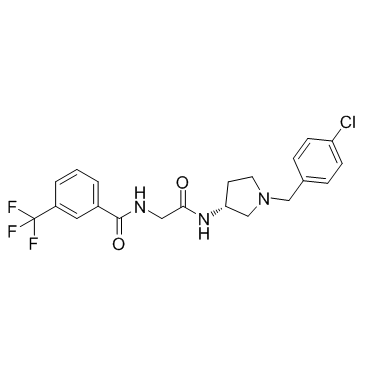
CCR2 antagonist 4 (Teijin compound 1) is a novel and potent CCR2 antagonist (IC50 = 180 nM for CCR2b) with anti-inflammatory and immunomodulatory effects.
Physicochemical Properties
| Molecular Formula | C21H22CL2F3N3O2 |
| Molecular Weight | 476.3195 |
| Exact Mass | 439.127 |
| CAS # | 226226-39-7 |
| Related CAS # | CCR2 antagonist 4 hydrochloride;1313730-14-1 |
| PubChem CID | 44453327 |
| Appearance | White to off-white solid powder |
| LogP | 5.634 |
| Hydrogen Bond Donor Count | 2 |
| Hydrogen Bond Acceptor Count | 6 |
| Rotatable Bond Count | 6 |
| Heavy Atom Count | 30 |
| Complexity | 597 |
| Defined Atom Stereocenter Count | 1 |
| SMILES | C1CN(C[C@@H]1NC(=O)CNC(=O)C2=CC(=CC=C2)C(F)(F)F)CC3=CC=C(C=C3)Cl |
| InChi Key | BAOQJSULMWXFRK-GOSISDBHSA-N |
| InChi Code | InChI=1S/C21H21ClF3N3O2/c22-17-6-4-14(5-7-17)12-28-9-8-18(13-28)27-19(29)11-26-20(30)15-2-1-3-16(10-15)21(23,24)25/h1-7,10,18H,8-9,11-13H2,(H,26,30)(H,27,29)/t18-/m1/s1 |
| Chemical Name | N-[2-[[(3R)-1-[(4-chlorophenyl)methyl]pyrrolidin-3-yl]amino]-2-oxoethyl]-3-(trifluoromethyl)benzamide |
| HS Tariff Code | 2934.99.9001 |
| Storage |
Powder-20°C 3 years 4°C 2 years In solvent -80°C 6 months -20°C 1 month |
| Shipping Condition | Room temperature (This product is stable at ambient temperature for a few days during ordinary shipping and time spent in Customs) |
Biological Activity
| Targets |
Teijin compound 1 targets chemokine receptor 2b (CCR2b) (Ki = 0.4 nM, competitive binding mode) [1] Teijin compound 1 targets chemokine receptor 5 (CCR5) (Ki = 3.2 nM, competitive binding mode) [2] |
| ln Vitro |
Teijin compound 1 binding in CCR2 is largely facilitated by Ile263 and Thr292 in CCR2. A highly conserved residue found in several CC chemokine receptors, Glu291 in TM7 plays a major role in the binding of protonated CCR2 antagonist 4 and CCL2. CCR2 antagonist 4 also interacts strongly with His121 on TM3 and Ile263 on TM6 [2]. Vp-TSL specifically targets the aortic plaque endothelium VCAM-1 and CCR2 antagonist 4 in ApoE-deficient animals, thereby inhibiting the adherence and infiltration of mouse monocyte/macrophage line (RAW 264.7) into the aorta [3]. - CCR2b receptor binding and functional antagonism: Teijin compound 1 potently bound to human CCR2b with Ki = 0.4 nM, competing with the natural ligand MCP-1 (CCL2) for receptor binding. It dose-dependently inhibited MCP-1-induced calcium mobilization in CCR2b-transfected CHO cells, with IC50 = 1.2 nM. At 10 nM, it blocked MCP-1-mediated cell migration by 85% in transwell assays [1] - CCR5 receptor antagonistic activity: The compound also bound to human CCR5 with Ki = 3.2 nM, inhibiting RANTES (CCL5)-induced calcium flux in CCR5-transfected HEK293 cells (IC50 = 4.5 nM). It showed selectivity over other chemokine receptors (CCR1, CCR3, CXCR4; Ki > 100 nM) [2] - Inhibition of monocyte adhesion and transmigration: Teijin compound 1 (1 nM, 10 nM, 100 nM) suppressed adhesion of human peripheral blood monocytes to TNF-α-activated human umbilical vein endothelial cells (HUVECs). At 10 nM, adhesion was reduced by 65% compared to control. It also inhibited monocyte transmigration through activated HUVEC monolayers, with a 70% inhibition rate at 10 nM [3] |
| Enzyme Assay |
- CCR2b receptor binding assay: CCR2b-transfected CHO cells were incubated with a radioactive-labeled MCP-1 analog and Teijin compound 1 at gradient concentrations (0.01-100 nM) in binding buffer (pH 7.4) for 1 hour at 4°C. Unbound ligand was removed by washing, and cell-associated radioactivity was measured. Ki values were calculated using competitive binding equations [1] - CCR5 receptor binding assay: CCR5-transfected HEK293 cells were incubated with radioactive-labeled RANTES and Teijin compound 1 (0.1-100 nM) for 1 hour at 4°C. After washing, bound radioactivity was detected, and Ki was determined by competitive displacement analysis [2] - Calcium mobilization assay: CCR2b-transfected CHO cells or CCR5-transfected HEK293 cells were loaded with a calcium-sensitive fluorescent dye for 30 minutes at 37°C. Cells were pre-treated with Teijin compound 1 (0.01-100 nM) for 15 minutes, then stimulated with MCP-1 (100 nM) or RANTES (100 nM). Fluorescence intensity changes were recorded in real-time to calculate IC50 for inhibiting calcium flux [1][2] |
| Cell Assay |
- Monocyte adhesion assay: Human peripheral blood monocytes were isolated and labeled with a fluorescent dye. TNF-α-activated HUVECs grown in 96-well plates were pre-treated with Teijin compound 1 (1-100 nM) for 30 minutes. Labeled monocytes were added and incubated for 1 hour at 37°C. Non-adherent cells were washed away, and fluorescence intensity of adherent cells was measured to calculate adhesion inhibition rate [3] - Monocyte transmigration assay: Transwell chambers with porous membranes were coated with TNF-α-activated HUVEC monolayers. Teijin compound 1 (1-100 nM) was added to both upper and lower chambers. Fluorescently labeled monocytes were seeded into the upper chamber, and MCP-1 (100 nM) was added to the lower chamber as a chemoattractant. After 4 hours of incubation, migrated monocytes in the lower chamber were quantified by fluorescence measurement [3] - CCR2b-mediated cell migration assay: CCR2b-transfected CHO cells were pre-treated with Teijin compound 1 (0.1-100 nM) for 15 minutes, then seeded into the upper chamber of Transwell plates. MCP-1 (100 nM) was added to the lower chamber, and cells were incubated for 24 hours. Migrated cells on the lower membrane surface were fixed, stained, and counted to determine migration inhibition [1] |
| References |
[1]. Potent antagonists of the CCR2b receptor. Part 3: SAR of the (R)-3-aminopyrrolidine series. Bioorg Med Chem Lett. 2008 Mar 15;18(6):1869-73. [2]. Elucidation of binding sites of dual antagonists in the human chemokine receptors CCR2 and CCR5. Mol Pharmacol. 2009 Jun;75(6):1325-36. [3]. VCAM-1 directed target-sensitive liposomes carrying CCR2 antagonists bind to activated endothelium and reduce adhesion and transmigration of monocytes. Eur J Pharm Biopharm. 2015 Jan;89:18-29. |
| Additional Infomation |
- Chemical classification: Teijin compound 1 is a small-molecule dual antagonist of CCR2b and CCR5, belonging to the (R)-3-aminopyrrolidine series of compounds [1] - Mechanism of action: The compound binds competitively to the ligand-binding pockets of CCR2b and CCR5, preventing the binding of their natural ligands (MCP-1 for CCR2b, RANTES for CCR5). This blocks downstream signaling pathways (e.g., calcium mobilization, PI3K/Akt activation), thereby inhibiting chemokine-mediated monocyte recruitment, adhesion, and transmigration [1][2][3] - Target background: CCR2b and CCR5 are G protein-coupled chemokine receptors expressed on monocytes, macrophages, and T cells. Their activation by chemokines (e.g., MCP-1, RANTES) promotes immune cell recruitment to inflammatory sites, contributing to the pathogenesis of chronic inflammatory diseases and atherosclerosis [1][3] - Therapeutic potential: Teijin compound 1 is a potent, selective dual CCR2b/CCR5 antagonist, showing promise in inhibiting monocyte-mediated inflammation. It has potential applications in treating inflammatory diseases such as rheumatoid arthritis, atherosclerosis, and inflammatory bowel disease [1][3] |
Solubility Data
| Solubility (In Vitro) | DMSO : ≥ 50 mg/mL (~113.67 mM) |
| Solubility (In Vivo) |
Solubility in Formulation 1: ≥ 2.5 mg/mL (5.68 mM) (saturation unknown) in 10% DMSO + 40% PEG300 + 5% Tween80 + 45% Saline (add these co-solvents sequentially from left to right, and one by one), clear solution. For example, if 1 mL of working solution is to be prepared, you can add 100 μL of 25.0 mg/mL clear DMSO stock solution to 400 μL PEG300 and mix evenly; then add 50 μL Tween-80 to the above solution and mix evenly; then add 450 μL normal saline to adjust the volume to 1 mL. Preparation of saline: Dissolve 0.9 g of sodium chloride in 100 mL ddH₂ O to obtain a clear solution. Solubility in Formulation 2: ≥ 2.5 mg/mL (5.68 mM) (saturation unknown) in 10% DMSO + 90% (20% SBE-β-CD in Saline) (add these co-solvents sequentially from left to right, and one by one), clear solution. For example, if 1 mL of working solution is to be prepared, you can add 100 μL of 25.0 mg/mL clear DMSO stock solution to 900 μL of 20% SBE-β-CD physiological saline solution and mix evenly. Preparation of 20% SBE-β-CD in Saline (4°C,1 week): Dissolve 2 g SBE-β-CD in 10 mL saline to obtain a clear solution. Solubility in Formulation 3: ≥ 2.5 mg/mL (5.68 mM) (saturation unknown) in 10% DMSO + 90% Corn Oil (add these co-solvents sequentially from left to right, and one by one), clear solution. For example, if 1 mL of working solution is to be prepared, you can add 100 μL of 25.0 mg/mL clear DMSO stock solution to 900 μL of corn oil and mix evenly. (Please use freshly prepared in vivo formulations for optimal results.) |
| Preparing Stock Solutions | 1 mg | 5 mg | 10 mg | |
| 1 mM | 2.0994 mL | 10.4971 mL | 20.9943 mL | |
| 5 mM | 0.4199 mL | 2.0994 mL | 4.1989 mL | |
| 10 mM | 0.2099 mL | 1.0497 mL | 2.0994 mL |