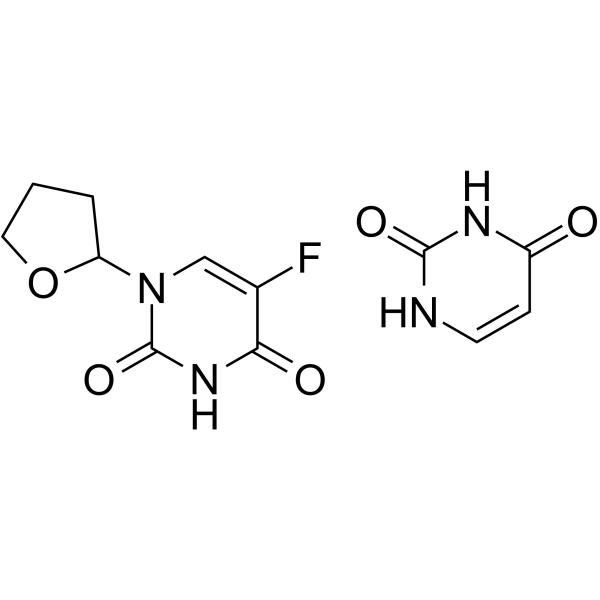
Physicochemical Properties
| Molecular Formula | C8H9FN2O3•4C4H4N2O2 |
| Molecular Weight | 312.2538 |
| Exact Mass | 312.087 |
| CAS # | 74578-38-4 |
| PubChem CID | 104747 |
| Appearance | White to off-white solid powder |
| Boiling Point | 467.1ºC at 760 mmHg |
| Flash Point | 236.3ºC |
| LogP | 0.284 |
| Hydrogen Bond Donor Count | 3 |
| Hydrogen Bond Acceptor Count | 6 |
| Rotatable Bond Count | 1 |
| Heavy Atom Count | 22 |
| Complexity | 477 |
| Defined Atom Stereocenter Count | 0 |
| SMILES | O=C1N(C=C(F)C(N1)=O)C2CCCO2.OC1=NC(O)=NC=C1 |
| InChi Key | DHMYGZIEILLVNR-UHFFFAOYSA-N |
| InChi Code | InChI=1S/C8H9FN2O3.C4H4N2O2/c9-5-4-11(6-2-1-3-14-6)8(13)10-7(5)12;7-3-1-2-5-4(8)6-3/h4,6H,1-3H2,(H,10,12,13);1-2H,(H2,5,6,7,8) |
| Chemical Name | 5-fluoro-1-(oxolan-2-yl)pyrimidine-2,4-dione;1H-pyrimidine-2,4-dione |
| HS Tariff Code | 2934.99.9001 |
| Storage |
Powder-20°C 3 years 4°C 2 years In solvent -80°C 6 months -20°C 1 month |
| Shipping Condition | Room temperature (This product is stable at ambient temperature for a few days during ordinary shipping and time spent in Customs) |
Biological Activity
| ADME/Pharmacokinetics |
Absorption, Distribution and Excretion The absorption into systemic circulation is very rapid and the peak concentration is reached within 1-2 hours. After a single dose of tegafur/uracil of 300 mg/m2/day in three divided doses, tegafur plasma concentration of >1000 ng/ml are maintained throughout the 8-hour dosing interval, whereas uracil concentrations decline rapidly following the peak concentration. The plasma concentration of 5-fluorouracil peaks at 30-60 min after administration with 200 ng/ml and remain detectable for 8-hour dosing interval. There is no significant long-term accumulation of either uracil, tegafur or 5-fluorouracil. Less than 20% of the administered dose of tegafur is excreted intact in the urine following the oral administration. The volume of distribution of tegafur is reported to be 59 L while the uracil volume of distribution of 474 L. The reported clearance of tegafur when administered in the form of tegafur/uracil ranged from 47 to 175 ml/min Metabolism / Metabolites Tegafur is bioactivated to 5-fluorouracil by the liver microsomal cytochrome P450 enzymes, mainly the CYP 2A6. This bioactivation is marked by the presence of C-5' oxidation and C-2' hydrolysis. The 5-fluorouracil is later transformed into its active metabolite 5-fluorodeoxyuridine-monophosphate and 5-fluorouridine-triphosphate. More than 80% of the administered dose is eliminated due to the metabolism of dihydropyridine dehydrogenase. Some other metabolic products include 3'-hydroxy tegafur, 4'-hydroxy tegafur and dihydro tegafur which all of them are significantly less cytotoxic than 5-fluorouracil. Biological Half-Life The presence of uracil generates an increase in the half-life of tegafur and it is registered to be of 11 hours. The elimination half-life of uracil is of 20-40 minutes. |
| Toxicity/Toxicokinetics |
Protein Binding The serum binding protein of tegafur is of 52% while the protein binding of uracil is negligible. |
| References |
[1]. UFT (tegafur-uracil) in rectal cancer. Ann Oncol. 2008;19(8):1371-1378. |
| Additional Infomation |
Tegafur-uracil is an anti-tumor compound containing tegafur (1-(2-tetrahydrofuryl)-5-fluorouracil) and uracil in a molar ratio of 1:4. It was developed as an anti-cancer therapy by Taiho Pharmaceutical Co Ltd. It is approved in different countries but it is not yet approved by the FDA, Health Canada or EMA. Tegafur-Uracil is a formulated therapeutic oral agent consisting of a combination of the 5-fluorouracil (5-FU) congener prodrug tegafur (tetrahydrofuranyl-5-fluorouracil) and uracil (1:4). The high concentration of uracil reversibly inhibits the uracil-reducing enzyme dihydropyrimidine dehydrogenase (DPD), thereby inhibiting first-pass DPD-mediated hepatic metabolism of the uracil analogue 5-FU and permitting administration of 5-FU as the orally bioavailable prodrug tegafur. Tegafur is bioactivated to 5-FU by liver microsomal cytochrome P450 enzymes. 5-FU is subsequently converted into its active metabolites 5-fluoro-deoxyuridine-monophosphate (FdUMP) and 5-fluorouridine-triphosphate (FUTP) intracellularly; these metabolites inhibit the enzyme thymidylate synthase and intercalate into RNA, resulting in decreased thymidine synthesis, reduced DNA synthesis, disrupted RNA function, and tumor cell cytotoxicity. Drug Indication Tegafur-uracil is indicated for the first line treatment of metastatic colorectal cancer with concomitant administration of calcium folinate. Colorectal cancer is the third most diagnosed cancer and 30% of the cases can present the metastatic state. Mechanism of Action The generation of this combo was conceived under the reported activation by the transformation of tegafur to 5-fluorouracil. These findings have convened with results that suggested that the degradation of 5-fluorouracil can be depressed by the addition of uracil. Uracil competitively inhibits the catabolic action of dihydropyrimidine dehydrogenase. This combined activity allows a significant increase in blood and tissue 5-fluorouracil levels by inhibiting its first-pass hepatic metabolism. The active metabolites of tegafur inhibit the enzyme thymidylate synthase (5-fluoro-deoxyuridine-monophosphate) and intercalate into RNA (5-fluorouridine-triphosphate). Pharmacodynamics The use of the combination of tegafur and uracil allows increasing the oral bioavailability, improving the pharmacokinetic behavior of the delivered 5-fluoruracil and increasing the half-life of tegafur. The effect of this combo drug can ameliorate the usage by reducing the dosage frequency which tends to be uncomfortable for the patients. The effect of tegafur's metabolites results in a decreased thymidine synthesis, DNA synthesis, disrupted RNA function and tumor cell cytotoxicity. |
Solubility Data
| Solubility (In Vitro) | May dissolve in DMSO (in most cases), if not, try other solvents such as H2O, Ethanol, or DMF with a minute amount of products to avoid loss of samples |
| Solubility (In Vivo) |
Note: Listed below are some common formulations that may be used to formulate products with low water solubility (e.g. < 1 mg/mL), you may test these formulations using a minute amount of products to avoid loss of samples. Injection Formulations (e.g. IP/IV/IM/SC) Injection Formulation 1: DMSO : Tween 80: Saline = 10 : 5 : 85 (i.e. 100 μL DMSO stock solution → 50 μL Tween 80 → 850 μL Saline) *Preparation of saline: Dissolve 0.9 g of sodium chloride in 100 mL ddH ₂ O to obtain a clear solution. Injection Formulation 2: DMSO : PEG300 :Tween 80 : Saline = 10 : 40 : 5 : 45 (i.e. 100 μL DMSO → 400 μLPEG300 → 50 μL Tween 80 → 450 μL Saline) Injection Formulation 3: DMSO : Corn oil = 10 : 90 (i.e. 100 μL DMSO → 900 μL Corn oil) Example: Take the Injection Formulation 3 (DMSO : Corn oil = 10 : 90) as an example, if 1 mL of 2.5 mg/mL working solution is to be prepared, you can take 100 μL 25 mg/mL DMSO stock solution and add to 900 μL corn oil, mix well to obtain a clear or suspension solution (2.5 mg/mL, ready for use in animals). Injection Formulation 4: DMSO : 20% SBE-β-CD in saline = 10 : 90 [i.e. 100 μL DMSO → 900 μL (20% SBE-β-CD in saline)] *Preparation of 20% SBE-β-CD in Saline (4°C,1 week): Dissolve 2 g SBE-β-CD in 10 mL saline to obtain a clear solution. Injection Formulation 5: 2-Hydroxypropyl-β-cyclodextrin : Saline = 50 : 50 (i.e. 500 μL 2-Hydroxypropyl-β-cyclodextrin → 500 μL Saline) Injection Formulation 6: DMSO : PEG300 : castor oil : Saline = 5 : 10 : 20 : 65 (i.e. 50 μL DMSO → 100 μLPEG300 → 200 μL castor oil → 650 μL Saline) Injection Formulation 7: Ethanol : Cremophor : Saline = 10: 10 : 80 (i.e. 100 μL Ethanol → 100 μL Cremophor → 800 μL Saline) Injection Formulation 8: Dissolve in Cremophor/Ethanol (50 : 50), then diluted by Saline Injection Formulation 9: EtOH : Corn oil = 10 : 90 (i.e. 100 μL EtOH → 900 μL Corn oil) Injection Formulation 10: EtOH : PEG300:Tween 80 : Saline = 10 : 40 : 5 : 45 (i.e. 100 μL EtOH → 400 μLPEG300 → 50 μL Tween 80 → 450 μL Saline) Oral Formulations Oral Formulation 1: Suspend in 0.5% CMC Na (carboxymethylcellulose sodium) Oral Formulation 2: Suspend in 0.5% Carboxymethyl cellulose Example: Take the Oral Formulation 1 (Suspend in 0.5% CMC Na) as an example, if 100 mL of 2.5 mg/mL working solution is to be prepared, you can first prepare 0.5% CMC Na solution by measuring 0.5 g CMC Na and dissolve it in 100 mL ddH2O to obtain a clear solution; then add 250 mg of the product to 100 mL 0.5% CMC Na solution, to make the suspension solution (2.5 mg/mL, ready for use in animals). Oral Formulation 3: Dissolved in PEG400 Oral Formulation 4: Suspend in 0.2% Carboxymethyl cellulose Oral Formulation 5: Dissolve in 0.25% Tween 80 and 0.5% Carboxymethyl cellulose Oral Formulation 6: Mixing with food powders Note: Please be aware that the above formulations are for reference only. InvivoChem strongly recommends customers to read literature methods/protocols carefully before determining which formulation you should use for in vivo studies, as different compounds have different solubility properties and have to be formulated differently. (Please use freshly prepared in vivo formulations for optimal results.) |
| Preparing Stock Solutions | 1 mg | 5 mg | 10 mg | |
| 1 mM | 3.2026 mL | 16.0128 mL | 32.0256 mL | |
| 5 mM | 0.6405 mL | 3.2026 mL | 6.4051 mL | |
| 10 mM | 0.3203 mL | 1.6013 mL | 3.2026 mL |