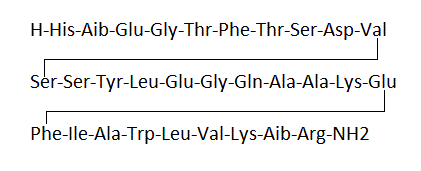
Taspoglutide (ITM-077; ITM077; ITM 077) is a novel, potent, and long-acting agonist of glucagon-like peptide 1 (GLP-1) receptor (EC50= 0.06 nM) with the potential to be used for treatment of type 2 diabetes.
Physicochemical Properties
| Molecular Formula | C152H232N40O45 |
| Molecular Weight | 3339.70947999999 |
| Exact Mass | 3338.712 |
| CAS # | 275371-94-3 |
| PubChem CID | 87453228 |
| Appearance | Typically exists as solid at room temperature |
| Density | 1.46 |
| LogP | -13.4 |
| Hydrogen Bond Donor Count | 49 |
| Hydrogen Bond Acceptor Count | 50 |
| Rotatable Bond Count | 109 |
| Heavy Atom Count | 237 |
| Complexity | 7810 |
| Defined Atom Stereocenter Count | 29 |
| SMILES | CC[C@H](C)[C@@H](C(=O)N[C@@H](C)C(=O)N[C@@H](CC1=CNC2=CC=CC=C21)C(=O)N[C@@H](CC(C)C)C(=O)N[C@@H](C(C)C)C(=O)N[C@@H](CCCCN)C(=O)NC(C)(C)C(=O)N[C@@H](CCCNC(=N)N)C(=O)N)NC(=O)[C@H](CC3=CC=CC=C3)NC(=O)[C@H](CCC(=O)O)NC(=O)[C@H](CCCCN)NC(=O)[C@H](C)NC(=O)[C@H](C)NC(=O)[C@H](CCC(=O)N)NC(=O)CNC(=O)[C@H](CCC(=O)O)NC(=O)[C@H](CC(C)C)NC(=O)[C@H](CC4=CC=C(C=C4)O)NC(=O)[C@H](CO)NC(=O)[C@H](CO)NC(=O)[C@H](C(C)C)NC(=O)[C@H](CC(=O)O)NC(=O)[C@H](CO)NC(=O)[C@H]([C@@H](C)O)NC(=O)[C@H](CC5=CC=CC=C5)NC(=O)[C@H]([C@@H](C)O)NC(=O)CNC(=O)[C@H](CCC(=O)O)NC(=O)C(C)(C)NC(=O)[C@H](CC6=CNC=N6)N |
| InChi Key | WRGVLTAWMNZWGT-VQSPYGJZSA-N |
| InChi Code | InChI=1S/C152H232N40O45/c1-20-78(10)119(145(233)168-81(13)125(213)174-105(63-87-66-162-92-39-28-27-38-90(87)92)134(222)176-101(59-75(4)5)135(223)187-117(76(6)7)143(231)173-95(41-30-32-56-154)142(230)192-152(18,19)148(236)184-93(122(157)210)42-33-57-161-150(158)159)189-136(224)103(60-84-34-23-21-24-35-84)177-131(219)99(50-54-115(206)207)172-130(218)94(40-29-31-55-153)170-124(212)80(12)166-123(211)79(11)167-129(217)98(47-51-110(156)199)169-111(200)68-163-127(215)96(48-52-113(202)203)171-132(220)100(58-74(2)3)175-133(221)102(62-86-43-45-89(198)46-44-86)178-139(227)107(70-193)181-141(229)109(72-195)182-144(232)118(77(8)9)188-138(226)106(65-116(208)209)179-140(228)108(71-194)183-147(235)121(83(15)197)190-137(225)104(61-85-36-25-22-26-37-85)180-146(234)120(82(14)196)186-112(201)69-164-128(216)97(49-53-114(204)205)185-149(237)151(16,17)191-126(214)91(155)64-88-67-160-73-165-88/h21-28,34-39,43-46,66-67,73-83,91,93-109,117-121,162,193-198H,20,29-33,40-42,47-65,68-72,153-155H2,1-19H3,(H2,156,199)(H2,157,210)(H,160,165)(H,163,215)(H,164,216)(H,166,211)(H,167,217)(H,168,233)(H,169,200)(H,170,212)(H,171,220)(H,172,218)(H,173,231)(H,174,213)(H,175,221)(H,176,222)(H,177,219)(H,178,227)(H,179,228)(H,180,234)(H,181,229)(H,182,232)(H,183,235)(H,184,236)(H,185,237)(H,186,201)(H,187,223)(H,188,226)(H,189,224)(H,190,225)(H,191,214)(H,192,230)(H,202,203)(H,204,205)(H,206,207)(H,208,209)(H4,158,159,161)/t78-,79-,80-,81-,82+,83+,91-,93-,94-,95-,96-,97-,98-,99-,100-,101-,102-,103-,104-,105-,106-,107-,108-,109-,117-,118-,119-,120-,121-/m0/s1 |
| Chemical Name | (4S)-4-[[(2S)-6-amino-2-[[(2S)-2-[[(2S)-2-[[(2S)-5-amino-2-[[2-[[(2S)-2-[[(2S)-2-[[(2S)-2-[[(2S)-2-[[(2S)-2-[[(2S)-2-[[(2S)-2-[[(2S)-2-[[(2S,3R)-2-[[(2S)-2-[[(2S,3R)-2-[[2-[[(2S)-2-[[2-[[(2S)-2-amino-3-(1H-imidazol-4-yl)propanoyl]amino]-2-methylpropanoyl]amino]-4-carboxybutanoyl]amino]acetyl]amino]-3-hydroxybutanoyl]amino]-3-phenylpropanoyl]amino]-3-hydroxybutanoyl]amino]-3-hydroxypropanoyl]amino]-3-carboxypropanoyl]amino]-3-methylbutanoyl]amino]-3-hydroxypropanoyl]amino]-3-hydroxypropanoyl]amino]-3-(4-hydroxyphenyl)propanoyl]amino]-4-methylpentanoyl]amino]-4-carboxybutanoyl]amino]acetyl]amino]-5-oxopentanoyl]amino]propanoyl]amino]propanoyl]amino]hexanoyl]amino]-5-[[(2S)-1-[[(2S,3S)-1-[[(2S)-1-[[(2S)-1-[[(2S)-1-[[(2S)-1-[[(2S)-6-amino-1-[[1-[[(2S)-1-amino-5-carbamimidamido-1-oxopentan-2-yl]amino]-2-methyl-1-oxopropan-2-yl]amino]-1-oxohexan-2-yl]amino]-3-methyl-1-oxobutan-2-yl]amino]-4-methyl-1-oxopentan-2-yl]amino]-3-(1H-indol-3-yl)-1-oxopropan-2-yl]amino]-1-oxopropan-2-yl]amino]-3-methyl-1-oxopentan-2-yl]amino]-1-oxo-3-phenylpropan-2-yl]amino]-5-oxopentanoic acid |
| Synonyms | HXEGTFTSDVSSYLEGQAAKEFIAWLVKXR (N-((N-(L-histidyl)-2-aminoisobutyryl)-L-alpha-glutamyl-glycyl-L-threonyl-L-phenylalanyl-L-threonyl-L-seryl-L-alpha-aspartyl-L-valyl-L-seryl-L-seryl-L-tyrosyl-L-leucyl-L-alpha-glutamyl-glycyl-L-glutaminyl-L-alanyl-L-alanyl-L-lysyl-L-alpha-glutamyl-L-phenylalanyl-L-isoleucyl-L-alanyl-L-tryptophyl-L-leucyl-L-valyl-L-lysyl)-2-aminoisobutyryl)-L-argininamide H-His-Aib-Glu-Gly-Thr-Phe-Thr-Ser-Asp-Val-Ser-Ser-Tyr-Leu-Glu-Gly-Gln-Ala-Ala-Lys-Glu-Phe-Ile-Ala-Trp-Leu-Val-Lys-Aib-Arg-NH2 |
| HS Tariff Code | 2934.99.9001 |
| Storage |
Powder-20°C 3 years 4°C 2 years In solvent -80°C 6 months -20°C 1 month Note: Please store this product in a sealed and protected environment (e.g. under nitrogen), avoid exposure to moisture and light. |
| Shipping Condition | Room temperature (This product is stable at ambient temperature for a few days during ordinary shipping and time spent in Customs) |
Biological Activity
| ln Vitro | Taspoglutide (R1583/BIM51077) is a long-acting 10% formulation of (Aib8-35) human GLP-1 (7-36 amides) having 93% similarity to the original peptide. It activates GLP-1 receptors. Tasglutide has comparable affinity (affinity constant 1.1±0.2 nM) to the endogenous ligand of hGLP-1 receptor (affinity constant 1.5±0.3 nM) and demonstrates equal effectiveness in inducing cAMP generation [2]. |
| ln Vivo | In isolated, cultured rat islets and perfused ZDF rat pancreas, taslutide has been demonstrated to accelerate the rate of glucose-induced insulin secretion. In Sprague-Dawley rats and diabetic db/db mice, taslutide demonstrates dose-related augmentation of glucose-dependent insulin release, which lowers blood glucose in the db/db animal model of type 2 diabetes [3]. During oGTT, acute tasglutide administration decreases glycemic swings and raises insulin responses. During the oGTT on day 21, there was a significant reduction in glucose excursions, GIP, PYY, and lipid levels in rats receiving continuous treatment [4]. Following tasglutide treatment, the liver's hepatic triglyceride levels were much lower. Taslutide did not lessen the amount of plaque or lipid in the abdomen or aortic arch, and neither metformin-or taslutide-treated animals showed any appreciable alterations in the buildup of aortic macrophages [5]. |
| References |
[1]. Panjwani N, et al. GLP-1 receptor activation indirectly reduces hepatic lipid accumulation but does not attenuate development of atherosclerosis in diabetic male ApoE(-/-) mice. Endocrinology. 2013 Jan;154(1):127-39. [2]. Sebokova E, et al. Taspoglutide, an analog of human glucagon-like Peptide-1 with enhanced stability and in vivo potency. Endocrinology. 2010 Jun;151(6):2474-82. [3]. Retterstol K, et al. Taspoglutide: a long acting human glucagon-like polypeptide-1 analogue. Expert Opin Investig Drugs. 2009 Sep;18(9):1405-11. [4]. Nauck MA, et al. Treatment with the human once-weekly glucagon-like peptide-1 analog taspoglutide in combination with metformin improves glycemic control and lowers body weight in patients with type 2 diabetes inadequately controlled with metformin alone: a double-blind placebo-controlled study. Diabetes Care. 2009 Jul;32(7):1237-43. [5]. Sebokova E, et al. Taspoglutide, a novel human once-weekly analogue of glucagon-like peptide-1, improves glucose homeostasis and body weight in the Zucker diabetic fatty rat. Diabetes Obes Metab. 2010 Aug;12(8):674-82. [6]. Panjwani N, et al. GLP-1 receptor activation indirectly reduces hepatic lipid accumulation but does not attenuate development of atherosclerosis in diabetic male ApoE(-/-) mice. Endocrinology. 2013 Jan;154(1):127-39 |
| Additional Infomation | See also: Taspoglutide (preferred). |
Solubility Data
| Solubility (In Vitro) | DMSO : ~50 mg/mL (~14.97 mM) |
| Solubility (In Vivo) |
Solubility in Formulation 1: 1.25 mg/mL (0.37 mM) in 10% DMSO + 40% PEG300 + 5% Tween80 + 45% Saline (add these co-solvents sequentially from left to right, and one by one), clear solution; with sonication. For example, if 1 mL of working solution is to be prepared, you can add 100 μL of 12.5 mg/mL clear DMSO stock solution to 400 μL PEG300 and mix evenly; then add 50 μL Tween-80 to the above solution and mix evenly; then add 450 μL normal saline to adjust the volume to 1 mL. Preparation of saline: Dissolve 0.9 g of sodium chloride in 100 mL ddH₂ O to obtain a clear solution. Solubility in Formulation 2: 1.25 mg/mL (0.37 mM) in 10% DMSO + 90% (20% SBE-β-CD in Saline) (add these co-solvents sequentially from left to right, and one by one), clear solution; with ultrasonication. For example, if 1 mL of working solution is to be prepared, you can add 100 μL of 12.5 mg/mL clear DMSO stock solution to 900 μL of 20% SBE-β-CD physiological saline solution and mix evenly. Preparation of 20% SBE-β-CD in Saline (4°C,1 week): Dissolve 2 g SBE-β-CD in 10 mL saline to obtain a clear solution. (Please use freshly prepared in vivo formulations for optimal results.) |
| Preparing Stock Solutions | 1 mg | 5 mg | 10 mg | |
| 1 mM | 0.2994 mL | 1.4971 mL | 2.9943 mL | |
| 5 mM | 0.0599 mL | 0.2994 mL | 0.5989 mL | |
| 10 mM | 0.0299 mL | 0.1497 mL | 0.2994 mL |