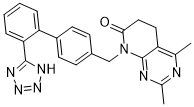
Tasosartan (ANA-756, AC1Q6LAA, DB01349, WAY-ANA-756, Verdia) is a pyrido-pyrimidin-based and long-acting antagonist of angiotensin II (AngII) receptor with anti-hypertensive effects. Its active metabolite, enoltasosartan, has been credited for its prolonged duration of action. In an investigation aimed at determining the respective roles played by enoltasosartan and tasosartan in the overall pharmacological effect of tasosartan. In a randomized, double blind, three-period crossover study, the AngII receptor blockade effect of single doses of tasosartan (100 mg p.o. and 50 mg i.v.) and enoltasosartan (2.5 mg i.v.) was compared in 12 healthy subjects using two approaches: the ex vivo AngII radioreceptor assay and the in vivo blood pressure response to exogenous AngII. Tasosartan caused AngII subtype-1 (AT1) receptors to be blocked quickly and persistently. In vivo, 1 to 2 hours after drug administration, tasosartan (p.o. or i.v.) blocked 80% of AT1 receptors, and it still had a 40% effect at 32 hours. The blockade in vitro was estimated to be 20% at 32 hours and 90% at 2 hours. On the other hand, despite the intravenous administration and elevated plasma levels, the blockade caused by enoltasosartan was significantly delayed and barely reached 60 to 70%. The presence of plasma proteins significantly affected the AT1 antagonistic effect of enoltasosartan in vitro, causing a decrease in its affinity for the receptor and a slower rate of receptor association. Tasosartan alone is mostly responsible for the early effects, with enoltasosartan having little to no effect. Oltasosartan's antagonistic effect manifests itself later. Oltasosartan's delayed in vivo blockade effect seems to be caused by a strong and slow protein binding followed by a slow process of dissociation from the carrier.
Physicochemical Properties
| Molecular Formula | C23H21N7O |
| Molecular Weight | 411.4591 |
| Exact Mass | 411.18 |
| Elemental Analysis | C, 67.14; H, 5.14; N, 23.83; O, 3.89 |
| CAS # | 145733-36-4 |
| Related CAS # | 145733-36-4 |
| PubChem CID | 60919 |
| Appearance | White to off-white solid powder |
| Density | 1.3±0.1 g/cm3 |
| Boiling Point | 759.4±70.0 °C at 760 mmHg |
| Flash Point | 413.1±35.7 °C |
| Vapour Pressure | 0.0±2.6 mmHg at 25°C |
| Index of Refraction | 1.665 |
| LogP | 2.62 |
| Hydrogen Bond Donor Count | 1 |
| Hydrogen Bond Acceptor Count | 6 |
| Rotatable Bond Count | 4 |
| Heavy Atom Count | 31 |
| Complexity | 625 |
| Defined Atom Stereocenter Count | 0 |
| SMILES | O=C1C([H])([H])C([H])([H])C2=C(C([H])([H])[H])N=C(C([H])([H])[H])N=C2N1C([H])([H])C1C([H])=C([H])C(C2=C([H])C([H])=C([H])C([H])=C2C2N=NN([H])N=2)=C([H])C=1[H] |
| InChi Key | ADXGNEYLLLSOAR-UHFFFAOYSA-N |
| InChi Code | InChI=1S/C23H21N7O/c1-14-18-11-12-21(31)30(23(18)25-15(2)24-14)13-16-7-9-17(10-8-16)19-5-3-4-6-20(19)22-26-28-29-27-22/h3-10H,11-13H2,1-2H3,(H,26,27,28,29) |
| Chemical Name | 2,4-dimethyl-8-[[4-[2-(2H-tetrazol-5-yl)phenyl]phenyl]methyl]-5,6-dihydropyrido[2,3-d]pyrimidin-7-one |
| Synonyms | ANA-756; AC1Q6LAA; DB01349; WAY-ANA-756; Verdia; AC1L1U5X; WAY-ANA 756; WAYANA-756; WAY ANA 756; Tasosartan |
| HS Tariff Code | 2934.99.9001 |
| Storage |
Powder-20°C 3 years 4°C 2 years In solvent -80°C 6 months -20°C 1 month |
| Shipping Condition | Room temperature (This product is stable at ambient temperature for a few days during ordinary shipping and time spent in Customs) |
Biological Activity
| Targets | Angiotensin II (AngII) receptor |
| ln Vitro | Tasosartan is an oral active nonpeptide AngII antagonist, exhibited specific and selective antagonistic activity against AT1 receptors in vitro. In the absence of proteins in the binding buffer, the IC50 value for inhibiting the specific binding of 125I-AngII to the rat adrenal membrane is 1.2±0.6 nM [1]. |
| ln Vivo | Tasosartan administration significantly (p<0.05) reduces the pressor response in rats to angiotensin-II at doses of 1.0 and 3.0 mg/kg (iv)[2]. |
| Animal Protocol | Rats: Four groups of rats, each weighing 343±8 g, were studied to determine the pressor response to angiotensin-II administration. After the introduction of either the vehicle or graded doses of Tasosartan (0.3, 1.0, or 3.0 mg/kg, iv), each rat receives four separate bolus injections of angiotensin-II. |
| ADME/Pharmacokinetics |
Metabolism / Metabolites Tasosartan has known human metabolites that include enoltasosartan. |
| References |
[1]. Tasosartan, enoltasosartan, and angiotensin II receptor blockade: the confounding role of protein binding. J Pharmacol Exp Ther. 2000 Nov;295(2):649-54. [2]. Novel human metabolites of the angiotensin-II antagonist Tasosartan and their pharmacological effects. Bioorg Med Chem Lett. 2002 Aug 5;12(15):1967-71. |
| Additional Infomation |
Tasosartan is a member of biphenyls. Tasosartan is a long-acting angiotensin II (AngII) receptor blocker. Its long duration of action has been attributed to its active metabolite enoltasosartan. It is used to treat patients with essential hypertension. Drug Indication Tasosartan is infrequently in the treatment of hypertension and heart failure. Mechanism of Action Tasosartan is a selective, potent, orally active and long-acting nonpeptide Angiotensin II type 1 (AT1) receptor antagonist. Tasosartan blocks the renin-angiotensin-aldosterone system (RAAS) at the level of the AT1 receptor that mediates most, if not all, of the important actions of Ang II. Tasosartan binds reversibly to the AT1 receptors in vascular smooth muscle and the adrenal gland. As angiotensin II is a vasoconstrictor, which also stimulates the synthesis and release of aldosterone, blockage of its effects results in decreases in systemic vascular resistance. AT1 receptor antagonists avoid the nonspecificity of the Ang I converting enzyme (ACE) inhibitors. Pharmacodynamics By blocking the angiotensin II (AT1) receptor, the drug ultimately causes vasodilation, reduced secretion of vasopressin (ADH), reduced production and secretion of aldosterone, amongst other actions leading to the combined effect of a reduction of blood pressure. |
Solubility Data
| Solubility (In Vitro) | DMSO: ~125 mg/mL (~303.8 mM) |
| Solubility (In Vivo) |
Solubility in Formulation 1: ≥ 2.08 mg/mL (5.06 mM) (saturation unknown) in 10% DMSO + 40% PEG300 + 5% Tween80 + 45% Saline (add these co-solvents sequentially from left to right, and one by one), clear solution. For example, if 1 mL of working solution is to be prepared, you can add 100 μL of 20.8 mg/mL clear DMSO stock solution to 400 μL PEG300 and mix evenly; then add 50 μL Tween-80 to the above solution and mix evenly; then add 450 μL normal saline to adjust the volume to 1 mL. Preparation of saline: Dissolve 0.9 g of sodium chloride in 100 mL ddH₂ O to obtain a clear solution. Solubility in Formulation 2: ≥ 2.08 mg/mL (5.06 mM) (saturation unknown) in 10% DMSO + 90% (20% SBE-β-CD in Saline) (add these co-solvents sequentially from left to right, and one by one), clear solution. For example, if 1 mL of working solution is to be prepared, you can add 100 μL of 20.8 mg/mL clear DMSO stock solution to 900 μL of 20% SBE-β-CD physiological saline solution and mix evenly. Preparation of 20% SBE-β-CD in Saline (4°C,1 week): Dissolve 2 g SBE-β-CD in 10 mL saline to obtain a clear solution. Solubility in Formulation 3: ≥ 2.08 mg/mL (5.06 mM) (saturation unknown) in 10% DMSO + 90% Corn Oil (add these co-solvents sequentially from left to right, and one by one), clear solution. For example, if 1 mL of working solution is to be prepared, you can add 100 μL of 20.8 mg/mL clear DMSO stock solution to 900 μL of corn oil and mix evenly. (Please use freshly prepared in vivo formulations for optimal results.) |
| Preparing Stock Solutions | 1 mg | 5 mg | 10 mg | |
| 1 mM | 2.4304 mL | 12.1518 mL | 24.3037 mL | |
| 5 mM | 0.4861 mL | 2.4304 mL | 4.8607 mL | |
| 10 mM | 0.2430 mL | 1.2152 mL | 2.4304 mL |