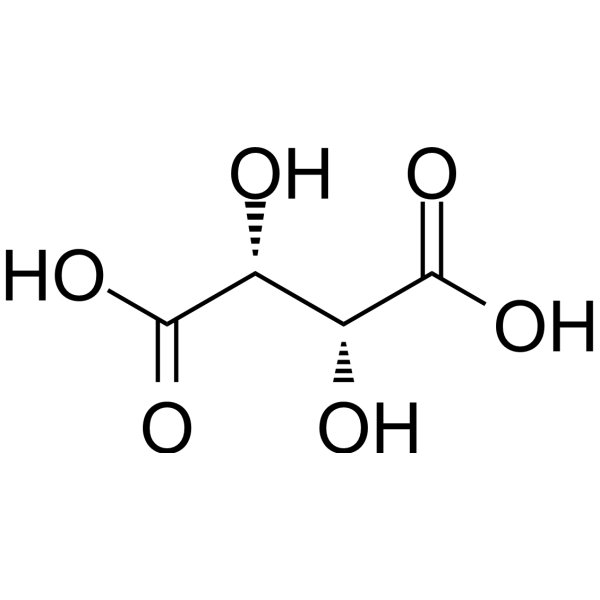
Physicochemical Properties
| Molecular Formula | C4H6O6 |
| Molecular Weight | 150.08 |
| Exact Mass | 150.016 |
| CAS # | 87-69-4 |
| Related CAS # | Tartaric acid disodium dihydrate;6106-24-7;L-Tartaric acid diammonium;3164-29-2 |
| PubChem CID | 444305 |
| Appearance | White to off-white solid powder |
| Density | 1.76 |
| Boiling Point | 399.3±42.0 °C at 760 mmHg |
| Melting Point | 170-172 °C(lit.) |
| Flash Point | 210 ºC |
| Vapour Pressure | 0.0±2.1 mmHg at 25°C |
| Index of Refraction | 1.586 |
| LogP | -1.43 |
| Hydrogen Bond Donor Count | 4 |
| Hydrogen Bond Acceptor Count | 6 |
| Rotatable Bond Count | 3 |
| Heavy Atom Count | 10 |
| Complexity | 134 |
| Defined Atom Stereocenter Count | 2 |
| SMILES | [C@@H]([C@H](C(=O)O)O)(C(=O)O)O |
| InChi Key | FEWJPZIEWOKRBE-JCYAYHJZSA-N |
| InChi Code | InChI=1S/C4H6O6/c5-1(3(7)8)2(6)4(9)10/h1-2,5-6H,(H,7,8)(H,9,10)/t1-,2-/m1/s1 |
| Chemical Name | (2R,3R)-2,3-dihydroxybutanedioic acid |
| Synonyms | Threaric acid; Cichoric acid; Tartaric acid |
| HS Tariff Code | 2934.99.9001 |
| Storage |
Powder-20°C 3 years 4°C 2 years In solvent -80°C 6 months -20°C 1 month |
| Shipping Condition | Room temperature (This product is stable at ambient temperature for a few days during ordinary shipping and time spent in Customs) |
Biological Activity
| ADME/Pharmacokinetics |
Absorption, Distribution and Excretion Oral or parenteral doses of monosodium 14C-L(+)-tartrate (400 mg/kg) are rapidly excreted by rats and a proportion completely metabolized to CO2. The oral dose was well-absorbed. Only about 15-20% of consumed tartaric acid is secreted in the urine unchanged. Metabolism / Metabolites Most tartarate that is consumed by humans is metabolized by bacteria in the gastrointestinal tract , primarily in the large instestine. |
| References |
[1]. Growth, molecular structure, NBO analysis and vibrational spectral analysis of l-tartaric acid single crystal. Spectrochim Acta A Mol Biomol Spectrosc. 2014 Apr 5;123:127-41. [2]. L-tartaric acid synthesis from vitamin C in higher plants. Proc Natl Acad Sci U S A. 2006 Apr 4;103(14):5608-13. [3]. L-Tartaric Acid Exhibits Antihypertensive and Vasorelaxant Effects: The Possible Role of eNOS/NO/cGMP Pathways. Cardiovasc Hematol Agents Med Chem. 2023;21(3):202-212. [4]. Re-evaluation of l(+)-tartaric acid (E 334), sodium tartrates (E 335), potassium tartrates (E 336), potassium sodium tartrate (E 337) and calcium tartrate (E 354) as food additives. EFSA J. 2020 Mar 11;18(3):e06030. |
| Additional Infomation |
L-tartaric acid is a tartaric acid. It is a conjugate acid of a L-tartrate(1-). It is an enantiomer of a D-tartaric acid. Tartaric acid is a white crystalline organic acid that occurs naturally in many plants, most notably in grapes.Tartaric is an alpha-hydroxy-carboxylic acid, is diprotic and aldaric in acid characteristics, and is a dihydroxyl derivative of succinic acid. Tartaric acid is a metabolite found in or produced by Escherichia coli (strain K12, MG1655). Tartaric Acid is a white crystalline dicarboxylic acid found in many plants, particularly tamarinds and grapes. Tartaric acid is used to generate carbon dioxide through interaction with sodium bicarbonate following oral administration. Carbon dioxide extends the stomach and provides a negative contrast medium during double contrast radiography. In high doses, this agent acts as a muscle toxin by inhibiting the production of malic acid, which could cause paralysis and maybe death. Tartaric acid is a white crystalline organic acid. It occurs naturally in many plants, particularly grapes and tamarinds, and is one of the main acids found in wine. It is added to other foods to give a sour taste, and is used as an antioxidant. Salts of tartaric acid are known as tartrates. It is a dihydroxy derivative of dicarboxylic acid. Tartaric acid is a muscle toxin, which works by inhibiting the production of malic acid, and in high doses causes paralysis and death. The minimum recorded fatal dose for a human is about 12 grams. In spite of that, it is included in many foods, especially sour-tasting sweets. As a food additive, tartaric acid is used as an antioxidant with E number E334, tartrates are other additives serving as antioxidants or emulsifiers. Naturally-occurring tartaric acid is chiral, meaning that it has molecules that are non-superimposable on their mirror-images. It is a useful raw material in organic chemistry for the synthesis of other chiral molecules. The naturally occurring form of the acid is L-(+)-tartaric acid or dextrotartaric acid. The mirror-image (enantiomeric) form, levotartaric acid or D-(-)-tartaric acid, and the achiral form, mesotartaric acid, can be made artificially. Tartarate is believed to play a role in inhibiting kidney stone formation. Most tartarate that is consumed by humans is metabolized by bacteria in the gastrointestinal tract -- primarily in the large instestine. Only about 15-20% of consumed tartaric acid is secreted in the urine unchanged. Drug Indication Tartaric Acid is primarily indicated in conditions like Antiscorbutic, Antiseptic. Stress incontinence, female Pharmacodynamics Tartaric acid is used to generate carbon dioxide through interaction with sodium bicarbonate following oral administration. Carbon dioxide extends the stomach and provides a negative contrast medium during double contrast radiography. In high doses, this agent acts as a muscle toxin by inhibiting the production of malic acid, which could cause paralysis and maybe death. |
Solubility Data
| Solubility (In Vitro) | DMSO : ~100 mg/mL (~666.27 mM) |
| Solubility (In Vivo) |
Solubility in Formulation 1: ≥ 2.5 mg/mL (16.66 mM) (saturation unknown) in 10% DMSO + 40% PEG300 + 5% Tween80 + 45% Saline (add these co-solvents sequentially from left to right, and one by one), clear solution. For example, if 1 mL of working solution is to be prepared, you can add 100 μL of 25.0 mg/mL clear DMSO stock solution to 400 μL PEG300 and mix evenly; then add 50 μL Tween-80 to the above solution and mix evenly; then add 450 μL normal saline to adjust the volume to 1 mL. Preparation of saline: Dissolve 0.9 g of sodium chloride in 100 mL ddH₂ O to obtain a clear solution. Solubility in Formulation 2: ≥ 2.5 mg/mL (16.66 mM) (saturation unknown) in 10% DMSO + 90% (20% SBE-β-CD in Saline) (add these co-solvents sequentially from left to right, and one by one), clear solution. For example, if 1 mL of working solution is to be prepared, you can add 100 μL of 25.0 mg/mL clear DMSO stock solution to 900 μL of 20% SBE-β-CD physiological saline solution and mix evenly. Preparation of 20% SBE-β-CD in Saline (4°C,1 week): Dissolve 2 g SBE-β-CD in 10 mL saline to obtain a clear solution. Solubility in Formulation 3: ≥ 2.5 mg/mL (16.66 mM) (saturation unknown) in 10% DMSO + 90% Corn Oil (add these co-solvents sequentially from left to right, and one by one), clear solution. For example, if 1 mL of working solution is to be prepared, you can add 100 μL of 25.0 mg/mL clear DMSO stock solution to 900 μL of corn oil and mix evenly. (Please use freshly prepared in vivo formulations for optimal results.) |
| Preparing Stock Solutions | 1 mg | 5 mg | 10 mg | |
| 1 mM | 6.6631 mL | 33.3156 mL | 66.6311 mL | |
| 5 mM | 1.3326 mL | 6.6631 mL | 13.3262 mL | |
| 10 mM | 0.6663 mL | 3.3316 mL | 6.6631 mL |