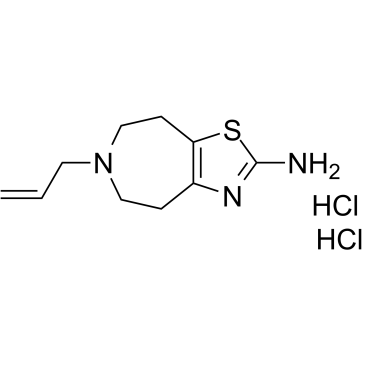
Talipexole dihydrochloride (also known as B-HT920, Domnin, B-HT-920 dihydrochloride) is a novel and potent dopamine D2 receptor agonist, α2-adrenoceptor agonist and 5-HT3 receptor antagonist, which displays anti-parkinsonian activity. Boehringer Ingelheim first brought talipexole to the Japanese market in 1996 with the goal of treating Parkinson's disease. As of December 2014 it was not approved for marketing in the US nor in Europe. Talipexole is a D2 dopamine receptor agonist and interacts both pre- and post-synaptic receptors. A α2-adrenergic agonist, it is as well. The most common adverse effects include lightheadedness, sleepiness, hallucinations, and mild gastrointestinal issues. The Japanese Ministry of Health, Labour, and Welfare ordered Boehringer to include a warning on the label about the possibility of sudden onset of sleep in 2008.
Physicochemical Properties
| Molecular Formula | C10H17CL2N3S |
| Molecular Weight | 282.23308 |
| Exact Mass | 281.052 |
| Elemental Analysis | C, 42.56; H, 6.07; Cl, 25.12; N, 14.89; S, 11.36 |
| CAS # | 36085-73-1 |
| Related CAS # | Talipexole; 101626-70-4 |
| PubChem CID | 104870 |
| Appearance | White to off-white solid powder |
| Boiling Point | 364.6ºC at 760mmHg |
| Melting Point | 245ºC dec. |
| Flash Point | 174.3ºC |
| LogP | 3.435 |
| Hydrogen Bond Donor Count | 3 |
| Hydrogen Bond Acceptor Count | 4 |
| Rotatable Bond Count | 2 |
| Heavy Atom Count | 16 |
| Complexity | 210 |
| Defined Atom Stereocenter Count | 0 |
| SMILES | NC1=NC2=C(CCN(CC2)CC=C)S1.Cl.Cl |
| InChi Key | DPQAXNSOFFYKDS-UHFFFAOYSA-N |
| InChi Code | InChI=1S/C10H15N3S.2ClH/c1-2-5-13-6-3-8-9(4-7-13)14-10(11)12-8;;/h2H,1,3-7H2,(H2,11,12);2*1H |
| Chemical Name | 6-prop-2-enyl-4,5,7,8-tetrahydro-[1,3]thiazolo[4,5-d]azepin-2-amine;dihydrochloride |
| Synonyms | Talipexole HCl; Talipexole dihydrochloride; Domnin; B-HT 920; B-HT-920; B-HT920 |
| HS Tariff Code | 2934.99.9001 |
| Storage |
Powder-20°C 3 years 4°C 2 years In solvent -80°C 6 months -20°C 1 month Note: Please store this product in a sealed and protected environment, avoid exposure to moisture. |
| Shipping Condition | Room temperature (This product is stable at ambient temperature for a few days during ordinary shipping and time spent in Customs) |
Biological Activity
| ln Vivo | Intravenous administration of 30 mcg/kg of talixol hydrochloride (B-HT 920) to cats initially causes an increase in blood pressure, followed by a long-lasting decrease in blood pressure and heart rate. Intracisternal injection of 10 μg/kg talixol dihydrochloride (B-HT 920) promotes vagus nerve-mediated reflex bradycardia in dogs with beta-adrenoceptor blockade and angiotensin injection. |
| References |
[1]. Ricci and Taira Adrenoceptor involvement in the cardiovascular responses to B-HT 920 in sinoaortic denervated rats. Gen.Pharmacol. (1999)32 29. [2]. Eur J Pharmacol. 1997 May 1;325(2-3):137-44. [3]. Kohno Y, Fukuzaki K, Kitahara K, Koja T.Anti-tremor activity of talipexole produced by selective dopamine D2 receptor stimulation in cynomolgus monkeys with unilateral lesions in the ventromedial tegmentum.Eur J Pharmacol. 1997 Jan 29;319(2-3):197-205. [4]. Momiyama T, Sasa M, Takaori S.Inhibition by talipexole, a thiazolo-azepine derivative, of dopaminergic neurons in the ventral tegmental area.Life Sci. 1991;49(7):535-43. [5]. Nishikawa T, Yamada S, Tsuda A, Tanaka M, Koga I, Uchida Y.Chronic treatment with talipexole dihydrochloride on abnormal involuntary movement in humans.Clin Neuropharmacol. 1990 Jun;13(3):259-63. [6]. In vivo comparisons of the effects of quinpirole and the putative presynaptic dopaminergic agonists B-HT 920 and SND 919 on striatal dopamine and acetylcholine release. J Pharmacol Exp Ther, 1993. 264(3): p. 1344-51. |
| Additional Infomation | Talipexole dihydrochloride is an azepine. |
Solubility Data
| Solubility (In Vitro) | DMSO : ~25 mg/mL (~88.58 mM) |
| Solubility (In Vivo) |
Solubility in Formulation 1: ≥ 2.5 mg/mL (8.86 mM) (saturation unknown) in 10% DMSO + 40% PEG300 + 5% Tween80 + 45% Saline (add these co-solvents sequentially from left to right, and one by one), clear solution. For example, if 1 mL of working solution is to be prepared, you can add 100 μL of 25.0 mg/mL clear DMSO stock solution to 400 μL PEG300 and mix evenly; then add 50 μL Tween-80 to the above solution and mix evenly; then add 450 μL normal saline to adjust the volume to 1 mL. Preparation of saline: Dissolve 0.9 g of sodium chloride in 100 mL ddH₂ O to obtain a clear solution. Solubility in Formulation 2: ≥ 2.5 mg/mL (8.86 mM) (saturation unknown) in 10% DMSO + 90% (20% SBE-β-CD in Saline) (add these co-solvents sequentially from left to right, and one by one), clear solution. For example, if 1 mL of working solution is to be prepared, you can add 100 μL of 25.0 mg/mL clear DMSO stock solution to 900 μL of 20% SBE-β-CD physiological saline solution and mix evenly. Preparation of 20% SBE-β-CD in Saline (4°C,1 week): Dissolve 2 g SBE-β-CD in 10 mL saline to obtain a clear solution. Solubility in Formulation 3: ≥ 2.5 mg/mL (8.86 mM) (saturation unknown) in 10% DMSO + 90% Corn Oil (add these co-solvents sequentially from left to right, and one by one), clear solution. For example, if 1 mL of working solution is to be prepared, you can add 100 μL of 25.0 mg/mL clear DMSO stock solution to 900 μL of corn oil and mix evenly. (Please use freshly prepared in vivo formulations for optimal results.) |
| Preparing Stock Solutions | 1 mg | 5 mg | 10 mg | |
| 1 mM | 3.5432 mL | 17.7160 mL | 35.4321 mL | |
| 5 mM | 0.7086 mL | 3.5432 mL | 7.0864 mL | |
| 10 mM | 0.3543 mL | 1.7716 mL | 3.5432 mL |