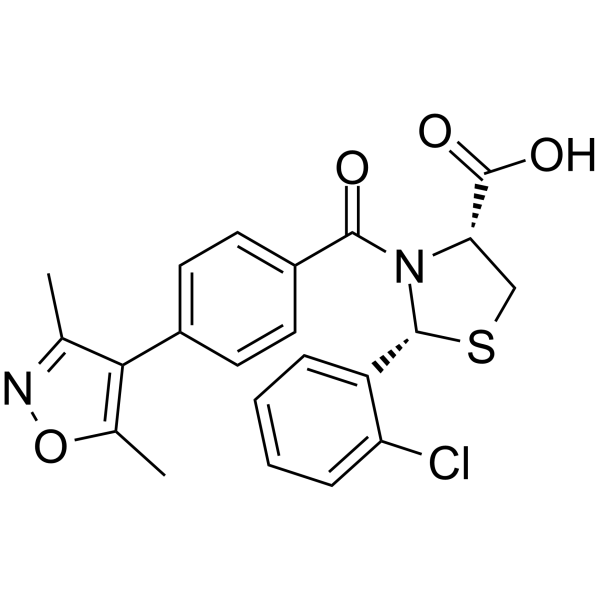
TUG-1375 is a novel and potent agonist of free fatty acid receptor 2 (FFA2/GPR43) with favorable pharmacokinetics. It exhibits pKi of 6.69. TUG-1375 is inactive on FFA3, FFA4, PPARα, PPARγ, PPARδ, LXRα or LXRβ.
Physicochemical Properties
| Molecular Formula | C22H19CLN2O4S |
| Molecular Weight | 442.915263414383 |
| Exact Mass | 442.075 |
| CAS # | 2247372-59-2 |
| PubChem CID | 138319694 |
| Appearance | White to off-white solid powder |
| LogP | 4.6 |
| Hydrogen Bond Donor Count | 1 |
| Hydrogen Bond Acceptor Count | 6 |
| Rotatable Bond Count | 4 |
| Heavy Atom Count | 30 |
| Complexity | 645 |
| Defined Atom Stereocenter Count | 2 |
| SMILES | ClC1C=CC=CC=1[C@@H]1N(C(C2C=CC(C3C(C)=NOC=3C)=CC=2)=O)[C@H](C(=O)O)CS1 |
| InChi Key | RZAMDGBOOPJHJQ-GHTZIAJQSA-N |
| InChi Code | InChI=1S/C22H19ClN2O4S/c1-12-19(13(2)29-24-12)14-7-9-15(10-8-14)20(26)25-18(22(27)28)11-30-21(25)16-5-3-4-6-17(16)23/h3-10,18,21H,11H2,1-2H3,(H,27,28)/t18-,21+/m0/s1 |
| Chemical Name | (2R,4R)-2-(2-chlorophenyl)-3-[4-(3,5-dimethyl-1,2-oxazol-4-yl)benzoyl]-1,3-thiazolidine-4-carboxylic acid |
| HS Tariff Code | 2934.99.9001 |
| Storage |
Powder-20°C 3 years 4°C 2 years In solvent -80°C 6 months -20°C 1 month |
| Shipping Condition | Room temperature (This product is stable at ambient temperature for a few days during ordinary shipping and time spent in Customs) |
Biological Activity
| Targets |
TUG-1375 targets free fatty acid receptor 2 (FFA2, GPR43) (EC50 = 0.08 μM for human FFA2-mediated calcium mobilization; Ki = 0.05 μM; full agonist with Emax = 98% vs. FFA2 endogenous ligand propionate) [1] TUG-1375 shows high selectivity over FFA3 (GPR41) (EC50 > 10 μM) and other G protein-coupled receptors (GPCRs, e.g., FFA1, FFA4, GPR109A; EC50 > 10 μM) [1] |
| ln Vitro |
In the cAMP FFA2 assay, Tug-1375 exhibits a pEC50 of 7.11 and is also effective against the mouse FFA2 homolog (pEC50, 6.44 in the cAMP assay) [1]. - FFA2 agonistic activity: TUG-1375 potently activates human and mouse FFA2 in a dose-dependent manner. In FFA2-transfected HEK293T cells, it induces calcium mobilization with EC50 = 0.08 μM (human) and 0.12 μM (mouse), and inhibits forskolin-induced cAMP accumulation (EC50 = 0.1 μM), confirming activation of both Gq and Gi signaling pathways [1] - Induction of FFA2 downstream target genes: TUG-1375 (0.01-1 μM) upregulates FFA2-mediated pro-inflammatory and chemotactic genes (IL-8, CXCL1, CCL20) in human colonic epithelial cells (Caco-2). At 0.5 μM, IL-8 and CXCL1 mRNA levels are increased by 4.2-fold and 3.8-fold respectively [1] - Promotion of immune cell chemotaxis: The compound (0.1-1 μM) dose-dependently induces chemotaxis of human peripheral blood monocytes and neutrophils, with maximal chemotactic index of 3.5 (monocytes) and 3.2 (neutrophils) at 1 μM, which is blocked by FFA2 antagonist CATPB [1] - High selectivity: TUG-1375 (10 μM) does not activate FFA1, FFA3, FFA4, or 20 other GPCRs; it shows no significant inhibition of kinases (e.g., CDK2, ERK1) or enzymes (e.g., PDE5) [1] - Minimal cytotoxicity: At concentrations up to 20 μM, TUG-1375 exhibits no obvious cytotoxicity to Caco-2 cells, monocytes, or normal human intestinal fibroblasts (cell viability > 90%) [1] |
| ln Vivo |
- Improvement of metabolic parameters in high-fat diet (HFD)-fed mice: C57BL/6 mice fed HFD for 8 weeks were orally administered TUG-1375 (10 mg/kg, 20 mg/kg) once daily for 21 days. The 20 mg/kg dose reduces body weight gain by 35%, fasting blood glucose by 42%, and serum triglycerides by 48% compared to vehicle control. It also increases insulin sensitivity (ITT AUC reduced by 38%) [1] - Attenuation of intestinal inflammation in DSS-induced colitis mice: Mice with DSS-induced ulcerative colitis were treated with TUG-1375 (20 mg/kg, oral, once daily for 7 days). Colon length was increased by 30% (vs. shortened by 40% in control), and colonic tissue TNF-α, IL-6 levels were reduced by 55% and 50% respectively. Histological scoring showed reduced mucosal damage and inflammatory infiltration [1] - Activation of FFA2 in vivo: Ileum and colon tissues from treated mice (20 mg/kg) show upregulated FFA2 target genes (CXCL1, CCL20) by 2.8-fold and 3.1-fold respectively, confirming in vivo FFA2 activation [1] - Tolerability: No significant body weight loss, lethargy, or gastrointestinal distress was observed in treated mice. Serum ALT, AST, creatinine, and urea nitrogen levels remained within normal ranges [1] |
| Enzyme Assay |
- FFA2 calcium mobilization assay: HEK293T cells stably expressing human/mouse FFA2 were loaded with calcium-sensitive fluorescent dye for 30 minutes at 37°C. Cells were treated with gradient concentrations of TUG-1375 (0.001-10 μM), and fluorescence intensity changes were recorded in real-time to calculate EC50. Propionate was used as positive control [1] - cAMP inhibition assay: FFA2-transfected HEK293T cells were pre-treated with TUG-1375 (0.001-10 μM) for 15 minutes, then stimulated with forskolin (10 μM) for 30 minutes. Intracellular cAMP levels were detected by ELISA to determine EC50 for cAMP inhibition [1] - Surface plasmon resonance (SPR) binding assay: Recombinant human FFA2 extracellular domain was immobilized on a sensor chip. TUG-1375 at gradient concentrations (0.01-10 μM) was injected, and binding affinity (Ki = 0.05 μM) was measured at 25°C [1] - GPCR selectivity assay: HEK293T cells transfected with FFA1, FFA3, FFA4, GPR109A, and 20 other GPCRs were subjected to calcium mobilization or cAMP assays with TUG-1375 (10 μM) to evaluate selectivity [1] |
| Cell Assay |
- Colonic epithelial cell target gene expression assay: Caco-2 cells were seeded into 6-well plates (5×10⁵ cells/well) and incubated overnight. Cells were treated with TUG-1375 (0.01-1 μM) for 6 hours, total RNA was extracted, and RT-PCR was performed to detect IL-8, CXCL1, and CCL20 mRNA levels (GAPDH as internal control) [1] - Immune cell chemotaxis assay: Human peripheral blood monocytes/neutrophils were isolated and suspended in chemotaxis buffer. TUG-1375 (0.1-1 μM) was added to the lower chamber of Transwell plates, and cells were seeded into the upper chamber. After 2 hours of incubation, migrated cells in the lower chamber were counted [1] - Cytotoxicity assay: Caco-2 cells, monocytes, and normal human intestinal fibroblasts were seeded into 96-well plates (5×10³ cells/well) and treated with TUG-1375 (0.01-20 μM) for 72 hours. Cell viability was measured by tetrazolium salt-based assay [1] |
| Animal Protocol |
- HFD-induced metabolic disorder mouse model: 8-week-old C57BL/6 mice were fed HFD for 8 weeks to induce obesity and insulin resistance. Mice were randomly divided into vehicle control, 10 mg/kg, and 20 mg/kg TUG-1375 groups (n=8 per group). The compound was dissolved in DMSO/PEG400/sterile water (1:3:6, v/v/v) and administered orally once daily for 21 days. Body weight, fasting blood glucose, and serum lipids were measured weekly; ITT was performed at week 2 [1] - DSS-induced colitis mouse model: 6-week-old C57BL/6 mice were given 3% DSS in drinking water for 7 days to induce colitis. Mice were randomly divided into control and 20 mg/kg TUG-1375 groups (n=10 per group). The compound was administered orally once daily for 7 days (concurrently with DSS). Colon length was measured after sacrifice; colonic tissues were collected for cytokine detection and histological analysis [1] |
| ADME/Pharmacokinetics |
- Absorption: TUG-1375 is rapidly absorbed after oral administration in mice, with Tmax = 1.0 hour. Absolute oral bioavailability is 75.2% [1] - Distribution: The compound has a volume of distribution (Vd) of 1.8 L/kg in mice, with extensive tissue distribution (highest in intestine, liver, and adipose tissue) [1] - Metabolism: TUG-1375 shows good metabolic stability in human and mouse liver microsomes, with half-lives (t1/2) of 8.5 hours (human) and 7.2 hours (mouse). It is primarily metabolized via oxidation (CYP3A4-mediated), with no major toxic metabolites [1] - Excretion: In mice, the elimination half-life (t1/2) is 6.2 hours. Approximately 65% of the dose is excreted in feces and 25% in urine (mainly as parent drug and minor metabolites) [1] - Plasma protein binding: The plasma protein binding rate is 91.3 ± 1.5% in human plasma (equilibrium dialysis method) [1] |
| Toxicity/Toxicokinetics |
- Acute toxicity: Mice showed no mortality or obvious toxicity symptoms (weight loss, lethargy) after a single oral dose of TUG-1375 up to 300 mg/kg, with maximum tolerated dose (MTD) > 300 mg/kg [1] - Subacute toxicity: In mice treated with TUG-1375 (20 mg/kg, oral, once daily for 28 days), no significant changes were observed in body weight, blood routine parameters (WBC, RBC, PLT), or liver/kidney function indices (ALT, AST, creatinine, urea nitrogen). Histopathological examination of major organs (heart, liver, spleen, lungs, kidneys, intestine) revealed no abnormal lesions [1] |
| References |
[1]. Discovery of a Potent Thiazolidine Free Fatty Acid Receptor 2 Agonist with Favorable Pharmacokinetic Properties. J Med Chem. 2018 Nov 8;61(21):9534-9550. |
| Additional Infomation |
- Chemical classification: TUG-1375 is a small-molecule FFA2 agonist, belonging to the thiazolidine derivative class [1] - Mechanism of action: The compound binds to the ligand-binding pocket of FFA2, activating Gq (calcium mobilization) and Gi (cAMP inhibition) signaling pathways. This induces expression of pro-inflammatory/chemotactic genes, promotes immune cell recruitment, regulates glucose/lipid metabolism, and alleviates intestinal mucosal inflammation [1] - Target background: FFA2 (GPR43) is a GPCR activated by short-chain fatty acids (SCFAs). It is highly expressed in intestinal epithelial cells, immune cells, and adipose tissue, playing key roles in metabolic homeostasis, intestinal barrier function, and innate immunity. Dysregulation of FFA2 is associated with obesity, type 2 diabetes, and inflammatory bowel disease [1] - Therapeutic potential: TUG-1375 is a potent, selective, and orally active FFA2 agonist with favorable pharmacokinetic properties. It shows promising efficacy in improving metabolic disorders and intestinal inflammation in preclinical models, with potential applications in treating obesity, type 2 diabetes, and inflammatory bowel disease (IBD) [1] |
Solubility Data
| Solubility (In Vitro) | DMSO : ~125 mg/mL (~282.22 mM) |
| Solubility (In Vivo) |
Solubility in Formulation 1: ≥ 2.25 mg/mL (5.08 mM) (saturation unknown) in 10% DMSO + 40% PEG300 + 5% Tween80 + 45% Saline (add these co-solvents sequentially from left to right, and one by one), clear solution. For example, if 1 mL of working solution is to be prepared, you can add 100 μL of 22.5 mg/mL clear DMSO stock solution to 400 μL PEG300 and mix evenly; then add 50 μL Tween-80 to the above solution and mix evenly; then add 450 μL normal saline to adjust the volume to 1 mL. Preparation of saline: Dissolve 0.9 g of sodium chloride in 100 mL ddH₂ O to obtain a clear solution. Solubility in Formulation 2: ≥ 2.25 mg/mL (5.08 mM) (saturation unknown) in 10% DMSO + 90% (20% SBE-β-CD in Saline) (add these co-solvents sequentially from left to right, and one by one), clear solution. For example, if 1 mL of working solution is to be prepared, you can add 100 μL of 22.5 mg/mL clear DMSO stock solution to 900 μL of 20% SBE-β-CD physiological saline solution and mix evenly. Preparation of 20% SBE-β-CD in Saline (4°C,1 week): Dissolve 2 g SBE-β-CD in 10 mL saline to obtain a clear solution. Solubility in Formulation 3: ≥ 2.25 mg/mL (5.08 mM) (saturation unknown) in 10% DMSO + 90% Corn Oil (add these co-solvents sequentially from left to right, and one by one), clear solution. For example, if 1 mL of working solution is to be prepared, you can add 100 μL of 22.5 mg/mL clear DMSO stock solution to 900 μL of corn oil and mix evenly. (Please use freshly prepared in vivo formulations for optimal results.) |
| Preparing Stock Solutions | 1 mg | 5 mg | 10 mg | |
| 1 mM | 2.2577 mL | 11.2887 mL | 22.5774 mL | |
| 5 mM | 0.4515 mL | 2.2577 mL | 4.5155 mL | |
| 10 mM | 0.2258 mL | 1.1289 mL | 2.2577 mL |