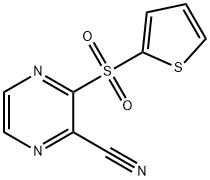
TSPC is a novel and potent inhibitor of GSK-3β (Glycogen Synthase Kinase-3β), also inhibits GA perception by in vitro and in planta evaluations.
Physicochemical Properties
| Molecular Formula | C9H5N3O2S2 |
| Molecular Weight | 251.284898519516 |
| Exact Mass | 250.982 |
| Elemental Analysis | C, 43.02; H, 2.01; N, 16.72; O, 12.73; S, 25.52 |
| CAS # | 882286-32-0 |
| PubChem CID | 2821421 |
| Appearance | Light yellow to yellow solid powder |
| LogP | 2.323 |
| Hydrogen Bond Donor Count | 0 |
| Hydrogen Bond Acceptor Count | 6 |
| Rotatable Bond Count | 2 |
| Heavy Atom Count | 16 |
| Complexity | 395 |
| Defined Atom Stereocenter Count | 0 |
| SMILES | S(C1C(C#N)=NC=CN=1)(C1=CC=CS1)(=O)=O |
| InChi Key | HGCFMGDVMNCLNU-UHFFFAOYSA-N |
| InChi Code | InChI=1S/C9H5N3O2S2/c10-6-7-9(12-4-3-11-7)16(13,14)8-2-1-5-15-8/h1-5H |
| Chemical Name | 3-thiophen-2-ylsulfonylpyrazine-2-carbonitrile |
| Synonyms | TSPC; 882286-32-0; 3-(2-thienylsulfonyl)pyrazine-2-carbonitrile; MLS000860740; 3-thiophen-2-ylsulfonylpyrazine-2-carbonitrile; 3-(thiophene-2-sulfonyl)pyrazine-2-carbonitrile; SMR000459524; 3-(thiophen-2-ylsulfonyl)pyrazine-2-carbonitrile; |
| HS Tariff Code | 2934.99.9001 |
| Storage |
Powder-20°C 3 years 4°C 2 years In solvent -80°C 6 months -20°C 1 month |
| Shipping Condition | Room temperature (This product is stable at ambient temperature for a few days during ordinary shipping and time spent in Customs) |
Biological Activity
| Targets |
Phytohormone gibberellin (GA) perception; Glycogen Synthase Kinase-3β/GSK-3β Gibberellin receptor (OsGID1, rice gibberellin receptor) with a Ki value of 0.3 μM and an IC50 value of 0.5 μM for inhibiting OsGID1-OsSLR1 interaction [1] |
| ln Vitro |
Researchers applied a yeast two-hybrid (Y2H) system to the high-throughput monitoring of two proteins' interaction, a receptor for phytohormone gibberellin (GA) and its direct signal transducer DELLA. With this system, they screened inhibitors to the interaction. As a result, they discovered a chemical, 3-(2-thienylsulfonyl)pyrazine-2-carbonitrile (TSPC), and they confirmed that TSPC is an inhibitor for GA perception by in vitro and in planta evaluations. [1] In yeast two-hybrid assays, TSPC dose-dependently inhibited the interaction between OsGID1 and OsSLR1 (a downstream regulatory protein of gibberellin signaling), with an IC50 of 0.5 μM. The inhibition was specific to the OsGID1-OsSLR1 complex without affecting the viability of yeast cells themselves [1] - TSPC showed no significant binding affinity to other plant hormone receptors (e.g., auxin receptor, cytokinin receptor) in in vitro binding assays, indicating selective targeting of gibberellin receptors [1] |
| Enzyme Assay |
OsGID1-OsSLR1 interaction inhibition assay: Recombinant plasmids containing OsGID1 and OsSLR1 genes were co-transfected into yeast cells. Yeast cultures were treated with TSPC at concentrations ranging from 0.01 to 10 μM, then incubated at 30°C for 48 hours. The interaction between OsGID1 and OsSLR1 was detected by measuring the activity of the reporter gene (β-galactosidase). The absorbance at 420 nm was recorded to quantify the inhibition efficiency and calculate Ki and IC50 values [1] |
| Cell Assay |
Yeast two-hybrid screening assay: Yeast cells co-expressing OsGID1 and OsSLR1 were seeded in 96-well plates (1×10⁴ cells/well) and treated with serial dilutions of TSPC. After 48 hours of incubation at 30°C, a chromogenic substrate for β-galactosidase was added. The reaction was stopped after 1 hour, and absorbance was measured to evaluate the effect of TSPC on the interaction between the two proteins. Yeast cell viability was assessed by absorbance at 600 nm to exclude non-specific cytotoxicity [1] |
| References |
[1]. Chemical screening of an inhibitor for gibberellin receptors based on a yeast two-hybrid system. Bioorg Med Chem Lett. 2013 Feb 15;23(4):1096-8. |
| Additional Infomation |
TSPC is a small-molecule inhibitor identified through high-throughput screening using a yeast two-hybrid system targeting the gibberellin receptor pathway [1] - The compound exerts its inhibitory effect by binding to OsGID1, thereby blocking the formation of the active OsGID1-gibberellin-OsSLR1 complex and inhibiting gibberellin-mediated signal transduction [1] - TSPC provides a potential tool for studying gibberellin signaling mechanisms in plants and may have applications in regulating plant growth and development [1] |
Solubility Data
| Solubility (In Vitro) | DMSO : ~125 mg/mL (~497.45 mM) |
| Solubility (In Vivo) |
Note: Listed below are some common formulations that may be used to formulate products with low water solubility (e.g. < 1 mg/mL), you may test these formulations using a minute amount of products to avoid loss of samples. Injection Formulations (e.g. IP/IV/IM/SC) Injection Formulation 1: DMSO : Tween 80: Saline = 10 : 5 : 85 (i.e. 100 μL DMSO stock solution → 50 μL Tween 80 → 850 μL Saline) *Preparation of saline: Dissolve 0.9 g of sodium chloride in 100 mL ddH ₂ O to obtain a clear solution. Injection Formulation 2: DMSO : PEG300 :Tween 80 : Saline = 10 : 40 : 5 : 45 (i.e. 100 μL DMSO → 400 μLPEG300 → 50 μL Tween 80 → 450 μL Saline) Injection Formulation 3: DMSO : Corn oil = 10 : 90 (i.e. 100 μL DMSO → 900 μL Corn oil) Example: Take the Injection Formulation 3 (DMSO : Corn oil = 10 : 90) as an example, if 1 mL of 2.5 mg/mL working solution is to be prepared, you can take 100 μL 25 mg/mL DMSO stock solution and add to 900 μL corn oil, mix well to obtain a clear or suspension solution (2.5 mg/mL, ready for use in animals). Injection Formulation 4: DMSO : 20% SBE-β-CD in saline = 10 : 90 [i.e. 100 μL DMSO → 900 μL (20% SBE-β-CD in saline)] *Preparation of 20% SBE-β-CD in Saline (4°C,1 week): Dissolve 2 g SBE-β-CD in 10 mL saline to obtain a clear solution. Injection Formulation 5: 2-Hydroxypropyl-β-cyclodextrin : Saline = 50 : 50 (i.e. 500 μL 2-Hydroxypropyl-β-cyclodextrin → 500 μL Saline) Injection Formulation 6: DMSO : PEG300 : castor oil : Saline = 5 : 10 : 20 : 65 (i.e. 50 μL DMSO → 100 μLPEG300 → 200 μL castor oil → 650 μL Saline) Injection Formulation 7: Ethanol : Cremophor : Saline = 10: 10 : 80 (i.e. 100 μL Ethanol → 100 μL Cremophor → 800 μL Saline) Injection Formulation 8: Dissolve in Cremophor/Ethanol (50 : 50), then diluted by Saline Injection Formulation 9: EtOH : Corn oil = 10 : 90 (i.e. 100 μL EtOH → 900 μL Corn oil) Injection Formulation 10: EtOH : PEG300:Tween 80 : Saline = 10 : 40 : 5 : 45 (i.e. 100 μL EtOH → 400 μLPEG300 → 50 μL Tween 80 → 450 μL Saline) Oral Formulations Oral Formulation 1: Suspend in 0.5% CMC Na (carboxymethylcellulose sodium) Oral Formulation 2: Suspend in 0.5% Carboxymethyl cellulose Example: Take the Oral Formulation 1 (Suspend in 0.5% CMC Na) as an example, if 100 mL of 2.5 mg/mL working solution is to be prepared, you can first prepare 0.5% CMC Na solution by measuring 0.5 g CMC Na and dissolve it in 100 mL ddH2O to obtain a clear solution; then add 250 mg of the product to 100 mL 0.5% CMC Na solution, to make the suspension solution (2.5 mg/mL, ready for use in animals). Oral Formulation 3: Dissolved in PEG400 Oral Formulation 4: Suspend in 0.2% Carboxymethyl cellulose Oral Formulation 5: Dissolve in 0.25% Tween 80 and 0.5% Carboxymethyl cellulose Oral Formulation 6: Mixing with food powders Note: Please be aware that the above formulations are for reference only. InvivoChem strongly recommends customers to read literature methods/protocols carefully before determining which formulation you should use for in vivo studies, as different compounds have different solubility properties and have to be formulated differently. (Please use freshly prepared in vivo formulations for optimal results.) |
| Preparing Stock Solutions | 1 mg | 5 mg | 10 mg | |
| 1 mM | 3.9796 mL | 19.8981 mL | 39.7962 mL | |
| 5 mM | 0.7959 mL | 3.9796 mL | 7.9592 mL | |
| 10 mM | 0.3980 mL | 1.9898 mL | 3.9796 mL |