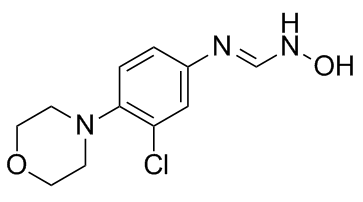
TS-011 (TS 011; TS011) is a novel and potent inhibitor of 20-Hydroxyeicosatetraenoic acid synthesis. It can improve cerebral microcirculatory autoregulation impaired by middle cerebral artery occlusion in mice.
Physicochemical Properties
| Molecular Formula | C₁₁H₁₄CLN₃O₂ |
| Molecular Weight | 255.70 |
| Exact Mass | 255.077 |
| CAS # | 339071-18-0 |
| PubChem CID | 9816527 |
| Appearance | White to light brown solid powder |
| Boiling Point | 477.8±55.0°C |
| LogP | 2.271 |
| Hydrogen Bond Donor Count | 2 |
| Hydrogen Bond Acceptor Count | 4 |
| Rotatable Bond Count | 3 |
| Heavy Atom Count | 17 |
| Complexity | 259 |
| Defined Atom Stereocenter Count | 0 |
| SMILES | ClC1C([H])=C(C([H])=C([H])C=1N1C([H])([H])C([H])([H])OC([H])([H])C1([H])[H])/N=C(\[H])/N([H])O[H] |
| InChi Key | ZTXADXBIGLLOFX-UHFFFAOYSA-N |
| InChi Code | InChI=1S/C11H14ClN3O2/c12-10-7-9(13-8-14-16)1-2-11(10)15-3-5-17-6-4-15/h1-2,7-8,16H,3-6H2,(H,13,14) |
| Chemical Name | N'-(3-chloro-4-morpholin-4-ylphenyl)-N-hydroxymethanimidamide |
| Synonyms | TS-011 TS 011TS011 |
| HS Tariff Code | 2934.99.9001 |
| Storage |
Powder-20°C 3 years 4°C 2 years In solvent -80°C 6 months -20°C 1 month |
| Shipping Condition | Room temperature (This product is stable at ambient temperature for a few days during ordinary shipping and time spent in Customs) |
Biological Activity
| Targets | 20-HETE synthase (cytochrome P450 enzyme family, involved in 20-HETE biosynthesis) [1][2] |
| ln Vivo |
The synthesis of 20-hydroxyeicosatetraenoic acid is selectively inhibited by TS-011. At 0.3 mg/kg, TS-011 prevented the drop in blood flow velocity at 1 and 7 hours following reperfusion (P<0.001). Furthermore, 24 hours following reperfusion, TS-011 reduced the rise in blood flow velocity (P<0.01). Microvascular perfusion regions are shielded from the loss shown in mice treated with vehicles by TS-011. TS-011 at 0.3 mg/kg (P<0.05) can also reduce infarct volume by about 40% [1]. Acute inhibition of 20-HETE production with TS-011 (1 mg/kg IV) significantly increased basilar artery diameter by 39% in 9 dogs with delayed vasospasm [2]. - In mice with middle cerebral artery occlusion (MCAO)-induced cerebral ischemia, intravenous injection of TS-011 (0.3, 1 mg/kg) 30 minutes after MCAO significantly improved cerebral microcirculatory autoregulation. It restored the myogenic response of cerebral arterioles to changes in perfusion pressure, with the 1 mg/kg dose achieving a restoration rate of ~70% compared with sham-operated mice. It also reduced cerebral infarct volume by ~35% (1 mg/kg) and improved neurological deficit scores (evaluated by rotarod and neurological scoring scale) [1] - In dogs with subarachnoid hemorrhage (SAH) induced by dual hemorrhage, intravenous administration of TS-011 (0.1, 0.3 mg/kg) on day 7 post-SAH (during delayed vasospasm) reversed basilar artery vasospasm. The 0.3 mg/kg dose reduced basilar artery diameter narrowing from ~45% (vehicle group) to ~15%, restoring cerebral blood flow to ~85% of pre-SAH levels (measured by cerebral angiography and laser Doppler flowmetry) [2] |
| Enzyme Assay | - 20-HETE synthesis inhibition assay: Rat renal cortical microsomes (rich in 20-HETE synthase) were suspended in reaction buffer containing arachidonic acid (substrate for 20-HETE synthesis). TS-011 (0.01-10 μM) was added, and the mixture was incubated at 37°C for 30 minutes. The reaction was terminated by adding ice-cold methanol, and the concentration of 20-HETE in the supernatant was quantified by liquid chromatography-tandem mass spectrometry (LC-MS/MS) to calculate the inhibition rate of 20-HETE synthesis [1][2] |
| Animal Protocol |
- Mouse MCAO model: Male C57BL/6 mice were anesthetized, and the middle cerebral artery was occluded for 90 minutes followed by reperfusion. TS-011 was dissolved in dimethyl sulfoxide (DMSO) and diluted with normal saline (final DMSO concentration ≤ 0.5%), then administered intravenously at 0.3 or 1 mg/kg 30 minutes after MCAO. Sham-operated mice and vehicle-treated MCAO mice served as controls. Cerebral microcirculatory autoregulation was evaluated by intravital microscopy 24 hours post-MCAO; cerebral infarct volume was measured by TTC staining; neurological function was assessed by rotarod test and neurological scoring [1] - Dog dual hemorrhage SAH model: Adult beagle dogs were anesthetized, and autologous blood was injected into the cisterna magna twice (day 0 and day 2) to induce SAH. On day 7 post-SAH, TS-011 was dissolved in DMSO and diluted with normal saline, then administered intravenously at 0.1 or 0.3 mg/kg. Basilar artery diameter was measured by cerebral angiography before SAH, on day 7 pre-treatment, and 2 hours post-treatment; cerebral blood flow was monitored by laser Doppler flowmetry [2] |
| References |
[1]. Marumo T, et al. The inhibitor of 20-HETE synthesis, TS-011, improves cerebral microcirculatory autoregulation impaired by middle cerebral artery occlusion in mice. Br J Pharmacol. 2010 Nov;161(6):1391-402. [2]. Hacein-Bey L, et al. Reversal of delayed vasospasm by TS-011 in the dual hemorrhage dog model of subarachnoid hemorrhage. AJNR Am J Neuroradiol. 2006 Jun-Jul;27(6):1350-4 |
| Additional Infomation |
- TS-011 is a synthetic small-molecule inhibitor of 20-HETE synthase [1][2] - Its core mechanism of action involves specifically inhibiting the synthesis of 20-HETE (a vasoactive eicosanoid), thereby restoring impaired cerebral microcirculatory autoregulation after cerebral ischemia and reversing delayed cerebral vasospasm following subarachnoid hemorrhage [1][2] - TS-011 exhibits potential therapeutic value for cerebrovascular diseases, including acute cerebral ischemia (stroke) and subarachnoid hemorrhage-induced delayed vasospasm, by targeting cerebral microcirculation and vascular tone regulation [1][2] |
Solubility Data
| Solubility (In Vitro) | DMSO : ~250 mg/mL (~977.71 mM) |
| Solubility (In Vivo) |
Solubility in Formulation 1: ≥ 2.08 mg/mL (8.13 mM) (saturation unknown) in 10% DMSO + 40% PEG300 + 5% Tween80 + 45% Saline (add these co-solvents sequentially from left to right, and one by one), clear solution. For example, if 1 mL of working solution is to be prepared, you can add 100 μL of 20.8 mg/mL clear DMSO stock solution to 400 μL PEG300 and mix evenly; then add 50 μL Tween-80 to the above solution and mix evenly; then add 450 μL normal saline to adjust the volume to 1 mL. Preparation of saline: Dissolve 0.9 g of sodium chloride in 100 mL ddH₂ O to obtain a clear solution. Solubility in Formulation 2: ≥ 2.08 mg/mL (8.13 mM) (saturation unknown) in 10% DMSO + 90% (20% SBE-β-CD in Saline) (add these co-solvents sequentially from left to right, and one by one), clear solution. For example, if 1 mL of working solution is to be prepared, you can add 100 μL of 20.8 mg/mL clear DMSO stock solution to 900 μL of 20% SBE-β-CD physiological saline solution and mix evenly. Preparation of 20% SBE-β-CD in Saline (4°C,1 week): Dissolve 2 g SBE-β-CD in 10 mL saline to obtain a clear solution. Solubility in Formulation 3: ≥ 2.08 mg/mL (8.13 mM) (saturation unknown) in 10% DMSO + 90% Corn Oil (add these co-solvents sequentially from left to right, and one by one), clear solution. For example, if 1 mL of working solution is to be prepared, you can add 100 μL of 20.8 mg/mL clear DMSO stock solution to 900 μL of corn oil and mix evenly. (Please use freshly prepared in vivo formulations for optimal results.) |
| Preparing Stock Solutions | 1 mg | 5 mg | 10 mg | |
| 1 mM | 3.9108 mL | 19.5542 mL | 39.1083 mL | |
| 5 mM | 0.7822 mL | 3.9108 mL | 7.8217 mL | |
| 10 mM | 0.3911 mL | 1.9554 mL | 3.9108 mL |