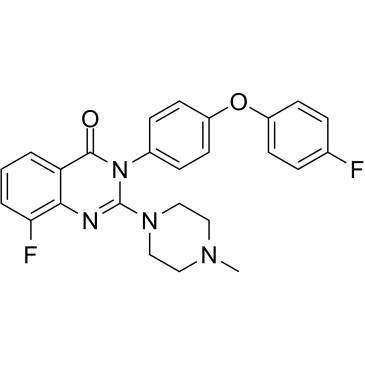
Physicochemical Properties
| Molecular Formula | C25H22F2N4O2 |
| Molecular Weight | 448.464592456818 |
| Exact Mass | 448.171 |
| CAS # | 2314467-59-7 |
| PubChem CID | 137628676 |
| Appearance | White to off-white solid powder |
| LogP | 4 |
| Hydrogen Bond Donor Count | 0 |
| Hydrogen Bond Acceptor Count | 6 |
| Rotatable Bond Count | 4 |
| Heavy Atom Count | 33 |
| Complexity | 713 |
| Defined Atom Stereocenter Count | 0 |
| SMILES | FC1=CC=CC2=C1N=C(N(C1C=CC(=CC=1)OC1C=CC(=CC=1)F)C2=O)N1CCN(C)CC1 |
| InChi Key | NUGPMKZYSBKNPU-UHFFFAOYSA-N |
| InChi Code | InChI=1S/C25H22F2N4O2/c1-29-13-15-30(16-14-29)25-28-23-21(3-2-4-22(23)27)24(32)31(25)18-7-11-20(12-8-18)33-19-9-5-17(26)6-10-19/h2-12H,13-16H2,1H3 |
| Chemical Name | 8-fluoro-3-[4-(4-fluorophenoxy)phenyl]-2-(4-methylpiperazin-1-yl)quinazolin-4-one |
| HS Tariff Code | 2934.99.9001 |
| Storage |
Powder-20°C 3 years 4°C 2 years In solvent -80°C 6 months -20°C 1 month |
| Shipping Condition | Room temperature (This product is stable at ambient temperature for a few days during ordinary shipping and time spent in Customs) |
Biological Activity
| Targets |
TRPV4 agonist-1 targets transient receptor potential vanilloid 4 (TRPV4) with an EC₅₀ value of 1.8 μM in calcium influx assay [1] |
| ln Vitro |
TRPV4 agonist-1 (compound 36) demonstrated noticeably higher potency (ECmax: 20 nM in SOX9 reporter assay). TRPV1 channels are not occupied by TRPV4 agonist-1 [1]. Treatment of primary rat articular chondrocytes with TRPV4 agonist-1 (1–10 μM) dose-dependently increased the mRNA expression of chondrogenic markers COL2A1, SOX9, and ACAN, while decreasing the expression of catabolic marker MMP13 [1] - At 5 μM concentration, TRPV4 agonist-1 significantly enhanced collagen type II protein synthesis in chondrocytes as detected by Western blot [1] - TRPV4 agonist-1 (10 μM) inhibited IL-1β-induced NF-κB activation in chondrocytes, as evidenced by reduced phosphorylation of IκBα and p65 [1] |
| ln Vivo |
In surgically induced rat osteoarthritis (OA) model (anterior cruciate ligament transection + medial meniscectomy), intra-articular injection of TRPV4 agonist-1 (10 μg/joint, once weekly for 4 weeks) significantly reduced cartilage erosion and Osteoarthritis Research Society International (OARSI) score compared to vehicle control [1] - TRPV4 agonist-1 treatment decreased synovial inflammation in OA rats, as shown by reduced levels of TNF-α and IL-6 in synovial fluid [1] - The drug preserved the thickness of articular cartilage and reduced subchondral bone sclerosis in OA rats, as demonstrated by micro-CT and histological staining [1] |
| Enzyme Assay |
Calcium influx assay: Chondrocytes were loaded with a calcium-sensitive fluorescent dye and incubated with serial dilutions of TRPV4 agonist-1. Fluorescence intensity was measured in real-time to determine the EC₅₀ value reflecting TRPV4 activation [1] - NF-κB luciferase assay: Chondrocytes transfected with NF-κB luciferase reporter plasmid were pretreated with TRPV4 agonist-1 followed by IL-1β stimulation. Luciferase activity was measured to evaluate NF-κB inhibition [1] |
| Cell Assay |
Primary rat articular chondrocyte isolation: Articular cartilage was harvested from rat knee joints, digested with collagenase, and cultured in chondrogenic medium. Cells at passage 2 were used for experiments [1] - mRNA expression analysis: Chondrocytes were treated with TRPV4 agonist-1 for 48 hours, total RNA was extracted, reverse-transcribed to cDNA, and qPCR was performed to detect COL2A1, SOX9, ACAN, and MMP13 mRNA levels [1] - Western blot analysis: Chondrocytes treated with the drug were lysed, proteins were separated by SDS-PAGE, transferred to membranes, and probed with antibodies against collagen type II, phospho-IκBα, and phospho-p65. Band intensity was quantified by densitometry [1] |
| Animal Protocol |
OA model establishment: Male Sprague-Dawley rats (200–250 g) underwent anterior cruciate ligament transection and medial meniscectomy under anesthesia to induce OA [1] - Drug formulation: TRPV4 agonist-1 was dissolved in dimethyl sulfoxide (DMSO) and further diluted with phosphate-buffered saline (PBS) to a final DMSO concentration of ≤5% [1] - Administration protocol: Rats were randomly divided into vehicle control and drug-treated groups. TRPV4 agonist-1 was administered via intra-articular injection at a dose of 10 μg/joint once weekly for 4 weeks, starting 1 week after surgery [1] - Sample collection: At the end of treatment, rats were euthanized, knee joints were harvested for histological analysis and micro-CT scanning, and synovial fluid was collected for cytokine detection [1] |
| Toxicity/Toxicokinetics |
In vitro toxicity: TRPV4 agonist-1 showed no significant cytotoxicity in primary chondrocytes at concentrations up to 20 μM, as determined by CCK-8 assay [1] - In vivo toxicity: No obvious systemic toxicity (such as weight loss, abnormal behavior, or organ damage) was observed in OA rats treated with TRPV4 agonist-1 during the 4-week study period [1] |
| References |
[1]. Discovery of Novel Transient Receptor Potential Vanilloid 4 (TRPV4) Agonists as Regulators of Chondrogenic Differentiation: Identification of Quinazolin-4(3 H)-ones and in Vivo Studies on a Surgically Induced Rat Model of Osteoarthritis. J Med Chem. 2019 Jan 28. |
| Additional Infomation |
TRPV4 agonist-1 is a quinazolin-4(3H)-one derivative designed as a selective TRPV4 agonist [1] - The drug exerts chondroprotective effects by activating TRPV4, which in turn promotes chondrogenic differentiation and inhibits catabolic and inflammatory responses in chondrocytes [1] - The in vivo study demonstrated that TRPV4 agonist-1 has potential therapeutic value for the treatment of osteoarthritis [1] |
Solubility Data
| Solubility (In Vitro) | DMSO : ~83.33 mg/mL (~185.81 mM) |
| Solubility (In Vivo) |
Solubility in Formulation 1: ≥ 2.08 mg/mL (4.64 mM) (saturation unknown) in 10% DMSO + 90% Corn Oil (add these co-solvents sequentially from left to right, and one by one), clear solution. For example, if 1 mL of working solution is to be prepared, you can add 100 μL of 20.8 mg/mL clear DMSO stock solution to 900 μL of corn oil and mix evenly. (Please use freshly prepared in vivo formulations for optimal results.) |
| Preparing Stock Solutions | 1 mg | 5 mg | 10 mg | |
| 1 mM | 2.2299 mL | 11.1493 mL | 22.2985 mL | |
| 5 mM | 0.4460 mL | 2.2299 mL | 4.4597 mL | |
| 10 mM | 0.2230 mL | 1.1149 mL | 2.2299 mL |