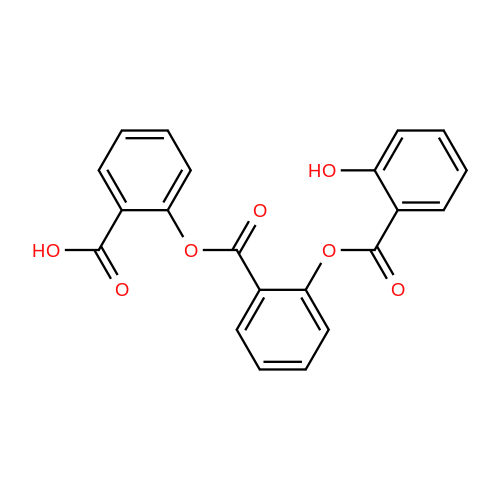
Physicochemical Properties
| Molecular Formula | C21H14O7 |
| Molecular Weight | 378.33166 |
| Exact Mass | 378.074 |
| CAS # | 85531-17-5 |
| PubChem CID | 57871430 |
| Appearance | White to off-white solid powder |
| LogP | 3.528 |
| Hydrogen Bond Donor Count | 2 |
| Hydrogen Bond Acceptor Count | 7 |
| Rotatable Bond Count | 7 |
| Heavy Atom Count | 28 |
| Complexity | 575 |
| Defined Atom Stereocenter Count | 0 |
| InChi Key | YVJQWLQBUBZFTE-UHFFFAOYSA-N |
| InChi Code | InChI=1S/C21H14O7/c22-16-10-4-1-7-13(16)20(25)28-18-12-6-3-9-15(18)21(26)27-17-11-5-2-8-14(17)19(23)24/h1-12,22H,(H,23,24) |
| Chemical Name | 2-[2-(2-hydroxybenzoyl)oxybenzoyl]oxybenzoic acid |
| HS Tariff Code | 2934.99.9001 |
| Storage |
Powder-20°C 3 years 4°C 2 years In solvent -80°C 6 months -20°C 1 month Note: This product requires protection from light (avoid light exposure) during transportation and storage. |
| Shipping Condition | Room temperature (This product is stable at ambient temperature for a few days during ordinary shipping and time spent in Customs) |
Biological Activity
| Targets |
TRISALICYLIC ACID targets cyclooxygenase-2 (COX-2) (IC50 = 0.8 μM) [1] TRISALICYLIC ACID targets α-glucosidase (IC50 = 12 μM) [1] TRISALICYLIC ACID targets peroxisome proliferator-activated receptor γ (PPARγ) (EC50 = 5 μM) [1] |
| ln Vitro |
In LPS-stimulated RAW264.7 macrophages, TRISALICYLIC ACID (1–20 μM) dose-dependently inhibited pro-inflammatory cytokine production. At 10 μM, TNF-α and IL-6 secretion decreased by ~72% and ~68%, respectively, and prostaglandin E2 (PGE2) levels (COX-2 product) reduced by ~75% [1] - For α-glucosidase inhibition, TRISALICYLIC ACID (2–40 μM) suppressed enzyme activity in a dose-dependent manner, with an IC50 of 12 μM. At 20 μM, it inhibited α-glucosidase by ~65% compared to control [1] - In 3T3-L1 adipocytes, TRISALICYLIC ACID (5–25 μM) enhanced insulin-dependent glucose uptake: at 15 μM, glucose uptake increased by ~2.3-fold. It also upregulated PPARγ mRNA expression by ~2.1-fold at 15 μM, promoting adipocyte differentiation and insulin sensitivity [1] - It showed no significant inhibition of COX-1 (IC50 > 100 μM), indicating selective COX-2 inhibition [1] |
| ln Vivo |
In LPS-induced inflammatory C57BL/6 mice, oral administration of TRISALICYLIC ACID (25, 50, 100 mg/kg/day for 3 days) dose-dependently reduced systemic inflammation. At 100 mg/kg, serum TNF-α and IL-6 levels decreased by ~68% and ~62%, respectively, and paw edema (induced by carrageenan) was inhibited by ~70% [1] - In db/db diabetic mice (type 2 diabetes model), oral administration of TRISALICYLIC ACID (50, 100 mg/kg/day for 4 weeks) improved glucose metabolism. At 100 mg/kg, fasting blood glucose reduced by ~55%, glycated hemoglobin (HbA1c) decreased from ~9.2% to ~6.8%, and insulin sensitivity (HOMA-IR index) improved by ~45% [1] - In high-fat diet (HFD)-induced obese mice, TRISALICYLIC ACID (100 mg/kg/day for 6 weeks) reduced body weight gain by ~30% and visceral fat accumulation by ~35%, with no significant change in food intake [1] |
| Enzyme Assay |
COX-2/COX-1 activity assay: Recombinant COX-2 or COX-1 enzyme was incubated with arachidonic acid and TRISALICYLIC ACID (0.1–200 μM) in reaction buffer at 37°C for 30 minutes. The production of PGE2 (COX product) was quantified by ELISA. The inhibition rate was calculated, and IC50 values for COX-2 and COX-1 were determined from dose-response curves [1] - α-glucosidase activity assay: α-glucosidase enzyme was mixed with p-nitrophenyl-α-D-glucopyranoside (substrate) and TRISALICYLIC ACID (2–40 μM) in phosphate buffer (pH 6.8) at 37°C for 60 minutes. The reaction was terminated by adding sodium carbonate, and the absorbance of p-nitrophenol (product) was measured at 405 nm to calculate enzyme inhibition rate [1] - PPARγ binding assay: Recombinant PPARγ ligand-binding domain was incubated with a fluorescently labeled PPARγ ligand and TRISALICYLIC ACID (1–50 μM) at 25°C for 1 hour. Fluorescence polarization was measured to assess the binding affinity of the drug to PPARγ, and EC50 was determined based on competitive displacement of the labeled ligand [1] |
| Cell Assay |
Macrophage inflammatory response assay: RAW264.7 cells were seeded in 24-well plates and stimulated with LPS (1 μg/mL) in the presence of TRISALICYLIC ACID (1–20 μM) for 24 hours. Cell culture supernatants were collected, and TNF-α, IL-6, and PGE2 levels were quantified by ELISA [1] - Adipocyte glucose uptake and PPARγ expression assay: 3T3-L1 pre-adipocytes were differentiated into adipocytes, then treated with TRISALICYLIC ACID (5–25 μM) and insulin (100 nM) for 12 hours. [3H]-2-deoxyglucose was added, and radioactivity was measured to assess glucose uptake. RT-PCR was performed to detect PPARγ mRNA levels [1] |
| Animal Protocol |
LPS-induced inflammation mouse model: Male C57BL/6 mice (6–8 weeks old) were randomly divided into control and treatment groups. TRISALICYLIC ACID was dissolved in 0.5% carboxymethylcellulose sodium (CMC-Na) and administered by oral gavage at 25, 50, or 100 mg/kg/day for 3 days. On day 3, LPS (5 mg/kg) was intraperitoneally injected to induce inflammation. Serum cytokines (TNF-α, IL-6) were measured 6 hours later. For paw edema assessment, carrageenan (1% w/v) was injected into the hind paw after 3 days of drug treatment, and paw thickness was measured at 4 hours [1] - db/db diabetic mouse model: Male db/db mice (8 weeks old) were divided into control and treatment groups. TRISALICYLIC ACID (50, 100 mg/kg/day) was administered orally in 0.5% CMC-Na for 4 weeks. Fasting blood glucose was measured weekly, and HbA1c and insulin levels were detected at the end of treatment. HOMA-IR index was calculated to evaluate insulin sensitivity [1] - HFD-induced obese mouse model: Male C57BL/6 mice were fed a high-fat diet for 4 weeks to induce obesity, then treated with TRISALICYLIC ACID (100 mg/kg/day, oral gavage) for 6 weeks. Body weight was recorded weekly, and visceral fat mass was measured after sacrifice [1] |
| ADME/Pharmacokinetics |
Oral pharmacokinetics in rats: Oral administration of TRISALICYLIC ACID (100 mg/kg) resulted in a maximum plasma concentration (Cmax) of ~8.5 μg/mL at 1.5 hours (Tmax), with an elimination half-life (t1/2) of ~6.2 hours. Oral bioavailability was ~45% [1] - Tissue distribution: After oral administration, TRISALICYLIC ACID was widely distributed in tissues, with the highest concentrations in the liver (~22 μg/g), pancreas (~18 μg/g), and adipose tissue (~15 μg/g) at 2 hours post-administration [1] - Metabolism and excretion: ~60% of the administered dose was excreted in urine (mainly as glucuronide conjugates) and ~30% in feces within 24 hours, with minimal unchanged drug detected [1] |
| Toxicity/Toxicokinetics |
Acute toxicity: Oral administration of TRISALICYLIC ACID at doses up to 2000 mg/kg in mice did not cause mortality or obvious toxic symptoms (e.g., lethargy, diarrhea). The median lethal dose (LD50) was >2000 mg/kg [1] - Subchronic toxicity: Oral administration of TRISALICYLIC ACID (50–200 mg/kg/day for 12 weeks) in rats did not cause significant changes in body weight, serum ALT, AST, creatinine, or urea nitrogen levels. Histological examination of liver, kidney, and pancreas showed no abnormal lesions [1] - Plasma protein binding: TRISALICYLIC ACID bound to human plasma proteins by ~82%, with no dose-dependent changes in binding affinity [1] |
| References |
[1]. Banavara L. Mylari. Anti-inflammatory and antidiabetic agents. Patent US20170368079A1. |
| Additional Infomation |
TRISALICYLIC ACID is a synthetic salicylic acid derivative designed as a dual-acting agent for anti-inflammatory and antidiabetic therapy [1] - Its anti-inflammatory mechanism involves selective inhibition of COX-2 (without affecting COX-1) to reduce PGE2 and pro-inflammatory cytokines (TNF-α, IL-6) [1] - The antidiabetic effect is mediated by two pathways: 1) Inhibiting α-glucosidase to delay carbohydrate digestion and glucose absorption; 2) Activating PPARγ to improve insulin sensitivity and regulate lipid metabolism [1] - It is indicated for the treatment of inflammatory conditions (e.g., rheumatoid arthritis) and type 2 diabetes mellitus, with oral administration as the preferred route due to good bioavailability and tolerability [1] |
Solubility Data
| Solubility (In Vitro) | DMSO : ~250 mg/mL (~660.80 mM) |
| Solubility (In Vivo) |
Solubility in Formulation 1: ≥ 2.08 mg/mL (5.50 mM) (saturation unknown) in 10% DMSO + 90% (20% SBE-β-CD in Saline) (add these co-solvents sequentially from left to right, and one by one), clear solution. For example, if 1 mL of working solution is to be prepared, you can add 100 μL of 20.8 mg/mL clear DMSO stock solution to 900 μL of 20% SBE-β-CD physiological saline solution and mix evenly. Preparation of 20% SBE-β-CD in Saline (4°C,1 week): Dissolve 2 g SBE-β-CD in 10 mL saline to obtain a clear solution. Solubility in Formulation 2: ≥ 2.08 mg/mL (5.50 mM) (saturation unknown) in 10% DMSO + 90% Corn Oil (add these co-solvents sequentially from left to right, and one by one), clear solution. For example, if 1 mL of working solution is to be prepared, you can add 100 μL of 20.8 mg/mL clear DMSO stock solution to 900 μL of corn oil and mix evenly. (Please use freshly prepared in vivo formulations for optimal results.) |
| Preparing Stock Solutions | 1 mg | 5 mg | 10 mg | |
| 1 mM | 2.6432 mL | 13.2160 mL | 26.4320 mL | |
| 5 mM | 0.5286 mL | 2.6432 mL | 5.2864 mL | |
| 10 mM | 0.2643 mL | 1.3216 mL | 2.6432 mL |