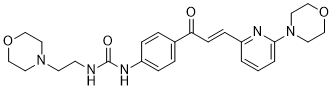
TRC051384 is an inducer of heat shock protein Hsp70, activating heat shock factor-1 and enhancing Hsp72 expression in neurons and glial cells.
Physicochemical Properties
| Molecular Formula | C25H31N5O4 |
| Molecular Weight | 465.54474568367 |
| Exact Mass | 501.214 |
| Elemental Analysis | C, 64.50; H, 6.71; N, 15.04; O, 13.75 |
| CAS # | 1333327-56-2 |
| Related CAS # | TRC051384;867164-40-7 |
| PubChem CID | 132350867 |
| Appearance | Light yellow to yellow solid powder |
| Hydrogen Bond Donor Count | 3 |
| Hydrogen Bond Acceptor Count | 7 |
| Rotatable Bond Count | 8 |
| Heavy Atom Count | 35 |
| Complexity | 670 |
| Defined Atom Stereocenter Count | 0 |
| SMILES | O1CCN(CCNC(NC2C=CC(C(/C=C/C3=CC=CC(=N3)N3CCOCC3)=O)=CC=2)=O)CC1 |
| InChi Key | BCOFJDCZCSLJAM-HRNDJLQDSA-N |
| InChi Code | InChI=1S/C25H31N5O4.ClH/c31-23(9-8-21-2-1-3-24(27-21)30-14-18-34-19-15-30)20-4-6-22(7-5-20)28-25(32)26-10-11-29-12-16-33-17-13-29;/h1-9H,10-19H2,(H2,26,28,32);1H/b9-8+; |
| Chemical Name | 1-(2-morpholin-4-ylethyl)-3-[4-[(E)-3-(6-morpholin-4-ylpyridin-2-yl)prop-2-enoyl]phenyl]urea;hydrochloride |
| Synonyms | TRC051384; TRC 051384; TRC-051384. |
| HS Tariff Code | 2934.99.9001 |
| Storage |
Powder-20°C 3 years 4°C 2 years In solvent -80°C 6 months -20°C 1 month |
| Shipping Condition | Room temperature (This product is stable at ambient temperature for a few days during ordinary shipping and time spent in Customs) |
Biological Activity
| Targets |
Induces human/rat Heat Shock Protein 70 (HSP70) expression (no direct binding target; exerts effects via inducing HSP70 transcription/translation) [1] |
| ln Vitro |
TRC051384, in both HeLa and rat primary mixed neurons, dose-dependently increases HSP70B mRNA by several hundred fold. Treatment with TRC051384 causes luciferase activity to recover and HSF1 transcriptional activity to significantly increase in a dose-dependent manner. In differentiated THP-1 cell line, TRC051384 inhibits TNF-α expression caused by LPS by 60% at 6.25 μM and 90% at 12.5 μM[1]. Induces HSP70 expression: TRC051384 at 10, 25, and 50 μM increased HSP70 protein levels by ~2.0-fold, ~3.5-fold, and ~5.0-fold, respectively, in primary rat cortical neurons after 24-hour treatment (western blot detection) [1] - Protects against oxygen-glucose deprivation (OGD)-induced neuronal injury: Pretreatment with 25 μM TRC051384 for 24 hours increased neuronal survival rate from 35% (vehicle control) to 68% after 4-hour OGD followed by 24-hour reoxygenation (LDH release assay) [1] - Reduces neuronal apoptosis: 50 μM TRC051384 decreased OGD-induced neuronal apoptosis rate by ~55% and caspase-3 activity by ~40% (colorimetric assay) [1] - Low cytotoxicity: Normal primary cortical neuron viability remained >90% at concentrations up to 100 μM (MTT assay) [1] |
| ln Vivo |
Treatment with TRC051384 dramatically lowers stroke associated neuronal injury (87% reduction in area of penumbra recruited to infarct, and 25% reduction in brain edema) and impairment in a rat model of transient ischemic stroke even when administered 8 hours post start of ischemia. When TRC051384 medication is started four hours after ischemia onset, there is a significant improvement in survival (50% by day two and 67.3% by day seven). Induction of HSP70 by TRC051384 includes HSF1 activation and leads in enhanced chaperone and anti-inflammatory activity[1]. Attenuates brain injury in rat middle cerebral artery occlusion (MCAO) model: Intraperitoneal injection of TRC051384 (10, 30 mg/kg) at 6 hours post-MCAO reduced cerebral infarct volume by ~30% and ~55%, respectively, at 24 hours post-infarction (TTC staining) [1] - Improves neurological deficits: The 30 mg/kg dose decreased neurological deficit score (0-5 scale, 0 = normal, 5 = severe hemiplegia) from 3.8 to 1.6, significantly enhancing motor coordination and balance (rotarod test, adhesive removal test) [1] - Induces HSP70 expression in brain tissue: 24 hours after 30 mg/kg administration, HSP70 protein expression in the ischemic cerebral cortex of rats increased by ~4.2-fold (immunohistochemistry and western blot) [1] - Effective with delayed intervention: Administration of 30 mg/kg at 12 hours post-MCAO still reduced infarct volume by ~40%, indicating a broad therapeutic time window [1] |
| Cell Assay |
Primary cortical neuron culture and OGD model establishment: Rat embryonic cortical neurons were isolated, seeded in 96-well or 6-well plates, and cultured for 7 days. TRC051384 (1-100 μM) was added for pretreatment 24 hours before OGD. For OGD, medium was replaced with glucose-free Earle's solution, and cells were incubated in a hypoxic incubator (1% O2, 5% CO2, 94% N2) for 4 hours, followed by reoxygenation with normal medium for 24 hours [1] - HSP70 expression detection: After reoxygenation, cells were collected to extract total protein. HSP70 protein levels were detected by western blot with β-actin as the internal reference, and relative expression was quantified [1] - Neuronal viability detection: For neurons in 96-well plates, LDH detection reagent was added after reoxygenation to measure LDH activity in the medium and calculate cell viability; alternatively, MTT assay was used to detect the absorbance of formazan crystals [1] - Apoptosis index detection: Cells in 6-well plates were collected, and caspase-3 activity was measured using a colorimetric assay kit after protein extraction; apoptosis rate was also detected by Annexin V-FITC/PI double staining and flow cytometry [1] |
| Animal Protocol |
Rat MCAO experimental stroke model: Male Sprague-Dawley rats (250-300 g) were subjected to middle cerebral artery occlusion by the intraluminal filament method to establish an ischemic stroke model. Successful modeling was confirmed by neurological deficit scoring (0-5 scale) after surgery [1] - Administration protocol: At 6 or 12 hours after model establishment, rats were randomly divided into vehicle and TRC051384 treatment groups (10, 30 mg/kg). The drug was dissolved in 5% DMSO + 95% normal saline and administered as a single intraperitoneal injection [1] - Detection indicators: At 24 hours post-administration, rats were anesthetized and decapitated to extract brains. Brains were cut into 2 mm-thick coronal slices for TTC staining, and infarct volume was analyzed with ImageJ software. Neurological function was evaluated (rotarod test: recording the time rats stayed on the rotating rod; adhesive removal test: recording the time rats took to remove adhesive from forelimbs). Part of the brain tissue was used for protein extraction or paraffin sectioning, and HSP70 expression was detected by western blot and immunohistochemistry [1] |
| Toxicity/Toxicokinetics |
Acute toxicity: No mortality or obvious behavioral abnormalities (e.g., ataxia, lethargy, anorexia) were observed in rats within 24 hours after a single intraperitoneal injection of TRC051384 up to 100 mg/kg [1] - No significant organ toxicity: At 24 hours after 30 mg/kg administration, liver and kidney function indicators (ALT, AST, creatinine, urea nitrogen) of rats showed no significant difference from the vehicle group, and histopathological examination of liver, kidney, and spleen showed no inflammation or damage [1] - Low in vitro cytotoxicity: Normal primary cortical neuron viability was >90% at concentrations ≤100 μM, with no obvious cell damage [1] |
| References |
[1]. Delayed intervention in experimental stroke with TRC051384--a small molecule HSP70 inducer. Neuropharmacology. 2011 May;60(6):991-9. [2]. HSP70 attenuates neuronal necroptosis through the HSP90α-RIPK3 pathway following neuronal trauma. Mol Biol Rep. 2023 Sep;50(9):7237-7244. |
| Additional Infomation |
TRC051384 is a small-molecule HSP70 inducer developed for delayed intervention in experimental ischemic stroke [1] - Core mechanism of action: Induces HSP70 expression in neurons, enhances cellular tolerance to ischemia-hypoxia injury, reduces neuronal apoptosis and necrosis, thereby alleviating cerebral infarct damage and improving neurological function [1] - Key advantage: Possesses a broad therapeutic time window, with effective infarct volume reduction even when administered 6-12 hours post-stroke, providing potential for delayed treatment in clinical stroke patients [1] - Potential therapeutic application: Treatment of ischemic stroke, especially in patients unable to receive timely thrombolytic therapy [1] - Research limitation: Efficacy and safety have only been verified in rat MCAO models, requiring further evaluation in higher animal models or clinical trials [1] |
Solubility Data
| Solubility (In Vitro) | May dissolve in DMSO (in most cases), if not, try other solvents such as H2O, Ethanol, or DMF with a minute amount of products to avoid loss of samples |
| Solubility (In Vivo) |
Note: Listed below are some common formulations that may be used to formulate products with low water solubility (e.g. < 1 mg/mL), you may test these formulations using a minute amount of products to avoid loss of samples. Injection Formulations (e.g. IP/IV/IM/SC) Injection Formulation 1: DMSO : Tween 80: Saline = 10 : 5 : 85 (i.e. 100 μL DMSO stock solution → 50 μL Tween 80 → 850 μL Saline) *Preparation of saline: Dissolve 0.9 g of sodium chloride in 100 mL ddH ₂ O to obtain a clear solution. Injection Formulation 2: DMSO : PEG300 :Tween 80 : Saline = 10 : 40 : 5 : 45 (i.e. 100 μL DMSO → 400 μLPEG300 → 50 μL Tween 80 → 450 μL Saline) Injection Formulation 3: DMSO : Corn oil = 10 : 90 (i.e. 100 μL DMSO → 900 μL Corn oil) Example: Take the Injection Formulation 3 (DMSO : Corn oil = 10 : 90) as an example, if 1 mL of 2.5 mg/mL working solution is to be prepared, you can take 100 μL 25 mg/mL DMSO stock solution and add to 900 μL corn oil, mix well to obtain a clear or suspension solution (2.5 mg/mL, ready for use in animals). Injection Formulation 4: DMSO : 20% SBE-β-CD in saline = 10 : 90 [i.e. 100 μL DMSO → 900 μL (20% SBE-β-CD in saline)] *Preparation of 20% SBE-β-CD in Saline (4°C,1 week): Dissolve 2 g SBE-β-CD in 10 mL saline to obtain a clear solution. Injection Formulation 5: 2-Hydroxypropyl-β-cyclodextrin : Saline = 50 : 50 (i.e. 500 μL 2-Hydroxypropyl-β-cyclodextrin → 500 μL Saline) Injection Formulation 6: DMSO : PEG300 : castor oil : Saline = 5 : 10 : 20 : 65 (i.e. 50 μL DMSO → 100 μLPEG300 → 200 μL castor oil → 650 μL Saline) Injection Formulation 7: Ethanol : Cremophor : Saline = 10: 10 : 80 (i.e. 100 μL Ethanol → 100 μL Cremophor → 800 μL Saline) Injection Formulation 8: Dissolve in Cremophor/Ethanol (50 : 50), then diluted by Saline Injection Formulation 9: EtOH : Corn oil = 10 : 90 (i.e. 100 μL EtOH → 900 μL Corn oil) Injection Formulation 10: EtOH : PEG300:Tween 80 : Saline = 10 : 40 : 5 : 45 (i.e. 100 μL EtOH → 400 μLPEG300 → 50 μL Tween 80 → 450 μL Saline) Oral Formulations Oral Formulation 1: Suspend in 0.5% CMC Na (carboxymethylcellulose sodium) Oral Formulation 2: Suspend in 0.5% Carboxymethyl cellulose Example: Take the Oral Formulation 1 (Suspend in 0.5% CMC Na) as an example, if 100 mL of 2.5 mg/mL working solution is to be prepared, you can first prepare 0.5% CMC Na solution by measuring 0.5 g CMC Na and dissolve it in 100 mL ddH2O to obtain a clear solution; then add 250 mg of the product to 100 mL 0.5% CMC Na solution, to make the suspension solution (2.5 mg/mL, ready for use in animals). Oral Formulation 3: Dissolved in PEG400 Oral Formulation 4: Suspend in 0.2% Carboxymethyl cellulose Oral Formulation 5: Dissolve in 0.25% Tween 80 and 0.5% Carboxymethyl cellulose Oral Formulation 6: Mixing with food powders Note: Please be aware that the above formulations are for reference only. InvivoChem strongly recommends customers to read literature methods/protocols carefully before determining which formulation you should use for in vivo studies, as different compounds have different solubility properties and have to be formulated differently. (Please use freshly prepared in vivo formulations for optimal results.) |
| Preparing Stock Solutions | 1 mg | 5 mg | 10 mg | |
| 1 mM | 2.1480 mL | 10.7402 mL | 21.4804 mL | |
| 5 mM | 0.4296 mL | 2.1480 mL | 4.2961 mL | |
| 10 mM | 0.2148 mL | 1.0740 mL | 2.1480 mL |