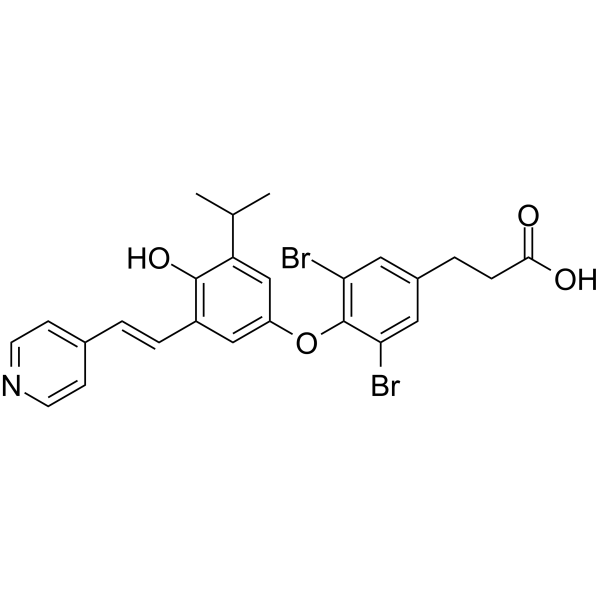
Physicochemical Properties
| Molecular Formula | C25H23BR2NO4 |
| Molecular Weight | 561.262425661087 |
| Exact Mass | 560.997 |
| CAS # | 500794-88-7 |
| PubChem CID | 135528521 |
| Appearance | Light yellow to yellow solid powder |
| LogP | 6.6 |
| Hydrogen Bond Donor Count | 2 |
| Hydrogen Bond Acceptor Count | 5 |
| Rotatable Bond Count | 8 |
| Heavy Atom Count | 32 |
| Complexity | 613 |
| Defined Atom Stereocenter Count | 0 |
| SMILES | BrC1C=C(C=C(C=1OC1C=C(/C=C/C2C=CN=CC=2)C(=C(C=1)C(C)C)O)Br)CCC(=O)O |
| InChi Key | JFQSWHAFVANRQE-HWKANZROSA-N |
| InChi Code | InChI=1S/C25H23Br2NO4/c1-15(2)20-14-19(13-18(24(20)31)5-3-16-7-9-28-10-8-16)32-25-21(26)11-17(12-22(25)27)4-6-23(29)30/h3,5,7-15,31H,4,6H2,1-2H3,(H,29,30)/b5-3+ |
| Chemical Name | 3-[3,5-dibromo-4-[4-hydroxy-3-propan-2-yl-5-[(E)-2-pyridin-4-ylethenyl]phenoxy]phenyl]propanoic acid |
| HS Tariff Code | 2934.99.9001 |
| Storage |
Powder-20°C 3 years 4°C 2 years In solvent -80°C 6 months -20°C 1 month Note: This product requires protection from light (avoid light exposure) during transportation and storage. |
| Shipping Condition | Room temperature (This product is stable at ambient temperature for a few days during ordinary shipping and time spent in Customs) |
Biological Activity
| Targets |
- The primary targets of TR antagonist 1 are thyroid hormone receptors (TR), including both TRα and TRβ subtypes. It exhibits high binding affinity to TRα with a Ki value of 0.3 nM, and to TRβ with a Ki value of 0.5 nM [1] |
| ln Vitro |
TR antagonist 1 has a high affinity (IC50 36 and 22 nM, respectively) for the thyroid hormones TRα and TRβ. With an IC50 of 32 nM for both TRAFα1 and TRAFβ1, TR Antagonist 1 functions as a complete antagonist in the TRAFR cellular assay [1]. - TR antagonist 1 acts as a "direct antagonist" of TR, with no agonist or inverse agonist activity. In a luciferase reporter gene assay using HEK293 cells transfected with TRα or TRβ, TR antagonist 1 (0.1–100 nM) dose-dependently inhibits triiodothyronine (T3)-induced TR activation. At 10 nM, it inhibits T3 (10 nM)-mediated TRα activation by 90% and TRβ activation by 85%, with IC₅₀ values of 0.8 nM (TRα) and 1.2 nM (TRβ) [1] - TR antagonist 1 shows high selectivity for TR over other nuclear receptors. At concentrations up to 1 μM, it does not bind to estrogen receptor (ER), progesterone receptor (PR), or glucocorticoid receptor (GR) (binding affinity <1% of TR binding), and does not modulate their transcriptional activity in reporter gene assays [1] |
| ln Vivo | In a rat model fed cholesterol, treatment with TR antagonist 1 lowers heart rate and may raise low-density lipoprotein cholesterol (LDL-C) [1]. |
| Enzyme Assay |
- TR Binding Assay: 1. Prepare recombinant human TRα and TRβ proteins (ligand-binding domains) and dilute them in binding buffer (containing Tris-HCl, EDTA, and 10% glycerol) to a concentration of 100 nM. 2. Add serial dilutions of TR antagonist 1 (0.01–10 nM) and a fixed concentration of [³H]-T3 (0.5 nM, a natural TR ligand) to the TR protein solution. Incubate the mixture at 4°C for 2 hours to reach binding equilibrium. 3. Separate bound and free [³H]-T3 using a gel filtration column equilibrated with binding buffer. Collect fractions containing TR-protein complexes and measure radioactivity using a liquid scintillation counter. 4. Calculate the Ki value using the Cheng-Prusoff equation, with non-specific binding defined by adding a 1000-fold excess of unlabeled T3. TR antagonist 1 shows Ki values of 0.3 nM (TRα) and 0.5 nM (TRβ) [1] - TR Transcriptional Activity Assay (Luciferase Reporter Assay): 1. Seed HEK293 cells in 96-well plates at a density of 5×10⁴ cells/well and incubate overnight in DMEM + 10% fetal bovine serum. 2. Co-transfect cells with TR expression plasmid (TRα or TRβ), thyroid hormone response element (TRE)-luciferase reporter plasmid, and Renilla luciferase plasmid (internal control) using transfection reagent. 3. After 24 hours of transfection, replace the medium with serum-free DMEM. Add TR antagonist 1 (0.1–100 nM) and T3 (10 nM) to the wells; the control group receives T3 alone or vehicle (DMSO, final concentration <0.1%). 4. Incubate for another 24 hours, then lyse cells with passive lysis buffer. Measure firefly luciferase and Renilla luciferase activities using a dual-luciferase reporter assay system. 5. Calculate relative luciferase activity (firefly/Renilla) and inhibition rate of T3-induced activation. TR antagonist 1 inhibits TRα and TRβ transcriptional activity with IC₅₀ values of 0.8 nM and 1.2 nM, respectively [1] |
| Cell Assay |
1. Culture HeLa cells (which endogenously express low levels of TR) in DMEM + 10% fetal bovine serum until 70% confluence. 2. Transfect cells with TRα plasmid and TRE-luciferase reporter plasmid using transfection reagent. Incubate for 24 hours to allow plasmid expression. 3. Treat cells with TR antagonist 1 (0.05–50 nM) and T3 (5 nM) for 20 hours. Set up three control groups: T3 alone, vehicle alone, and untransfected cells. 4. Wash cells twice with cold PBS, add cell lysis buffer, and collect lysates by scraping. Centrifuge at 10,000 × g for 5 minutes to remove cell debris. 5. Transfer 50 μL of supernatant to a white 96-well plate, add luciferase substrate, and measure luminescence intensity using a microplate reader. 6. The results show that TR antagonist 1 inhibits T3-induced luciferase activity in a dose-dependent manner: 5 nM TR antagonist 1 reduces luminescence by 75% compared to the T3-only group [1] |
| References |
[1]. Thyroid receptor ligands. 6. A high affinity "direct antagonist" selective for the thyroid hormone receptor. J Med Chem. 2006 Nov 16;49(23):6635-7. |
| Additional Infomation |
- TR antagonist 1 is a synthetic small-molecule thyroid hormone receptor antagonist, classified as a "direct antagonist" because it binds to TR without inducing conformational changes that trigger agonist or inverse agonist activity [1] - The structural design of TR antagonist 1 includes a central benzene ring with specific hydrophobic substituents (e.g., isopropyl, methoxy groups) and a carboxamide moiety, which are critical for high TR binding affinity and selectivity. These substituents form hydrophobic interactions with the TR ligand-binding pocket, preventing T3 from binding and activating the receptor [1] - TR antagonist 1 represents a potential lead compound for the treatment of thyroid hormone excess-related diseases (e.g., Graves' disease, thyrotoxicosis), as its high TR selectivity and lack of off-target activity minimize the risk of adverse effects associated with non-specific nuclear receptor modulation [1] |
Solubility Data
| Solubility (In Vitro) | DMSO : ≥ 83.3 mg/mL (~148.42 mM) |
| Solubility (In Vivo) |
Note: Listed below are some common formulations that may be used to formulate products with low water solubility (e.g. < 1 mg/mL), you may test these formulations using a minute amount of products to avoid loss of samples. Injection Formulations (e.g. IP/IV/IM/SC) Injection Formulation 1: DMSO : Tween 80: Saline = 10 : 5 : 85 (i.e. 100 μL DMSO stock solution → 50 μL Tween 80 → 850 μL Saline) *Preparation of saline: Dissolve 0.9 g of sodium chloride in 100 mL ddH ₂ O to obtain a clear solution. Injection Formulation 2: DMSO : PEG300 :Tween 80 : Saline = 10 : 40 : 5 : 45 (i.e. 100 μL DMSO → 400 μLPEG300 → 50 μL Tween 80 → 450 μL Saline) Injection Formulation 3: DMSO : Corn oil = 10 : 90 (i.e. 100 μL DMSO → 900 μL Corn oil) Example: Take the Injection Formulation 3 (DMSO : Corn oil = 10 : 90) as an example, if 1 mL of 2.5 mg/mL working solution is to be prepared, you can take 100 μL 25 mg/mL DMSO stock solution and add to 900 μL corn oil, mix well to obtain a clear or suspension solution (2.5 mg/mL, ready for use in animals). Injection Formulation 4: DMSO : 20% SBE-β-CD in saline = 10 : 90 [i.e. 100 μL DMSO → 900 μL (20% SBE-β-CD in saline)] *Preparation of 20% SBE-β-CD in Saline (4°C,1 week): Dissolve 2 g SBE-β-CD in 10 mL saline to obtain a clear solution. Injection Formulation 5: 2-Hydroxypropyl-β-cyclodextrin : Saline = 50 : 50 (i.e. 500 μL 2-Hydroxypropyl-β-cyclodextrin → 500 μL Saline) Injection Formulation 6: DMSO : PEG300 : castor oil : Saline = 5 : 10 : 20 : 65 (i.e. 50 μL DMSO → 100 μLPEG300 → 200 μL castor oil → 650 μL Saline) Injection Formulation 7: Ethanol : Cremophor : Saline = 10: 10 : 80 (i.e. 100 μL Ethanol → 100 μL Cremophor → 800 μL Saline) Injection Formulation 8: Dissolve in Cremophor/Ethanol (50 : 50), then diluted by Saline Injection Formulation 9: EtOH : Corn oil = 10 : 90 (i.e. 100 μL EtOH → 900 μL Corn oil) Injection Formulation 10: EtOH : PEG300:Tween 80 : Saline = 10 : 40 : 5 : 45 (i.e. 100 μL EtOH → 400 μLPEG300 → 50 μL Tween 80 → 450 μL Saline) Oral Formulations Oral Formulation 1: Suspend in 0.5% CMC Na (carboxymethylcellulose sodium) Oral Formulation 2: Suspend in 0.5% Carboxymethyl cellulose Example: Take the Oral Formulation 1 (Suspend in 0.5% CMC Na) as an example, if 100 mL of 2.5 mg/mL working solution is to be prepared, you can first prepare 0.5% CMC Na solution by measuring 0.5 g CMC Na and dissolve it in 100 mL ddH2O to obtain a clear solution; then add 250 mg of the product to 100 mL 0.5% CMC Na solution, to make the suspension solution (2.5 mg/mL, ready for use in animals). Oral Formulation 3: Dissolved in PEG400 Oral Formulation 4: Suspend in 0.2% Carboxymethyl cellulose Oral Formulation 5: Dissolve in 0.25% Tween 80 and 0.5% Carboxymethyl cellulose Oral Formulation 6: Mixing with food powders Note: Please be aware that the above formulations are for reference only. InvivoChem strongly recommends customers to read literature methods/protocols carefully before determining which formulation you should use for in vivo studies, as different compounds have different solubility properties and have to be formulated differently. (Please use freshly prepared in vivo formulations for optimal results.) |
| Preparing Stock Solutions | 1 mg | 5 mg | 10 mg | |
| 1 mM | 1.7817 mL | 8.9085 mL | 17.8171 mL | |
| 5 mM | 0.3563 mL | 1.7817 mL | 3.5634 mL | |
| 10 mM | 0.1782 mL | 0.8909 mL | 1.7817 mL |