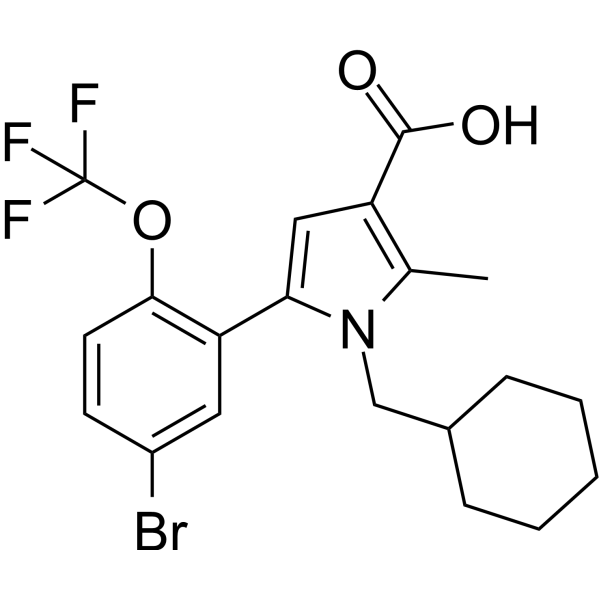
Physicochemical Properties
| Molecular Formula | C20H21BRF3NO3 |
| Molecular Weight | 460.284855604172 |
| Exact Mass | 459.065 |
| CAS # | 2804595-86-4 |
| PubChem CID | 154730265 |
| Appearance | White to light yellow solid powder |
| LogP | 6.4 |
| Hydrogen Bond Donor Count | 1 |
| Hydrogen Bond Acceptor Count | 6 |
| Rotatable Bond Count | 5 |
| Heavy Atom Count | 28 |
| Complexity | 541 |
| Defined Atom Stereocenter Count | 0 |
| InChi Key | INDFMVADKKBSSU-UHFFFAOYSA-N |
| InChi Code | InChI=1S/C20H21BrF3NO3/c1-12-15(19(26)27)10-17(25(12)11-13-5-3-2-4-6-13)16-9-14(21)7-8-18(16)28-20(22,23)24/h7-10,13H,2-6,11H2,1H3,(H,26,27) |
| Chemical Name | 5-[5-bromo-2-(trifluoromethoxy)phenyl]-1-(cyclohexylmethyl)-2-methylpyrrole-3-carboxylic acid |
| HS Tariff Code | 2934.99.9001 |
| Storage |
Powder-20°C 3 years 4°C 2 years In solvent -80°C 6 months -20°C 1 month |
| Shipping Condition | Room temperature (This product is stable at ambient temperature for a few days during ordinary shipping and time spent in Customs) |
Biological Activity
| Targets | EC50: 10.5 μM (TPC2)[2] |
| ln Vitro | Ancient members of the voltage-gated ion channel superfamily are known as two-pore channels (TPC1-3). TPCs govern the trafficking of many payloads and are expressed throughout the endo-lysosomal system[1]. Depending on how it is triggered, TPC2 can mediate various physiological and potentially pathological effects. TPC2's ion selectivity is agonist-dependent rather than fixed. One special type of ion channel that responds to various activating ligands by conducting distinct ions is TPC2[1]. Does TPC2-A1- P (10 μM) consistently elicit Ca2+?signals, and compared to TPC2-A1-N, the TPC2-A1-P response reaches its plateau more slowly. The 50th EC?In a cell line that consistently expresses TPC2L11A/L12A, the entire concentration-effect relationships for the plateau response are 10.5 μM for TPC2-A1-P. TPC2-A1-P generates Ca2+ at 10-30 μM?signals in Hela cells that express TPC2 when extracellular Ca2+ is present but not absent. In contrast to TPC2-A1-N, the reactions are smaller and more gradual, which is in line with the outcomes seen in cells that express TPC2L11A/L12A stable. Can't TPC2-A1-P induce Ca2+?signals in cells that do not elicit Ca2+ influx and express "pore-dead" TPC2L11A/L12A/L265P?signals were redirected to the plasma membrane (TRPML1ΔNC) in cells expressing human TRPML1[1]. Endo-lysosomes isolated from cells expressing TPC2 and TPC2M484L exhibit currents evoked by TPC2-A1-P (10 μM) in endo-lysosomal patch-clamp experiments. The currents evoked by TPC2-A1-P are significantly larger than those evoked by TPC2-A1-N in both wild-type and gain-of-function variant, and exhibit an EC50?0.6 μM was the result for TPC2-A1 -P[1]. |
| References |
[1]. Agonist-mediated switching of ion selectivity in TPC2 differentially promotes lysosomal function. Elife. 2020 Mar 16;9:e54712. [2]. Discovery of lipophilic two-pore channel agonists. FEBS J. 2020;287(24):5284-5293. [3]. Targeting Two-Pore Channels: Current Progress and Future Challenges. Trends Pharmacol Sci. 2020 Aug;41(8):582-594. |
Solubility Data
| Solubility (In Vitro) | DMSO: 50 mg/mL (108.63 mM) |
| Solubility (In Vivo) |
Solubility in Formulation 1: ≥ 2.5 mg/mL (5.43 mM) (saturation unknown) in 10% DMSO + 90% Corn Oil (add these co-solvents sequentially from left to right, and one by one), clear solution. For example, if 1 mL of working solution is to be prepared, you can add 100 μL of 25.0 mg/mL clear DMSO stock solution to 900 μL of corn oil and mix evenly. (Please use freshly prepared in vivo formulations for optimal results.) |
| Preparing Stock Solutions | 1 mg | 5 mg | 10 mg | |
| 1 mM | 2.1726 mL | 10.8630 mL | 21.7259 mL | |
| 5 mM | 0.4345 mL | 2.1726 mL | 4.3452 mL | |
| 10 mM | 0.2173 mL | 1.0863 mL | 2.1726 mL |