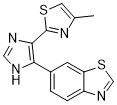
TP0427736 is a novel, potent and selective inhibitor of ALK5 kinase with IC50 value of 2.72 nM and appropriate in vitro and in vivo profiles. The inhibitory effect on ALK5 kinase is 300-fold higher than thaton ALK3 (IC50 = 836 nM for ALK3). It also inhibits Smad2/3 phosphorylation in A549 cells induced by TGF-β1 with an IC50 value of 8.68 nM. TP0427736 inhibited ALK5 kinase activity with an IC50 of 2.72nM; this effect was 300-fold higher than the inhibitory effect on ALK3. In cell-based assays, TP0427736 inhibited Smad2/3 phosphorylation in A549 cells and decreased the growth inhibition of human outer root sheath cells. The topical application of TP0427736 significantly decreased Smad2 phosphorylation in mouse skin, and its repeated application suppressed the shortening of average hair follicle length during the transition from the late anagen phase to the catagen phase. TP0427736 may serve as a potential new therapy for AGA (Androgenic alopecia), which occurs as a result of the contraction of the anagen phase because of the action of androgens on hair follicles. TGF-β production from dermal papillae is enhanced by androgens, and growth inhibition of hair-follicle cells is induced by TGF-β, and the hair cycle progresses from the anagen phase to the catagen phase.
Physicochemical Properties
| Molecular Formula | C14H10N4S2 | |
| Molecular Weight | 298.38 | |
| Exact Mass | 298.034 | |
| CAS # | 864374-00-5 | |
| Related CAS # | TP0427736 hydrochloride;2459963-17-6 | |
| PubChem CID | 136105618 | |
| Appearance | Typically exists as solid at room temperature | |
| Density | 1.4±0.1 g/cm3 | |
| Boiling Point | 634.7±65.0 °C at 760 mmHg | |
| Flash Point | 333.8±24.7 °C | |
| Vapour Pressure | 0.0±1.8 mmHg at 25°C | |
| Index of Refraction | 1.740 | |
| LogP | 3.37 | |
| Hydrogen Bond Donor Count | 1 | |
| Hydrogen Bond Acceptor Count | 5 | |
| Rotatable Bond Count | 2 | |
| Heavy Atom Count | 20 | |
| Complexity | 356 | |
| Defined Atom Stereocenter Count | 0 | |
| SMILES | CC1=CSC(C2N=CNC=2C2=CC=C3N=CSC3=C2)=N1 |
|
| InChi Key | LLFCXRYULHMNCG-UHFFFAOYSA-N | |
| InChi Code | InChI=1S/C14H10N4S2/c1-8-5-19-14(18-8)13-12(15-6-16-13)9-2-3-10-11(4-9)20-7-17-10/h2-7H,1H3,(H,15,16) | |
| Chemical Name |
|
|
| Synonyms |
|
|
| HS Tariff Code | 2934.99.9001 | |
| Storage |
Powder-20°C 3 years 4°C 2 years In solvent -80°C 6 months -20°C 1 month |
|
| Shipping Condition | Room temperature (This product is stable at ambient temperature for a few days during ordinary shipping and time spent in Customs) |
Biological Activity
| Targets |
Transforming Growth Factor-β Receptor I (ALK5/TGF-βRI) (IC₅₀=0.03 μM in recombinant ALK5 kinase assay) [1] |
| ln Vitro |
In vitro activity: TP0427736 is a novel, potent and selective inhibitor of ALK5 kinase with IC50 value of 2.72 nM and appropriate in vitro and in vivo profiles. The inhibitory effect on ALK5 kinase is 300-fold higher than thaton ALK3 (IC50 = 836 nM for ALK3). It also inhibits Smad2/3 phosphorylation in A549 cells induced by TGF-β1 with an IC50 value of 8.68 nM. TP0427736 inhibited ALK5 kinase activity with an IC50 of 2.72nM; this effect was 300-fold higher than the inhibitory effect on ALK3. In cell-based assays, TP0427736 inhibited Smad2/3 phosphorylation in A549 cells and decreased the growth inhibition of human outer root sheath cells. The topical application of TP0427736 significantly decreased Smad2 phosphorylation in mouse skin, and its repeated application suppressed the shortening of average hair follicle length during the transition from the late anagen phase to the catagen phase. TP0427736 may serve as a potential new therapy for AGA (Androgenic alopecia), which occurs as a result of the contraction of the anagen phase because of the action of androgens on hair follicles. TGF-β production from dermal papillae is enhanced by androgens, and growth inhibition of hair-follicle cells is induced by TGF-β, and the hair cycle progresses from the anagen phase to the catagen phase. Kinase Assay: TP0427736 inhibits Smad2/3 phosphorylation in a concentration-dependent manner, with an IC50 value of 8.68 nM. In a cell-based assay of outer root sheath cells, TP0427736 rescued the inhibited proliferation by TGF-β1 and TGF-β2 in a concentration-dependent manner Cell Assay: A549 cells are cultured in plates overnight at 37℃ in a 5% CO2, 95% air atmosphere. Cells are pretreated with various concentrations of TP0427736 or DMSO as a control for 2 h, followed by the addition of 1 ng/mL TGF-β1. After 1 h of incubation, the cells are washed with PBS and lysed with RIPA solution, then mixed with biotinylated anti-Smad2/3 antibody. The mixture is transferred to a streptavidin-coated 96 well plate and incubated for 2 h. The mixture is then discarded, and each well is treated with rabbit anti-phosphoserine antibody, followed by Eu-labeled anti-rabbit IgG antibody and DELFIA Enhancement solution. The developed fluorescence is measured using an ARVO multi-label counter. The IC50 values are determined by analyzing the concentration-response curves. TP0427736 is a potent and selective inhibitor of ALK5 (TGF-βRI), specifically blocking TGF-β-mediated signaling pathways [1] - Inhibits recombinant human ALK5 kinase activity with an IC₅₀ of 0.03 μM, showing high potency against the target kinase [1] - Reduces TGF-β₁-induced growth inhibition in human outer root sheath cells (HORSCs): TGF-β₁ (5 ng/mL) alone inhibits HORSC proliferation by 45% compared to vehicle control; co-treatment with TP0427736 (0.01–1 μM) dose-dependently reverses this inhibition, with 1 μM achieving 90% recovery of cell proliferation (p<0.001) [1] - Blocks TGF-β₁-induced Smad2/3 phosphorylation in HORSCs: Western blot analysis shows that TP0427736 (0.03–1 μM) dose-dependently reduces phosphorylated Smad2/3 (p-Smad2/3) levels, with 0.3 μM inhibiting p-Smad2/3 by 75% compared to TGF-β₁-treated group; total Smad2/3 levels remain unchanged [1] - Downregulates TGF-β₁-induced target gene expression in HORSCs: qPCR analysis reveals that TP0427736 (0.1–1 μM) reduces mRNA levels of p21 (cell cycle inhibitor) and PAI-1 (plasminogen activator inhibitor-1) by 40–65% and 50–70%, respectively, in TGF-β₁-stimulated HORSCs [1] - Shows no significant cytotoxicity to HORSCs at concentrations up to 10 μM: Cell viability assay (CCK-8) shows >95% viability compared to vehicle control after 72 hours of treatment [1] |
| ln Vivo |
Elongates the anagen phase of hair follicles in C57BL/6 mice: Mice were depilated to synchronize hair follicle cycling, then treated with TP0427736 (1 mg/kg, 3 mg/kg, 10 mg/kg) or vehicle via intraperitoneal injection once daily for 21 days. At day 21, the 10 mg/kg group shows significantly longer hair length (12.5 ± 1.3 mm vs 8.2 ± 0.9 mm in vehicle group, p<0.01) and a higher proportion of anagen-phase hair follicles (85% vs 52% in vehicle group, p<0.001) [1] - Promotes hair follicle proliferation in vivo: Histopathological analysis of mouse skin shows that TP0427736 (10 mg/kg) increases the number of proliferating cells in hair follicles (Ki-67-positive cells) by 60% compared to vehicle control [1] - Reduces TGF-β-mediated Smad activation in mouse skin: Western blot of skin homogenates from the 10 mg/kg treatment group shows a 58% reduction in p-Smad2/3 levels compared to vehicle group, confirming in vivo inhibition of ALK5 signaling [1] |
| Enzyme Assay |
Recombinant ALK5 kinase activity assay (HTRF-based): Recombinant human ALK5 kinase (catalytic domain) is diluted in assay buffer (50 mM Tris-HCl pH 7.5, 10 mM MgCl₂, 1 mM EGTA, 0.01% BSA, 1 mM DTT). Serial 3-fold dilutions of TP0427736 (0.001–1 μM) are mixed with the kinase and pre-incubated for 30 minutes at room temperature. The reaction is initiated by adding ATP (final concentration 5 μM) and biotinylated peptide substrate (derived from Smad3, final concentration 2 μM), followed by incubation at 37°C for 60 minutes. The reaction is stopped with 50 mM EDTA, and phosphorylated substrate is detected using streptavidin-conjugated beads and anti-phospho-Smad3 antibody. Fluorescence intensity is measured, and IC₅₀ values are calculated via nonlinear regression analysis [1] |
| Cell Assay |
HORSC proliferation assay: Human outer root sheath cells are isolated and seeded in 96-well plates (3×10³ cells/well) in keratinocyte growth medium. After 24 hours of attachment, cells are pre-treated with TP0427736 (0.01–10 μM) for 1 hour, then stimulated with TGF-β₁ (5 ng/mL) for 72 hours. Cell viability is detected by CCK-8 assay, and proliferation rate is calculated relative to vehicle control (without TGF-β₁ and drug) [1] - Western blot for Smad2/3 phosphorylation: HORSCs are seeded in 6-well plates (2×10⁵ cells/well) and pre-treated with TP0427736 (0.03–1 μM) for 1 hour, followed by TGF-β₁ (5 ng/mL) stimulation for 1 hour. Cells are lysed, proteins are separated by SDS-PAGE, transferred to PVDF membranes, and probed with antibodies against p-Smad2 (Ser465/467), p-Smad3 (Ser423/425), total Smad2/3, and β-actin (loading control). Band intensity is quantified using image analysis software [1] - qPCR for TGF-β target genes: HORSCs are treated with TP0427736 (0.1–1 μM) + TGF-β₁ (5 ng/mL) for 24 hours. Total RNA is extracted, reverse-transcribed into cDNA, and qPCR is performed to detect mRNA expression of p21 (CDKN1A) and PAI-1 (SERPINE1). GAPDH is used as an internal reference gene [1] |
| Animal Protocol |
Mouse hair follicle cycle assay: C57BL/6 mice (6–8 weeks old, male) are depilated on the dorsal skin to synchronize hair follicle cycling (inducing telogen phase). One day after depilation, mice are randomized into vehicle control and treatment groups (n=6/group). TP0427736 is formulated in 0.5% carboxymethylcellulose sodium (CMC-Na) + 0.1% Tween 80 and administered via intraperitoneal injection at doses of 1 mg/kg, 3 mg/kg, or 10 mg/kg once daily for 21 days. Vehicle control mice receive the same volume of 0.5% CMC-Na + 0.1% Tween 80. Hair length is measured every 7 days using a digital caliper. At day 21, mice are euthanized, and dorsal skin samples are collected for histopathological analysis (H&E staining) to determine the proportion of anagen-phase hair follicles. Immunohistochemistry for Ki-67 is performed to evaluate cell proliferation in hair follicles [1] |
| Toxicity/Toxicokinetics |
In vivo tolerability: No significant changes in body weight, food intake, or general health status are observed in mice treated with TP0427736 at doses up to 10 mg/kg/day for 21 days. Histopathological examination of major organs (liver, kidney, heart, lung) shows no abnormal lesions [1] |
| References |
[1]. Novel ALK5 inhibitor TP0427736 reduces TGF-βinduced growth inhibition in human outer root sheath cells and elongates anagen phase in mouse hair follicles. Pharmacol Rep. 2017 Jun;69(3):485-491. |
| Additional Infomation |
TP0427736 is a novel, potent, and selective ALK5 (TGF-βRI) inhibitor developed for the potential treatment of hair loss (alopecia) [1] - Its mechanism of action involves specific inhibition of ALK5 kinase activity, blocking TGF-β-mediated Smad2/3 phosphorylation and downstream signaling, thereby reversing TGF-β-induced growth inhibition of human outer root sheath cells (key cells in hair follicles) and prolonging the anagen (growth) phase of hair follicles in mice [1] - TGF-β signaling is known to promote hair follicle entry into catagen (regression) phase; inhibition of this pathway by TP0427736 represents a potential therapeutic strategy for hair loss disorders characterized by premature catagen induction [1] - The compound shows high potency against ALK5 with no significant cytotoxicity in vitro and good tolerability in vivo, supporting further development for dermatological applications [1] |
Solubility Data
| Solubility (In Vitro) |
|
|||
| Solubility (In Vivo) |
Note: Listed below are some common formulations that may be used to formulate products with low water solubility (e.g. < 1 mg/mL), you may test these formulations using a minute amount of products to avoid loss of samples. Injection Formulations (e.g. IP/IV/IM/SC) Injection Formulation 1: DMSO : Tween 80: Saline = 10 : 5 : 85 (i.e. 100 μL DMSO stock solution → 50 μL Tween 80 → 850 μL Saline) *Preparation of saline: Dissolve 0.9 g of sodium chloride in 100 mL ddH ₂ O to obtain a clear solution. Injection Formulation 2: DMSO : PEG300 :Tween 80 : Saline = 10 : 40 : 5 : 45 (i.e. 100 μL DMSO → 400 μLPEG300 → 50 μL Tween 80 → 450 μL Saline) Injection Formulation 3: DMSO : Corn oil = 10 : 90 (i.e. 100 μL DMSO → 900 μL Corn oil) Example: Take the Injection Formulation 3 (DMSO : Corn oil = 10 : 90) as an example, if 1 mL of 2.5 mg/mL working solution is to be prepared, you can take 100 μL 25 mg/mL DMSO stock solution and add to 900 μL corn oil, mix well to obtain a clear or suspension solution (2.5 mg/mL, ready for use in animals). Injection Formulation 4: DMSO : 20% SBE-β-CD in saline = 10 : 90 [i.e. 100 μL DMSO → 900 μL (20% SBE-β-CD in saline)] *Preparation of 20% SBE-β-CD in Saline (4°C,1 week): Dissolve 2 g SBE-β-CD in 10 mL saline to obtain a clear solution. Injection Formulation 5: 2-Hydroxypropyl-β-cyclodextrin : Saline = 50 : 50 (i.e. 500 μL 2-Hydroxypropyl-β-cyclodextrin → 500 μL Saline) Injection Formulation 6: DMSO : PEG300 : castor oil : Saline = 5 : 10 : 20 : 65 (i.e. 50 μL DMSO → 100 μLPEG300 → 200 μL castor oil → 650 μL Saline) Injection Formulation 7: Ethanol : Cremophor : Saline = 10: 10 : 80 (i.e. 100 μL Ethanol → 100 μL Cremophor → 800 μL Saline) Injection Formulation 8: Dissolve in Cremophor/Ethanol (50 : 50), then diluted by Saline Injection Formulation 9: EtOH : Corn oil = 10 : 90 (i.e. 100 μL EtOH → 900 μL Corn oil) Injection Formulation 10: EtOH : PEG300:Tween 80 : Saline = 10 : 40 : 5 : 45 (i.e. 100 μL EtOH → 400 μLPEG300 → 50 μL Tween 80 → 450 μL Saline) Oral Formulations Oral Formulation 1: Suspend in 0.5% CMC Na (carboxymethylcellulose sodium) Oral Formulation 2: Suspend in 0.5% Carboxymethyl cellulose Example: Take the Oral Formulation 1 (Suspend in 0.5% CMC Na) as an example, if 100 mL of 2.5 mg/mL working solution is to be prepared, you can first prepare 0.5% CMC Na solution by measuring 0.5 g CMC Na and dissolve it in 100 mL ddH2O to obtain a clear solution; then add 250 mg of the product to 100 mL 0.5% CMC Na solution, to make the suspension solution (2.5 mg/mL, ready for use in animals). Oral Formulation 3: Dissolved in PEG400 Oral Formulation 4: Suspend in 0.2% Carboxymethyl cellulose Oral Formulation 5: Dissolve in 0.25% Tween 80 and 0.5% Carboxymethyl cellulose Oral Formulation 6: Mixing with food powders Note: Please be aware that the above formulations are for reference only. InvivoChem strongly recommends customers to read literature methods/protocols carefully before determining which formulation you should use for in vivo studies, as different compounds have different solubility properties and have to be formulated differently. (Please use freshly prepared in vivo formulations for optimal results.) |
| Preparing Stock Solutions | 1 mg | 5 mg | 10 mg | |
| 1 mM | 3.3514 mL | 16.7572 mL | 33.5143 mL | |
| 5 mM | 0.6703 mL | 3.3514 mL | 6.7029 mL | |
| 10 mM | 0.3351 mL | 1.6757 mL | 3.3514 mL |