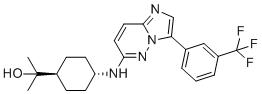
TP-3654 is a novel and potent inhibitor of Pim-1 and Pim-3 (proviral integration site for moloney murine leukemia virus) kinase that is potentially useful for the treatment of various cancers such as prostate cancer, acute myeloid leukemia, multiple sclerosis and psoriasis. As a second-generation PIM inhibitor, TP-3654 displays submicromolar activity with Ki values of 5 and 42 nM for Pim-1 and Pim-3, respectively in pharmacodynamic biomarker modulation, cell proliferation studies, and colony formation assays using the UM-UC-3 bladder cancer cell line. TP-3654 demostrates favorable human ether-à-go-go-related gene and cytochrome P450 inhibition profiles compared with the first-generation PIM inhibitor, SGI-1776, and exhibits oral bioavailability. In vivo xenograft studies using a bladder cancer cell line show that PIM kinase inhibition can reduce tumor growth, suggesting that PIM kinase inhibitors may be active in human urothelial carcinomas.
Physicochemical Properties
| Molecular Formula | C22H25F3N4O | |
| Molecular Weight | 418.4553 | |
| Exact Mass | 418.198 | |
| CAS # | 1361951-15-6 | |
| Related CAS # | 1418143-09-5 (HCl);1361951-15-6; | |
| PubChem CID | 66598080 | |
| Appearance | White to light yellow solid powder | |
| LogP | 4.6 | |
| Hydrogen Bond Donor Count | 2 | |
| Hydrogen Bond Acceptor Count | 7 | |
| Rotatable Bond Count | 4 | |
| Heavy Atom Count | 30 | |
| Complexity | 579 | |
| Defined Atom Stereocenter Count | 0 | |
| SMILES | FC(C1=C([H])C([H])=C([H])C(=C1[H])C1=C([H])N=C2C([H])=C([H])C(=NN21)N([H])C1([H])C([H])([H])C([H])([H])C([H])(C(C([H])([H])[H])(C([H])([H])[H])O[H])C([H])([H])C1([H])[H])(F)F |
|
| InChi Key | XRNVABDYQLHODA-UHFFFAOYSA-N | |
| InChi Code | InChI=1S/C22H25F3N4O/c1-21(2,30)15-6-8-17(9-7-15)27-19-10-11-20-26-13-18(29(20)28-19)14-4-3-5-16(12-14)22(23,24)25/h3-5,10-13,15,17,30H,6-9H2,1-2H3,(H,27,28) | |
| Chemical Name | 2-[4-[[3-[3-(trifluoromethyl)phenyl]imidazo[1,2-b]pyridazin-6-yl]amino]cyclohexyl]propan-2-ol | |
| Synonyms |
|
|
| HS Tariff Code | 2934.99.9001 | |
| Storage |
Powder-20°C 3 years 4°C 2 years In solvent -80°C 6 months -20°C 1 month |
|
| Shipping Condition | Room temperature (This product is stable at ambient temperature for a few days during ordinary shipping and time spent in Customs) |
Biological Activity
| Targets | Pim-1 (Ki=5 nM); Pim-2 (Ki=239 nM); Pim-3 (Ki=42 nM) |
| ln Vitro | In the PIM-1/BAD overexpression system, TP-3654 exhibits strong PIM-1 specific cellular action with an average EC50 of 67 nM. TP-3654 therapy lowers phospho-BAD levels in vitro using UM-UC-3 bladder cancer cell line. T24 and UM-UC3 cell colony growth is inhibited by TP-3654, indicating that PIM-1 is required for the proliferation of these two cell lines[1]. |
| ln Vivo | With no appreciable changes in body weight or gross adverse toxicity, oral dosage of 200 mg/kg TP-3654 significantly reduces both UM-UC-3 and PC-3 tumor growth as measured by volume (caliper) and final tumor weight[1]. |
| Cell Assay | TP-3654 is tested against 336 kinases at 10 μM ATP concentration. IC50 determinations of PI3K and all inhibited kinases are performed using 10-dose, three-fold serial dilutions of TP-3654 starting with 10 μM at Km ATP concentrations for each kinase.[1]. |
| Animal Protocol | The study involved mice with tumors measuring 100-200 mm3 and randomized to receive oral dosing of TP-3654 or vehicle control every day for 5 days, with 2 days off for 18-21 days, and tumor volumes and body weights determined weekly[1]. |
| References |
[1]. A small-molecule inhibitor of PIM kinases as a potential treatment for urothelial carcinomas. Neoplasia. 2014 May;16(5):403-12. |
| Additional Infomation | Nuvisertib is an orally available, second-generation and selective ATP-competitive inhibitor of proviral integration site for Moloney murine leukemia virus (PIM) kinases, with potential antineoplastic activity. Upon oral administration, nuvisertib selectively binds to and prevents the activation of the PIM kinases. This prevents the activation of PIM-mediated signaling pathways and inhibits proliferation in cells that overexpress PIM. PIMs, constitutively active proto-oncogenic serine/threonine kinases, are upregulated in various types of cancers and play key roles in tumor cell proliferation and survival. |
Solubility Data
| Solubility (In Vitro) |
DMSO: ~84 mg/mL ( 200.73 mM) Water: <6 mg/mL Ethanol: Insoluble |
| Solubility (In Vivo) |
Solubility in Formulation 1: 2.5 mg/mL (5.97 mM) in 10% DMSO + 90% (20% SBE-β-CD in Saline) (add these co-solvents sequentially from left to right, and one by one), suspension solution; with sonication. For example, if 1 mL of working solution is to be prepared, you can add 100 μL of 25.0 mg/mL clear DMSO stock solution to 900 μL of 20% SBE-β-CD physiological saline solution and mix evenly. Preparation of 20% SBE-β-CD in Saline (4°C,1 week): Dissolve 2 g SBE-β-CD in 10 mL saline to obtain a clear solution. Solubility in Formulation 2: ≥ 2.08 mg/mL (4.97 mM) (saturation unknown) in 10% DMSO + 40% PEG300 + 5% Tween80 + 45% Saline (add these co-solvents sequentially from left to right, and one by one), clear solution. For example, if 1 mL of working solution is to be prepared, you can add 100 μL of 20.8 mg/mL clear DMSO stock solution to 400 μL PEG300 and mix evenly; then add 50 μL Tween-80 to the above solution and mix evenly; then add 450 μL normal saline to adjust the volume to 1 mL. Preparation of saline: Dissolve 0.9 g of sodium chloride in 100 mL ddH₂ O to obtain a clear solution. Solubility in Formulation 3: ≥ 2.08 mg/mL (4.97 mM) (saturation unknown) in 10% DMSO + 90% Corn Oil (add these co-solvents sequentially from left to right, and one by one), clear solution. For example, if 1 mL of working solution is to be prepared, you can add 100 μL of 20.8 mg/mL clear DMSO stock solution to 900 μL of corn oil and mix evenly. (Please use freshly prepared in vivo formulations for optimal results.) |
| Preparing Stock Solutions | 1 mg | 5 mg | 10 mg | |
| 1 mM | 2.3897 mL | 11.9486 mL | 23.8971 mL | |
| 5 mM | 0.4779 mL | 2.3897 mL | 4.7794 mL | |
| 10 mM | 0.2390 mL | 1.1949 mL | 2.3897 mL |