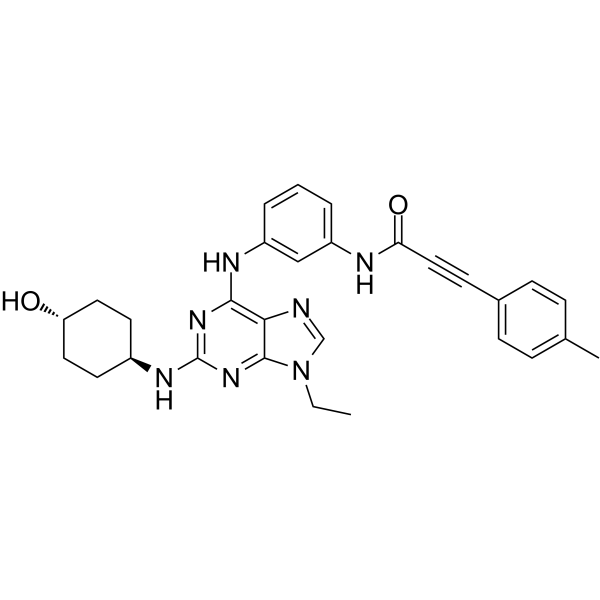
Physicochemical Properties
| Molecular Formula | C29H31N7O2 |
| Molecular Weight | 509.6021 |
| Exact Mass | 509.253 |
| CAS # | 289479-94-3 |
| PubChem CID | 69828124 |
| Appearance | White to off-white solid powder |
| LogP | 5 |
| Hydrogen Bond Donor Count | 4 |
| Hydrogen Bond Acceptor Count | 7 |
| Rotatable Bond Count | 7 |
| Heavy Atom Count | 38 |
| Complexity | 842 |
| Defined Atom Stereocenter Count | 0 |
| SMILES | O([H])C1([H])C([H])([H])C([H])([H])C([H])(C([H])([H])C1([H])[H])N([H])C1=NC(=C2C(N(C([H])=N2)C([H])([H])C([H])([H])[H])=N1)N([H])C1C([H])=C([H])C([H])=C(C=1[H])N([H])C(C#CC1C([H])=C([H])C(C([H])([H])[H])=C([H])C=1[H])=O |
| InChi Key | QPFYQTIUHLNNSI-UHFFFAOYSA-N |
| InChi Code | InChI=1S/C29H31N7O2/c1-3-36-18-30-26-27(34-29(35-28(26)36)33-21-12-14-24(37)15-13-21)32-23-6-4-5-22(17-23)31-25(38)16-11-20-9-7-19(2)8-10-20/h4-10,17-18,21,24,37H,3,12-15H2,1-2H3,(H,31,38)(H2,32,33,34,35) |
| Chemical Name | N-[3-[[9-ethyl-2-[(4-hydroxycyclohexyl)amino]purin-6-yl]amino]phenyl]-3-(4-methylphenyl)prop-2-ynamide |
| HS Tariff Code | 2934.99.9001 |
| Storage |
Powder-20°C 3 years 4°C 2 years In solvent -80°C 6 months -20°C 1 month |
| Shipping Condition | Room temperature (This product is stable at ambient temperature for a few days during ordinary shipping and time spent in Customs) |
Biological Activity
| Targets |
- Fetal hemoglobin (HbF) expression regulatory targets [1] |
| ln Vitro |
High-throughput screening of a wide chemical library found the 2,6-diamino-substituted purine TN1, which produces fetal hemoglobin (HbF) more efficiently than hydroxyurea in KU812 and K562 leukemia cell lines. TN1 raises HbF protein in both leukemias KU812 and K562 cells in a dose-dependent manner. At 100 nM concentration, Western blot examination showed that TN1 boosted γ-globin expression (2.9-fold and 3.7-fold in KU812 cells and K562 cells, respectively) to greater levels than 50-100 μM HU (1.8-fold increase in KU812 cells and K562 cells, respectively). times and 1.9-fold) in KU812 cells and K562 cells, respectively), the first medication licensed for the treatment of SCD. The EC50 values of TN1-mediated HbF induction were nearly three orders of magnitude lower than those of HU (HU: EC50=50-100 μM; TN1: EC50=100 nM). Furthermore, TN1 is more powerful than many previously described small-molecule HbF inducers, including sodium butyrate and other histone deacetylase (HDAC) inhibitors. TN1, along with hemin and HU, enhanced γ-globin mRNA transcription (more than fourfold) at the quantities tested, demonstrating that TN1 increases γ-globin levels at both the transcriptional and protein levels. The time course of TN1-induced γ-globin mRNA and protein production was examined and both increased around 24 h after treatment. Similar to hydroxyurea, TN1 induces β-globin mRNA in addition to γ-globin mRNA [1]. - TN1 exhibited potent fetal hemoglobin (HbF) inducing activity in K562 human erythroleukemia cells. It increased the percentage of HbF-positive cells in a dose-dependent manner: at 1 μM, 5 μM, and 10 μM, the HbF-positive cell ratio was 18.3 ± 2.1%, 35.7 ± 3.4%, and 52.6 ± 4.2%, respectively, compared to 2.8 ± 0.5% in the control group [1] - The compound significantly upregulated γ-globin mRNA expression in K562 cells. At 10 μM, γ-globin mRNA levels were increased by 4.8 ± 0.6-fold compared to the control [1] - In primary human CD34+ hematopoietic progenitor cells, TN1 (5 μM) induced HbF production, with the HbF-positive cell percentage elevated to 27.5 ± 3.1% from 3.2 ± 0.7% in the untreated group [1] - It showed no significant cytotoxicity to K562 cells at concentrations up to 10 μM, with cell viability maintained above 85% [1] |
| Cell Assay |
- K562 cell HbF induction assay: K562 cells were seeded in 24-well plates at 5×10⁴ cells/well and incubated overnight. TN1 was added at concentrations of 0.1, 1, 5, 10 μM, and cells were cultured for 72 hours. Cells were harvested, fixed, permeabilized, and stained with a fluorescein-conjugated anti-HbF antibody. The percentage of HbF-positive cells was analyzed by flow cytometry [1] - γ-globin mRNA detection assay: K562 cells were treated with TN1 (1, 5, 10 μM) for 72 hours. Total RNA was extracted, reverse-transcribed to cDNA, and real-time PCR was performed using specific primers for γ-globin and GAPDH (internal control). The relative expression level of γ-globin mRNA was calculated using the 2⁻ΔΔCt method [1] - Primary CD34+ cell assay: Human CD34+ hematopoietic progenitor cells were isolated and cultured in erythroid differentiation medium. TN1 (5 μM) was added to the medium, and cells were cultured for 14 days. HbF expression was detected by flow cytometry with anti-HbF antibody staining [1] - Cell viability assay: K562 cells were seeded in 96-well plates at 1×10⁴ cells/well, treated with TN1 (0.1–20 μM) for 72 hours, and cell viability was measured by a colorimetric assay. The percentage of viable cells relative to the control group was calculated [1] |
| References |
[1]. Identification and characterization of small-molecule inducers of fetal hemoglobin. ChemMedChem. 2011 May 2;6(5):777-80. |
| Additional Infomation |
- TN1 is a small-molecule compound identified as a potent inducer of fetal hemoglobin (HbF) [1] - Its mechanism of action involves upregulating γ-globin gene expression, which leads to increased HbF production in erythroid cells [1] - TN1 shows potential therapeutic value for the treatment of β-hemoglobinopathies (such as sickle cell anemia and β-thalassemia) by inducing HbF, which can compensate for the defective adult hemoglobin (HbA) [1] - Among the screened small-molecule candidates, TN1 demonstrated one of the highest HbF-inducing activities with low cytotoxicity [1] |
Solubility Data
| Solubility (In Vitro) | DMSO : ~100 mg/mL (~196.23 mM) |
| Solubility (In Vivo) |
Solubility in Formulation 1: ≥ 2.5 mg/mL (4.91 mM) (saturation unknown) in 10% DMSO + 40% PEG300 + 5% Tween80 + 45% Saline (add these co-solvents sequentially from left to right, and one by one), clear solution. For example, if 1 mL of working solution is to be prepared, you can add 100 μL of 25.0 mg/mL clear DMSO stock solution to 400 μL PEG300 and mix evenly; then add 50 μL Tween-80 to the above solution and mix evenly; then add 450 μL normal saline to adjust the volume to 1 mL. Preparation of saline: Dissolve 0.9 g of sodium chloride in 100 mL ddH₂ O to obtain a clear solution. Solubility in Formulation 2: ≥ 2.5 mg/mL (4.91 mM) (saturation unknown) in 10% DMSO + 90% Corn Oil (add these co-solvents sequentially from left to right, and one by one), clear solution. For example, if 1 mL of working solution is to be prepared, you can add 100 μL of 25.0 mg/mL clear DMSO stock solution to 900 μL of corn oil and mix evenly. (Please use freshly prepared in vivo formulations for optimal results.) |
| Preparing Stock Solutions | 1 mg | 5 mg | 10 mg | |
| 1 mM | 1.9623 mL | 9.8116 mL | 19.6232 mL | |
| 5 mM | 0.3925 mL | 1.9623 mL | 3.9246 mL | |
| 10 mM | 0.1962 mL | 0.9812 mL | 1.9623 mL |