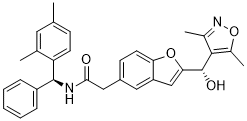
Physicochemical Properties
| Molecular Formula | C31H30N2O4 |
| Molecular Weight | 494.580908298492 |
| Exact Mass | 494.22 |
| Elemental Analysis | C, 75.28; H, 6.11; N, 5.66; O, 12.94 |
| CAS # | 1422171-08-1 |
| Related CAS # | TMP780;1422053-03-9 |
| PubChem CID | 71247312 |
| Appearance | White to off-white solid powder |
| LogP | 5.6 |
| Hydrogen Bond Donor Count | 2 |
| Hydrogen Bond Acceptor Count | 5 |
| Rotatable Bond Count | 7 |
| Heavy Atom Count | 37 |
| Complexity | 758 |
| Defined Atom Stereocenter Count | 0 |
| SMILES | CC1=CC(=C(C=C1)[C@H](C2=CC=CC=C2)NC(=O)CC3=CC4=C(C=C3)OC(=C4)[C@H](C5=C(ON=C5C)C)O)C |
| InChi Key | DIURRJOJDQOMFC-IOWSJCHKSA-N |
| InChi Code | InChI=1S/C31H30N2O4/c1-18-10-12-25(19(2)14-18)30(23-8-6-5-7-9-23)32-28(34)16-22-11-13-26-24(15-22)17-27(36-26)31(35)29-20(3)33-37-21(29)4/h5-15,17,30-31,35H,16H2,1-4H3,(H,32,34)/t30-,31+/m0/s1 |
| Chemical Name | 2-[2-[(S)-(3,5-dimethyl-1,2-oxazol-4-yl)-hydroxymethyl]-1-benzofuran-5-yl]-N-[(S)-(2,4-dimethylphenyl)-phenylmethyl]acetamide |
| Synonyms | TMP778; TMP-778; TMP 778. |
| HS Tariff Code | 2934.99.9001 |
| Storage |
Powder-20°C 3 years 4°C 2 years In solvent -80°C 6 months -20°C 1 month |
| Shipping Condition | Room temperature (This product is stable at ambient temperature for a few days during ordinary shipping and time spent in Customs) |
Biological Activity
| Targets |
|
|
| ln Vitro | TMP778 is observed to exhibit hazardous effects on cell growth at concentrations greater than 2.5 μM. It is important to note that these effects are not dependent on RORγt, as there is also a decrease in the proliferation of RORγt-deficient T cells cultured under Th17 cell-polarizing conditions. In contrast, these inhibitors effectively suppressed the synthesis of IL-17 while having no effect on RORγt expression, nuclear translocation, or cell proliferation. Given its increased binding affinity for RORγt, TMP778 effectively reduced IL-17 broader production over a considerably wider dose range. According to these findings, the RORγt inhibitor that most effectively decreased the synthesis of IL-17 was TMP778[2]. | |
| ln Vivo | When compared to mice administered with a control, all three compounds (such as TMP778) significantly lessen the severity of disease progression and postpone the onset of the illness. Treatment with TMP778 has the greatest noticeable impact on the disease phenotype, which is in line with in vitro findings. This medication not only lowers the percentage of IL-17+ T cells (including IL-17+ IFNγ+) in the central nervous system (CNS), but it also significantly lowers the quantity of mononuclear cells invading the CNS. None of the inhibitors significantly alters Th1 responses, as seen by the constant percentage of IFNγ+ IL-17-T cells in the CNS across all groups. TMP778 significantly slows down the development of Th17 cells, lowers the amount of IL-17 produced by differentiated Th17 cells, and also significantly slows down the progression of EAE [2]. | |
| Cell Assay |
|
|
| Animal Protocol |
|
|
| References |
[1]. Pharmacologic inhibition of RORγt regulates Th17 signature gene expression and suppresses cutaneous inflammation in vivo. J Immunol. 2014 Mar 15;192(6):2564-75. [2]. Small-molecule RORγt antagonists inhibit T helper 17 cell transcriptional network by divergent mechanisms. Immunity. 2014 Apr 17;40(4):477-89. |
Solubility Data
| Solubility (In Vitro) | May dissolve in DMSO (in most cases), if not, try other solvents such as H2O, Ethanol, or DMF with a minute amount of products to avoid loss of samples |
| Solubility (In Vivo) |
Note: Listed below are some common formulations that may be used to formulate products with low water solubility (e.g. < 1 mg/mL), you may test these formulations using a minute amount of products to avoid loss of samples. Injection Formulations (e.g. IP/IV/IM/SC) Injection Formulation 1: DMSO : Tween 80: Saline = 10 : 5 : 85 (i.e. 100 μL DMSO stock solution → 50 μL Tween 80 → 850 μL Saline) *Preparation of saline: Dissolve 0.9 g of sodium chloride in 100 mL ddH ₂ O to obtain a clear solution. Injection Formulation 2: DMSO : PEG300 :Tween 80 : Saline = 10 : 40 : 5 : 45 (i.e. 100 μL DMSO → 400 μLPEG300 → 50 μL Tween 80 → 450 μL Saline) Injection Formulation 3: DMSO : Corn oil = 10 : 90 (i.e. 100 μL DMSO → 900 μL Corn oil) Example: Take the Injection Formulation 3 (DMSO : Corn oil = 10 : 90) as an example, if 1 mL of 2.5 mg/mL working solution is to be prepared, you can take 100 μL 25 mg/mL DMSO stock solution and add to 900 μL corn oil, mix well to obtain a clear or suspension solution (2.5 mg/mL, ready for use in animals). Injection Formulation 4: DMSO : 20% SBE-β-CD in saline = 10 : 90 [i.e. 100 μL DMSO → 900 μL (20% SBE-β-CD in saline)] *Preparation of 20% SBE-β-CD in Saline (4°C,1 week): Dissolve 2 g SBE-β-CD in 10 mL saline to obtain a clear solution. Injection Formulation 5: 2-Hydroxypropyl-β-cyclodextrin : Saline = 50 : 50 (i.e. 500 μL 2-Hydroxypropyl-β-cyclodextrin → 500 μL Saline) Injection Formulation 6: DMSO : PEG300 : castor oil : Saline = 5 : 10 : 20 : 65 (i.e. 50 μL DMSO → 100 μLPEG300 → 200 μL castor oil → 650 μL Saline) Injection Formulation 7: Ethanol : Cremophor : Saline = 10: 10 : 80 (i.e. 100 μL Ethanol → 100 μL Cremophor → 800 μL Saline) Injection Formulation 8: Dissolve in Cremophor/Ethanol (50 : 50), then diluted by Saline Injection Formulation 9: EtOH : Corn oil = 10 : 90 (i.e. 100 μL EtOH → 900 μL Corn oil) Injection Formulation 10: EtOH : PEG300:Tween 80 : Saline = 10 : 40 : 5 : 45 (i.e. 100 μL EtOH → 400 μLPEG300 → 50 μL Tween 80 → 450 μL Saline) Oral Formulations Oral Formulation 1: Suspend in 0.5% CMC Na (carboxymethylcellulose sodium) Oral Formulation 2: Suspend in 0.5% Carboxymethyl cellulose Example: Take the Oral Formulation 1 (Suspend in 0.5% CMC Na) as an example, if 100 mL of 2.5 mg/mL working solution is to be prepared, you can first prepare 0.5% CMC Na solution by measuring 0.5 g CMC Na and dissolve it in 100 mL ddH2O to obtain a clear solution; then add 250 mg of the product to 100 mL 0.5% CMC Na solution, to make the suspension solution (2.5 mg/mL, ready for use in animals). Oral Formulation 3: Dissolved in PEG400 Oral Formulation 4: Suspend in 0.2% Carboxymethyl cellulose Oral Formulation 5: Dissolve in 0.25% Tween 80 and 0.5% Carboxymethyl cellulose Oral Formulation 6: Mixing with food powders Note: Please be aware that the above formulations are for reference only. InvivoChem strongly recommends customers to read literature methods/protocols carefully before determining which formulation you should use for in vivo studies, as different compounds have different solubility properties and have to be formulated differently. (Please use freshly prepared in vivo formulations for optimal results.) |
| Preparing Stock Solutions | 1 mg | 5 mg | 10 mg | |
| 1 mM | 2.0219 mL | 10.1096 mL | 20.2192 mL | |
| 5 mM | 0.4044 mL | 2.0219 mL | 4.0438 mL | |
| 10 mM | 0.2022 mL | 1.0110 mL | 2.0219 mL |