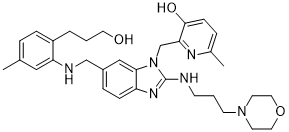
Physicochemical Properties
| Molecular Formula | C32H42N6O3 |
| Molecular Weight | 558.727 |
| Exact Mass | 558.332 |
| CAS # | 857066-90-1 |
| Related CAS # | 857066-90-1 |
| PubChem CID | 11249932 |
| Appearance | Pink to red solid powder |
| LogP | 3.906 |
| Hydrogen Bond Donor Count | 4 |
| Hydrogen Bond Acceptor Count | 8 |
| Rotatable Bond Count | 13 |
| Heavy Atom Count | 41 |
| Complexity | 757 |
| Defined Atom Stereocenter Count | 0 |
| InChi Key | DKORMNNYNRPTBJ-UHFFFAOYSA-N |
| InChi Code | InChI=1S/C32H42N6O3/c1-23-6-9-26(5-3-16-39)28(19-23)34-21-25-8-10-27-30(20-25)38(22-29-31(40)11-7-24(2)35-29)32(36-27)33-12-4-13-37-14-17-41-18-15-37/h6-11,19-20,34,39-40H,3-5,12-18,21-22H2,1-2H3,(H,33,36) |
| Chemical Name | 2-[[6-[[2-(3-hydroxypropyl)-5-methylanilino]methyl]-2-(3-morpholin-4-ylpropylamino)benzimidazol-1-yl]methyl]-6-methylpyridin-3-ol |
| Synonyms | TMC-353121 TMC353121 TMC 353121 |
| HS Tariff Code | 2934.99.9001 |
| Storage |
Powder-20°C 3 years 4°C 2 years In solvent -80°C 6 months -20°C 1 month |
| Shipping Condition | Room temperature (This product is stable at ambient temperature for a few days during ordinary shipping and time spent in Customs) |
Biological Activity
| ln Vitro | TMC353121 shown effectiveness against a panel of clinical isolates with comparable potency as well as group A and group B RSV [1]. A strong in vitro RSV fusion inhibitor is TMC353121. In HeLaM cells, TMC353121 exhibits 50% effective concentration (EC50) of 0.07 ng/mL against wild-type RSV (LO strain) [2]. |
| ln Vivo | After giving Sprague-Dawley rats a single intravenous bolus dosage of 10 mg/kg, TMC353121's plasma concentration-time profile showed multicompartmental pharmacokinetics. The final part of the curve, which shows the mean plasma drug concentrations between 8 and 24 hours after dose, shows that the drug concentrations decrease quickly in the first few hours after dosing and then more slowly, with a half-life of about 12 hours. With a clearance rate of 8.6 L/h/kg and a distribution width of 55 L/kg, TMC353121 is rapidly removed from plasma [2]. Two injections of TMC353121, at a dose of 2.5 mg/kg or 0.25 mg/kg, are given intravenously once. Serum, bronchoalveolar lavage fluid, and lung tissue drug concentrations were assessed at various times. When administered intravenously, TMC353121 exhibits multicompartmental pharmacokinetics, meaning that its serum concentration rapidly decreases within the first hour and then slowly declines over the next hour. After a day, the drug's blood levels are extremely low due to its rapid excretion from the body. The drug was marginally above the detection limit in BAL fluid eight hours after injection, and pulmonary concentrations were significantly greater than serum concentrations. |
| References |
[1]. Selection of a respiratory syncytial virus fusion inhibitor clinical candidate. 2. Discovery of a morpholinopropylaminobenzimidazole derivative (TMC353121). J Med Chem. 2008 Feb 28;51(4):875-96. [2]. Pharmacokinetics-pharmacodynamics of a respiratory syncytial virus fusion inhibitor in the cotton rat model. Antimicrob Agents Chemother. 2010 Nov;54(11):4534-9. [3]. Antiviral and lung protective activity of a novel respiratory syncytial virus fusion inhibitor in a mouse model. Eur Respir J. 2011 Aug;38(2):401-8. |
Solubility Data
| Solubility (In Vitro) | DMSO : ~50 mg/mL (~89.49 mM) |
| Solubility (In Vivo) |
Solubility in Formulation 1: ≥ 2.5 mg/mL (4.47 mM) (saturation unknown) in 10% DMSO + 40% PEG300 + 5% Tween80 + 45% Saline (add these co-solvents sequentially from left to right, and one by one), clear solution. For example, if 1 mL of working solution is to be prepared, you can add 100 μL of 25.0 mg/mL clear DMSO stock solution to 400 μL PEG300 and mix evenly; then add 50 μL Tween-80 to the above solution and mix evenly; then add 450 μL normal saline to adjust the volume to 1 mL. Preparation of saline: Dissolve 0.9 g of sodium chloride in 100 mL ddH₂ O to obtain a clear solution. Solubility in Formulation 2: 2.5 mg/mL (4.47 mM) in 10% DMSO + 90% (20% SBE-β-CD in Saline) (add these co-solvents sequentially from left to right, and one by one), suspension solution; with ultrasonication. For example, if 1 mL of working solution is to be prepared, you can add 100 μL of 25.0 mg/mL clear DMSO stock solution to 900 μL of 20% SBE-β-CD physiological saline solution and mix evenly. Preparation of 20% SBE-β-CD in Saline (4°C,1 week): Dissolve 2 g SBE-β-CD in 10 mL saline to obtain a clear solution. Solubility in Formulation 3: ≥ 2.5 mg/mL (4.47 mM) (saturation unknown) in 10% DMSO + 90% Corn Oil (add these co-solvents sequentially from left to right, and one by one), clear solution. For example, if 1 mL of working solution is to be prepared, you can add 100 μL of 25.0 mg/mL clear DMSO stock solution to 900 μL of corn oil and mix evenly. (Please use freshly prepared in vivo formulations for optimal results.) |
| Preparing Stock Solutions | 1 mg | 5 mg | 10 mg | |
| 1 mM | 1.7898 mL | 8.9489 mL | 17.8977 mL | |
| 5 mM | 0.3580 mL | 1.7898 mL | 3.5795 mL | |
| 10 mM | 0.1790 mL | 0.8949 mL | 1.7898 mL |