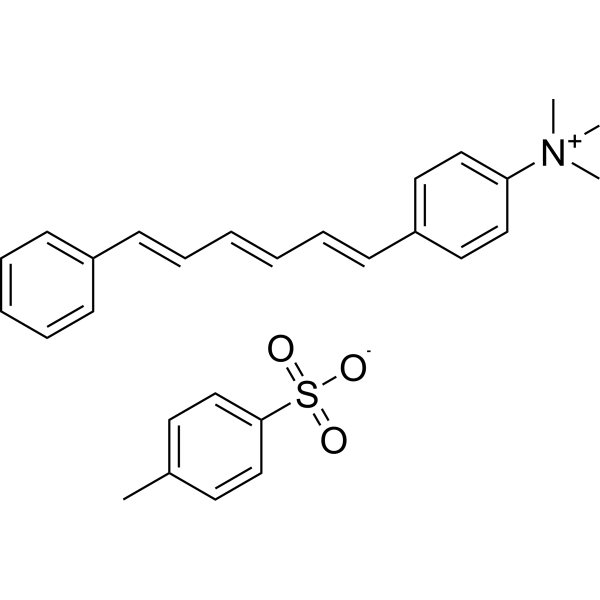
Physicochemical Properties
| Molecular Formula | C21H24N+.C7H7O3S- |
| Molecular Weight | 461.61564 |
| Exact Mass | 461.202 |
| CAS # | 115534-33-3 |
| PubChem CID | 5706757 |
| Appearance | Off-white to light brown solid powder |
| Melting Point | 237ºC (dec.)(lit.) |
| LogP | 7.146 |
| Hydrogen Bond Donor Count | 0 |
| Hydrogen Bond Acceptor Count | 3 |
| Rotatable Bond Count | 5 |
| Heavy Atom Count | 33 |
| Complexity | 576 |
| Defined Atom Stereocenter Count | 0 |
| SMILES | CC1=CC=C(C=C1)S(=O)(=O)[O-].C[N+](C)(C)C1=CC=C(C=C1)/C=C/C=C/C=C/C2=CC=CC=C2 |
| InChi Key | ZKARERKEBVSZCX-VMDDUYISSA-M |
| InChi Code | InChI=1S/C21H24N.C7H8O3S/c1-22(2,3)21-17-15-20(16-18-21)14-8-5-4-7-11-19-12-9-6-10-13-19;1-6-2-4-7(5-3-6)11(8,9)10/h4-18H,1-3H3;2-5H,1H3,(H,8,9,10)/q+1;/p-1/b5-4+,11-7+,14-8+; |
| Chemical Name | 4-methylbenzenesulfonate;trimethyl-[4-[(1E,3E,5E)-6-phenylhexa-1,3,5-trienyl]phenyl]azanium |
| HS Tariff Code | 2934.99.9001 |
| Storage |
Powder-20°C 3 years 4°C 2 years In solvent -80°C 6 months -20°C 1 month Note: (1). Please store this product in a sealed and protected environment (e.g. under nitrogen), avoid exposure to moisture and light.(2). This product is not stable in solution, please use freshly prepared working solution for optimal results. |
| Shipping Condition | Room temperature (This product is stable at ambient temperature for a few days during ordinary shipping and time spent in Customs) |
Biological Activity
| ln Vitro | TMA-DPH is quickly absorbed into the plasma membrane upon coming into contact with cells. Lysosomes and very acidic late endosomes are the sites of TMA-DPH concentration [1]. The TMA-DPH fluorescence lifetime exhibits a considerable decrease with increasing concentration, peaking at 6.2±0.2 ns, which is less than the same critical concentration of 2 μM. Above 5 μM, nevertheless, this decline becomes less rapid. The evolution of TMA-DPH fluorescence anisotropy and fluorescence lifespan are comparable. At 0.283±0.003 till 2 μM, it stays steady at first, but at higher concentrations it decreases more slowly, dropping quickly to 0.270±0.003 at 5 μM [2]. |
| References |
[1]. The kinetic aspects of intracellular fluorescence labeling with TMA-DPH support the maturation model for endocytosis in L929 cells. J Cell Biol. 1994 May;125(4):783-94. [2]. A comparison of the fluorescence properties of TMA-DPH as a probe for plasma membrane and for endocytic membrane. Biochim Biophys Acta. 1995 Oct 4;1239(1):58-66. [3]. Plasma membrane fluidity in isolated rat hepatocytes: comparative study using DPH and TMA-DPH as fluorescent probes. J Gastroenterol Hepatol. 1989 May-Jun;4(3):221-7. |
Solubility Data
| Solubility (In Vitro) | DMSO : ~10 mg/mL (~21.66 mM) |
| Solubility (In Vivo) |
Solubility in Formulation 1: ≥ 1 mg/mL (2.17 mM) (saturation unknown) in 10% DMSO + 40% PEG300 + 5% Tween80 + 45% Saline (add these co-solvents sequentially from left to right, and one by one), clear solution. For example, if 1 mL of working solution is to be prepared, you can add 100 μL of 10.0 mg/mL clear DMSO stock solution to 400 μL of PEG300 and mix evenly; then add 50 μL of Tween-80 to the above solution and mix evenly; then add 450 μL of normal saline to adjust the volume to 1 mL. Preparation of saline: Dissolve 0.9 g of sodium chloride in 100 mL ddH₂ O to obtain a clear solution. Solubility in Formulation 2: ≥ 1 mg/mL (2.17 mM) (saturation unknown) in 10% DMSO + 90% (20% SBE-β-CD in Saline) (add these co-solvents sequentially from left to right, and one by one), clear solution. For example, if 1 mL of working solution is to be prepared, you can add 100 μL of 10.0 mg/mL clear DMSO stock solution to 900 μL of 20% SBE-β-CD physiological saline solution and mix evenly. Preparation of saline: Dissolve 0.9 g of sodium chloride in 100 mL ddH₂ O to obtain a clear solution. Solubility in Formulation 3: 1 mg/mL (2.17 mM) in 10% DMSO + 90% Corn Oil (add these co-solvents sequentially from left to right, and one by one), suspension solution; with ultrasonication. For example, if 1 mL of working solution is to be prepared, you can add 100 μL of 10.0 mg/mL clear DMSO stock solution to 900 μL of corn oil and mix evenly. (Please use freshly prepared in vivo formulations for optimal results.) |
| Preparing Stock Solutions | 1 mg | 5 mg | 10 mg | |
| 1 mM | 2.1663 mL | 10.8314 mL | 21.6628 mL | |
| 5 mM | 0.4333 mL | 2.1663 mL | 4.3326 mL | |
| 10 mM | 0.2166 mL | 1.0831 mL | 2.1663 mL |