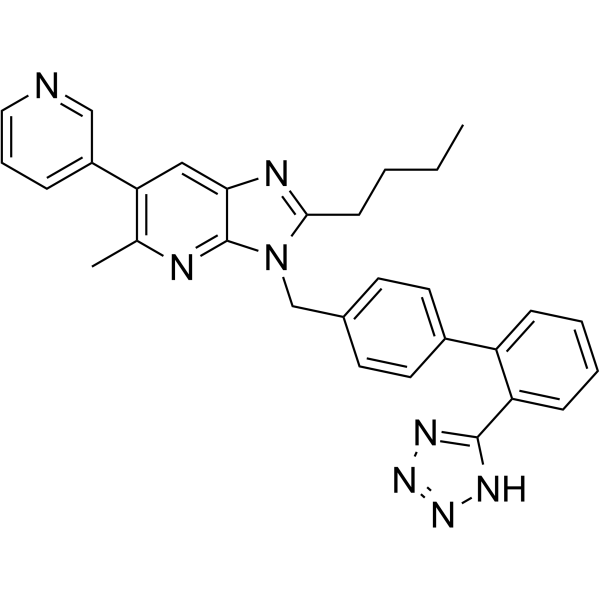
Physicochemical Properties
| Molecular Formula | C30H28N8 |
| Molecular Weight | 500.596924781799 |
| Exact Mass | 500.243 |
| CAS # | 260553-97-7 |
| PubChem CID | 49821008 |
| Appearance | White to off-white solid powder |
| LogP | 5.8 |
| Hydrogen Bond Donor Count | 1 |
| Hydrogen Bond Acceptor Count | 6 |
| Rotatable Bond Count | 8 |
| Heavy Atom Count | 38 |
| Complexity | 729 |
| Defined Atom Stereocenter Count | 0 |
| InChi Key | KCOQNLYGMQJUJD-UHFFFAOYSA-N |
| InChi Code | InChI=1S/C30H28N8/c1-3-4-11-28-33-27-17-26(23-8-7-16-31-18-23)20(2)32-30(27)38(28)19-21-12-14-22(15-13-21)24-9-5-6-10-25(24)29-34-36-37-35-29/h5-10,12-18H,3-4,11,19H2,1-2H3,(H,34,35,36,37) |
| Chemical Name | 2-butyl-5-methyl-6-pyridin-3-yl-3-[[4-[2-(2H-tetrazol-5-yl)phenyl]phenyl]methyl]imidazo[4,5-b]pyridine |
| HS Tariff Code | 2934.99.9001 |
| Storage |
Powder-20°C 3 years 4°C 2 years In solvent -80°C 6 months -20°C 1 month |
| Shipping Condition | Room temperature (This product is stable at ambient temperature for a few days during ordinary shipping and time spent in Customs) |
Biological Activity
| Targets |
TM-25659 targets transcriptional co-activator TAZ [1] |
| ln Vitro |
TM-25659 (2, 10, 20, 100 μM) promotes intranuclear TAZ localization in an intermittent manner and opens PPARγ-mediated adipocyte gaps by enhancing the PPARγ inhibitory action of TAZ [1]. TM-25659 (2, 10, 50 μM) promotes osteogenic gene expression, hence boosting osteoblast secretion [1]. TM-25659 enhanced osteogenic differentiation of C3H10T1/2 mesenchymal stem cells and MC3T3-E1 osteoblastic cells in a dose-dependent manner (1, 5, 10 μM) [1] It significantly increased alkaline phosphatase (ALP) activity, mineralized nodule formation (Alizarin Red S staining), and mRNA/protein expression of osteogenic markers (Runx2, OCN, Col1a1) in osteogenic induction medium [1] The compound suppressed adipogenic differentiation of C3H10T1/2 cells, reducing lipid droplet accumulation (Oil Red O staining) and downregulating mRNA/protein expression of adipogenic markers (PPARγ, C/EBPα, aP2) in adipogenic induction medium [1] TM-25659 promoted nuclear translocation of TAZ, increased TAZ protein stability, and enhanced TAZ-dependent transcriptional activity (assessed by luciferase reporter assay with TAZ-responsive elements) [1] Knockdown of TAZ via siRNA abolished the osteogenic-promoting and adipogenic-suppressing effects of TM-25659, confirming TAZ as the key mediator [1] |
| ln Vivo | In vivo in cyclohexane buffer, TM-25659 (50 mg/kg, intraperitoneally, every other day for two weeks) decreases body weight gain in prepared models [1]. In solution, TM-25659 has favorable pharmacokinetics. The rope concentration of TM-25659 recovers with a t1/2 of approximately 7 or 10 hours after iv or po, respectively. Systemic clearance (CL) is 0.21 L × h-1 × kg-1, repeated distribution |
| Cell Assay |
Cell proliferation analysis[1] Cell Types: 3T3-L1 Cell Tested Concentrations: 2, 10, 20, 100 μM Incubation Duration: 6 days Experimental Results: Acts as an inhibitor of PPARγ-dependent adipocyte differentiation[1]. C3H10T1/2 mesenchymal stem cells and MC3T3-E1 osteoblastic cells were cultured in α-MEM medium supplemented with 10% fetal bovine serum and antibiotics, maintained at 37°C in a 5% CO₂ incubator [1] Osteogenic differentiation assay: Cells were seeded in 6-well plates (C3H10T1/2) or 96-well plates (MC3T3-E1), allowed to adhere overnight, then treated with TM-25659 (1, 5, 10 μM) in osteogenic induction medium (containing ascorbic acid and β-glycerophosphate) for 7–21 days [1] - ALP activity assay: Cells were lysed, and ALP activity was measured using a colorimetric assay with p-nitrophenyl phosphate as substrate, absorbance detected at 405 nm [1] - Alizarin Red S staining: Mineralized nodules were stained with Alizarin Red S solution, excess dye was washed off, and stained nodules were quantified by elution with cetylpyridinium chloride and absorbance measurement at 562 nm [1] Adipogenic differentiation assay: C3H10T1/2 cells were seeded in 6-well plates, adherent overnight, treated with TM-25659 (1, 5, 10 μM) in adipogenic induction medium (containing insulin, dexamethasone, and IBMX) for 14 days [1] - Oil Red O staining: Lipid droplets were stained with Oil Red O solution, washed with phosphate-buffered saline, and stained droplets were quantified by elution with isopropanol and absorbance measurement at 510 nm [1] Western blot analysis: Cells were harvested after treatment, lysed in RIPA buffer with protease inhibitors, protein concentrations determined by BCA assay, equal amounts of protein separated by SDS-PAGE, transferred to PVDF membranes, incubated with primary antibodies (TAZ, Runx2, OCN, PPARγ, C/EBPα, β-actin) overnight at 4°C, followed by HRP-conjugated secondary antibodies for 1 hour at room temperature, and protein bands visualized by ECL detection system [1] RT-PCR analysis: Total RNA was extracted, reverse-transcribed into cDNA, PCR amplified with specific primers for osteogenic/adipogenic markers and GAPDH (housekeeping gene), and relative mRNA expression calculated by the comparative Ct method [1] Immunofluorescence assay: C3H10T1/2 cells were seeded on coverslips, treated with TM-25659 (10 μM) for 24 hours, fixed with paraformaldehyde, permeabilized with Triton X-100, blocked with bovine serum albumin, incubated with TAZ primary antibody and fluorescent secondary antibody, counterstained with DAPI for nuclei, and observed under a confocal microscope to assess TAZ subcellular localization [1] Luciferase reporter assay: C3H10T1/2 cells were co-transfected with TAZ-responsive luciferase reporter plasmid and Renilla luciferase plasmid (internal control), treated with TM-25659 (1, 5, 10 μM) for 24 hours, and luciferase activity measured using a dual-luciferase assay system [1] siRNA knockdown assay: C3H10T1/2 cells were transfected with TAZ siRNA or scrambled siRNA, incubated for 48 hours, then treated with TM-25659 (10 μM) in osteogenic/adipogenic induction medium, and differentiation markers were detected by Western blot and staining assays [1] |
| Animal Protocol |
Animal/Disease Models: C57BL6 mice (4- to 6 weeks old) [1] Doses: 50 mg/kg Route of Administration: Ip, every The next day, for 2 weeks, Experimental Results: these obese mice had attenuated weight gain [1]. Animal/Disease Models: Adult male SD (SD (Sprague-Dawley)) rat [1] Doses: 10 mg/kg Route of Administration: intravenous (iv) (iv)(2, 10 and 30 minutes), oral (15 and 30 minutes and 1, 2, 4 and 8 hrs (hrs (hours))) Experimental Results: After 4 weeks of oral administration, the weight gain of OVX rats was moderately but Dramatically attenuated, and BMD was partially restored [1]. |
| References |
[1]. TM-25659 enhances osteogenic differentiation and suppresses adipogenic differentiation by modulating the transcriptional co-activator TAZ. Br J Pharmacol. 2012 Mar;165(5):1584-94. |
| Additional Infomation |
TM-25659 is a synthetic small-molecule compound [1] Its mechanism of action involves modulating TAZ signaling: promoting TAZ nuclear translocation, enhancing TAZ protein stability, and activating TAZ-dependent transcription of osteogenic genes while repressing adipogenic gene expression [1] It exhibits potential therapeutic value for bone-related disorders such as osteoporosis, by shifting mesenchymal stem cell differentiation toward osteoblasts and away from adipocytes [1] |
Solubility Data
| Solubility (In Vitro) | DMSO : ≥ 135 mg/mL (~269.68 mM) |
| Solubility (In Vivo) |
Solubility in Formulation 1: ≥ 2.25 mg/mL (4.49 mM) (saturation unknown) in 10% DMSO + 40% PEG300 + 5% Tween80 + 45% Saline (add these co-solvents sequentially from left to right, and one by one), clear solution. For example, if 1 mL of working solution is to be prepared, you can add 100 μL of 22.5 mg/mL clear DMSO stock solution to 400 μL PEG300 and mix evenly; then add 50 μL Tween-80 to the above solution and mix evenly; then add 450 μL normal saline to adjust the volume to 1 mL. Preparation of saline: Dissolve 0.9 g of sodium chloride in 100 mL ddH₂ O to obtain a clear solution. Solubility in Formulation 2: 2.25 mg/mL (4.49 mM) in 10% DMSO + 90% (20% SBE-β-CD in Saline) (add these co-solvents sequentially from left to right, and one by one), suspension solution; with ultrasonication. For example, if 1 mL of working solution is to be prepared, you can add 100 μL of 22.5 mg/mL clear DMSO stock solution to 900 μL of 20% SBE-β-CD physiological saline solution and mix evenly. Preparation of 20% SBE-β-CD in Saline (4°C,1 week): Dissolve 2 g SBE-β-CD in 10 mL saline to obtain a clear solution. Solubility in Formulation 3: ≥ 2.25 mg/mL (4.49 mM) (saturation unknown) in 10% DMSO + 90% Corn Oil (add these co-solvents sequentially from left to right, and one by one), clear solution. For example, if 1 mL of working solution is to be prepared, you can add 100 μL of 22.5 mg/mL clear DMSO stock solution to 900 μL of corn oil and mix evenly. (Please use freshly prepared in vivo formulations for optimal results.) |
| Preparing Stock Solutions | 1 mg | 5 mg | 10 mg | |
| 1 mM | 1.9976 mL | 9.9880 mL | 19.9760 mL | |
| 5 mM | 0.3995 mL | 1.9976 mL | 3.9952 mL | |
| 10 mM | 0.1998 mL | 0.9988 mL | 1.9976 mL |