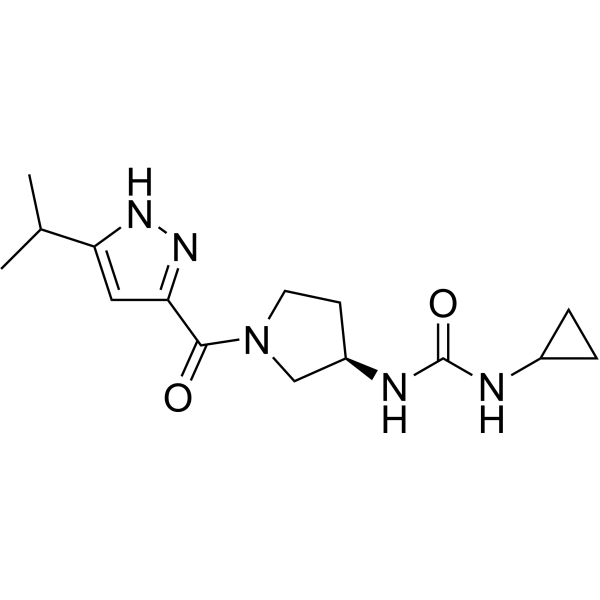
Physicochemical Properties
| Molecular Formula | C15H23N5O2 |
| Molecular Weight | 305.38 |
| CAS # | 3031476-73-7 |
| Appearance | White to off-white solid powder |
| HS Tariff Code | 2934.99.9001 |
| Storage |
Powder-20°C 3 years 4°C 2 years In solvent -80°C 6 months -20°C 1 month |
| Shipping Condition | Room temperature (This product is stable at ambient temperature for a few days during ordinary shipping and time spent in Customs) |
Biological Activity
| Targets | KDM5 44 nM (IC50) |
| ln Vitro | In vitro Ang II-induced myofibroblast activation, migration, and proliferation are dramatically reduced by TK-129-mediated reduction of KDM5B activity[1]. Low cytotoxicity of TK-129 (10 μM; 48 h) is observed in NRCFs and NRCMs[1]. KDM5B activity in NRCFs can be engaged and inhibited by TK-129 (0.1, 0.2, 0.3, 0.4, and 0.5 μM; 48 hours)[1]. |
| ln Vivo | In mice, TK-129 (2 g/kg; po; single) has good biosafety[1]. Effectively reducing isoproterenol-induced pathological cardiac remodeling in vivo is TK-129 (50 mg/kg; po; twice daily for 24 days)[1]. In vivo, TK-129 (2 or 10 mg/kg; iv or po; single) exhibits advantageous PK characteristics[1]. |
| Cell Assay |
Cell Cytotoxicity Assay[1] Cell Types: NRCFs and NRCMs Tested Concentrations: 10 μM Incubation Duration: 48 h Experimental Results: demonstrated the cell survival rates were almost more than 90%. Western Blot Analysis[1] Cell Types: NRCFs Tested Concentrations: 0.1, 0.2, 0.3, 0.4, 0.5 μM Incubation Duration: 48 h Experimental Results: Increased the expression level of KDM5B substrate H3K4me3 protein in a concentration-dependent manner. |
| Animal Protocol |
Animal/Disease Models: Wild C57BL/6 mice (8 to 10weeks old; half male and half female)[1]. Doses: 2 g/kg Route of Administration: po (oral gavage), single. Experimental Results: demonstrated all mice in the acute toxicity group survived and gained weight normally, after 2 weeks. Animal/Disease Models: C57BL/6 mice ( isoproterenol (ISO)-induced)[1]. Doses: 50 mg/kg Route of Administration: po (oral gavage), twice (two times) daily for 24 days. Experimental Results: Alleviated myocardial remodeling induced by ISO in vivo. Animal/Disease Models: Male SD Rats (223.5-265.1 g )[1]. Doses: 2 mg/kg (for iv); 10 mg/kg (for po). Route of Administration: intravenous (iv) injection or po (oral gavage); single. Experimental Results: 1.19 pharmacokinetic/PK Parameters of TK-129 in Male SD Rats[1 ]. PO (10 mg/kg) IV (2 mg/kg) CL (L/h/kg) 9.9 4.2 Vss (L/kg) 33.4 2.7 T1/2 (h) 2.4 0.4 Tmax (h) 0.4 - Cmax ( ng/mL) 709.7 1229.1 AUC0-24 (ng/mL·h) 1038.2 479.6 F (%) 42.37 - |
| References |
[1]. Discovery of Novel Pyrazole-Based KDM5B Inhibitor TK-129 and Its Protective Effects on Myocardial Remodeling and Fibrosis. J Med Chem. 2022 Sep 16. |
Solubility Data
| Solubility (In Vitro) | DMSO :~100 mg/mL (~327.46 mM) |
| Solubility (In Vivo) |
Solubility in Formulation 1: ≥ 2.5 mg/mL (8.19 mM) (saturation unknown) in 10% DMSO + 40% PEG300 + 5% Tween80 + 45% Saline (add these co-solvents sequentially from left to right, and one by one), clear solution. For example, if 1 mL of working solution is to be prepared, you can add 100 μL of 25.0 mg/mL clear DMSO stock solution to 400 μL PEG300 and mix evenly; then add 50 μL Tween-80 to the above solution and mix evenly; then add 450 μL normal saline to adjust the volume to 1 mL. Preparation of saline: Dissolve 0.9 g of sodium chloride in 100 mL ddH₂ O to obtain a clear solution. Solubility in Formulation 2: ≥ 2.5 mg/mL (8.19 mM) (saturation unknown) in 10% DMSO + 90% (20% SBE-β-CD in Saline) (add these co-solvents sequentially from left to right, and one by one), clear solution. For example, if 1 mL of working solution is to be prepared, you can add 100 μL of 25.0 mg/mL clear DMSO stock solution to 900 μL of 20% SBE-β-CD physiological saline solution and mix evenly. Preparation of 20% SBE-β-CD in Saline (4°C,1 week): Dissolve 2 g SBE-β-CD in 10 mL saline to obtain a clear solution. Solubility in Formulation 3: ≥ 2.5 mg/mL (8.19 mM) (saturation unknown) in 10% DMSO + 90% Corn Oil (add these co-solvents sequentially from left to right, and one by one), clear solution. For example, if 1 mL of working solution is to be prepared, you can add 100 μL of 25.0 mg/mL clear DMSO stock solution to 900 μL of corn oil and mix evenly. (Please use freshly prepared in vivo formulations for optimal results.) |
| Preparing Stock Solutions | 1 mg | 5 mg | 10 mg | |
| 1 mM | 3.2746 mL | 16.3730 mL | 32.7461 mL | |
| 5 mM | 0.6549 mL | 3.2746 mL | 6.5492 mL | |
| 10 mM | 0.3275 mL | 1.6373 mL | 3.2746 mL |