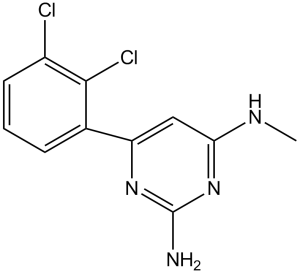
TH287 is a potent and selective MTH1 (NUDT1) inhibitor with IC50 of 0.8 nM. TH287 selectively and efficiently kills U2OS and other cancer cell lines while being less toxic to many primary or immortalized cells, and it causes oxidative DNA damage. In U2OS and other cancer cell lines, TH287 treatment selectively and effectively kills cancer cells while being less toxic to some primary or immortalized cells. Increase in 8-oxodG in DNA is observed in U2OS cells treated with TH287. In U2OS cells, the MTH1 inhibitor TH287 causes DNA damage, activates an ATM-p53-mediated death response, and causes DNA repair.
Physicochemical Properties
| Molecular Formula | C11H10CL2N4 | |
| Molecular Weight | 269.13 | |
| Exact Mass | 268.028 | |
| Elemental Analysis | C, 49.09; H, 3.75; Cl, 26.34; N, 20.82 | |
| CAS # | 1609960-30-6 | |
| Related CAS # | TH287 hydrochloride;1638211-05-8 | |
| PubChem CID | 73441664 | |
| Appearance | White to off-white solid powder | |
| Density | 1.4±0.1 g/cm3 | |
| Boiling Point | 512.2±60.0 °C at 760 mmHg | |
| Flash Point | 263.5±32.9 °C | |
| Vapour Pressure | 0.0±1.3 mmHg at 25°C | |
| Index of Refraction | 1.681 | |
| LogP | 3.48 | |
| Hydrogen Bond Donor Count | 2 | |
| Hydrogen Bond Acceptor Count | 4 | |
| Rotatable Bond Count | 2 | |
| Heavy Atom Count | 17 | |
| Complexity | 254 | |
| Defined Atom Stereocenter Count | 0 | |
| SMILES | ClC1C(=C([H])C([H])=C([H])C=1C1=C([H])C(=NC(N([H])[H])=N1)N([H])C([H])([H])[H])Cl |
|
| InChi Key | URWCXPXBBITYLR-UHFFFAOYSA-N | |
| InChi Code | InChI=1S/C11H10Cl2N4/c1-15-9-5-8(16-11(14)17-9)6-3-2-4-7(12)10(6)13/h2-5H,1H3,(H3,14,15,16,17) | |
| Chemical Name | 6-(2,3-dichlorophenyl)-N4-methylpyrimidine-2,4-diamine | |
| Synonyms |
|
|
| HS Tariff Code | 2934.99.9001 | |
| Storage |
Powder-20°C 3 years 4°C 2 years In solvent -80°C 6 months -20°C 1 month |
|
| Shipping Condition | Room temperature (This product is stable at ambient temperature for a few days during ordinary shipping and time spent in Customs) |
Biological Activity
| Targets |
MTH1 (IC50 = 0.8 nM) TH287 targets MutT homolog 1 (MTH1, NUDT1) (IC50 = 0.8 nM for enzymatic inhibition; Ki = 0.5 nM) [1] |
| ln Vitro |
TH287 (1-10 μM; 24 h) selectively and efficiently destroys U2OS and other cancer cell lines, but is considerably less toxic to several primary or immortalized cells[1]. TH287 potently inhibited MTH1 enzymatic activity, preventing hydrolysis of oxidized dNTPs (8-oxo-dGTP, 2-OH-dATP) with >95% inhibition at 10 nM [1] TH287 exhibited antiproliferative activity against diverse cancer cell lines: IC50 = 1.2 μM (A549 lung cancer), IC50 = 0.9 μM (HCT116 colon cancer), IC50 = 1.5 μM (MDA-MB-231 breast cancer), IC50 = 0.7 μM (K562 leukemia) [1] TH287 (2 μM, 48 hours) induced accumulation of oxidized dNTPs in cancer cells (8-oxo-dGTP levels increased by 3.2-fold), leading to DNA oxidative damage (γH2AX foci increased by 4.5-fold) [1] TH287 (1 μM, 72 hours) induced apoptosis in cancer cells, with Annexin V-positive cells reaching 52% and caspase-3/7 activity elevated by 3.8-fold [1] TH287 showed minimal toxicity to normal human fibroblasts (IC50 > 20 μM), with 15–25-fold selectivity for cancer cells [1] |
| ln Vivo |
In mice, TH287 (5 mg/kg; i.p.) has a Cmax of 0.82 M and a tmax of 0.5 h[2]. TH287 (25 mg/kg/day, intraperitoneal injection for 14 days) inhibited HCT116 colon cancer xenograft growth in nude mice by 68%, with no significant body weight loss (<5% change) [1] TH287 (15 mg/kg/day, oral gavage for 21 days) reduced A549 lung cancer xenograft volume by 62% in BALB/c nude mice, accompanied by increased γH2AX expression in tumor tissues [1] TH287 (20 mg/kg, intravenous injection) in C57BL/6 mice showed rapid distribution to tumor tissues (tumor/plasma ratio = 5.1 at 1 hour post-administration) [2] |
| Enzyme Assay |
MTH1 enzymatic activity assay: Recombinant MTH1 protein was incubated with TH287 (0.01–100 nM) and fluorescently labeled 8-oxo-dGTP substrate in reaction buffer; after 30 minutes at 37°C, hydrolyzed products were separated by HPLC, and fluorescence intensity was measured to calculate inhibition rate and IC50 [1] Surface Plasmon Resonance (SPR) assay: MTH1 protein was immobilized on a sensor chip; TH287 (0.1–50 nM) was injected at a constant flow rate, and binding affinity (Ki) was determined by analyzing sensorgrams with steady-state affinity models [1] |
| Cell Assay |
In U2OS and other cancer cell lines, TH287 treatment selectively and effectively kill cancer cells with less toxic to some primary or immortalized cells. Increase in 8-oxodG in DNA is seen in U2OS cells treated with TH287. In U2OS cells, the MTH1 inhibitor TH287 causes DNA damage that prompts DNA repair and an ATM-p53-mediated death response. Antiproliferation assay: Cancer cells and normal fibroblasts were seeded in 96-well plates (5×10³ cells/well) and treated with TH287 (0.1–50 μM) for 72 hours; cell viability was assessed by MTT assay (absorbance at 570 nm), and IC50 values were calculated [1] Oxidized dNTP accumulation assay: HCT116 cells were treated with TH287 (0.5–5 μM) for 48 hours; intracellular dNTPs were extracted, and 8-oxo-dGTP/2-OH-dATP levels were quantified by LC-MS/MS [1] DNA damage assay: A549 cells were treated with TH287 (0.5–2 μM) for 24 hours, fixed and immunostained with anti-γH2AX antibody; γH2AX foci were counted under fluorescence microscope [1] Apoptosis assay: K562 cells were treated with TH287 (0.5–3 μM) for 72 hours, stained with Annexin V-FITC/PI, and apoptotic cells were analyzed by flow cytometry; caspase-3/7 activity was detected by luminescent assay with specific substrates [1] |
| Animal Protocol |
Dissolved in 1% DMSO, 10% ethanol, 10% Chremophore EL and 10% Tween-80 and diluted with PBS; 5 mg/kg; i.p. injection. C57Bl/6 mice Colon cancer xenograft model: Nude mice (6–8 weeks old) were subcutaneously injected with 2×10⁶ HCT116 cells; when tumors reached 120 mm³, mice were randomly divided into control and treatment groups; treatment group received TH287 (25 mg/kg/day, dissolved in 10% DMSO + 90% saline) via intraperitoneal injection for 14 days, control group received vehicle; tumor volume and body weight were measured every 2 days [1] Lung cancer xenograft model: BALB/c nude mice were subcutaneously implanted with 1×10⁷ A549 cells; tumors were allowed to grow to 100 mm³, then mice were administered TH287 (15 mg/kg/day, dissolved in 0.5% carboxymethylcellulose sodium) via oral gavage for 21 days; tumor tissues were collected for γH2AX expression analysis [1] Pharmacokinetic model: C57BL/6 mice (20–25 g) were administered TH287 (20 mg/kg, dissolved in PBS) via intravenous injection; blood samples were collected at 0.083, 0.25, 0.5, 1, 2, 4, 8, 12, and 24 hours post-administration; plasma drug concentration was detected by UHPLC-MS/MS [2] |
| ADME/Pharmacokinetics |
Intravenous administration of TH287 (20 mg/kg) in mice resulted in peak plasma concentration (Cmax) of 8.3 μg/mL, area under the curve (AUC₀₋₂₄h) of 25.6 μg·h/mL, and elimination half-life (t1/2) of 3.7 hours [2] TH287 showed high tissue distribution to liver (tissue/plasma ratio = 6.2 at 2 hours), tumor, and kidneys, with low brain penetration (brain/plasma ratio = 0.2) [2] Oral bioavailability of TH287 in mice was approximately 22% due to partial first-pass metabolism [1] TH287 is metabolized in the liver via cytochrome P450-mediated oxidation, with major metabolites excreted in feces (65%) and urine (28%) within 48 hours [2] |
| Toxicity/Toxicokinetics |
TH287 showed low acute toxicity in mice: LD50 = 180 mg/kg (intraperitoneal), LD50 = 350 mg/kg (oral) [1] Chronic administration (25 mg/kg/day for 28 days) in mice caused no significant changes in serum ALT, AST, BUN, or creatinine levels, indicating no obvious [1] Plasma protein binding rate of TH287 was 92% in human plasma and 89% in mouse plasma [2] No significant drug-drug interactions were observed with major CYP450 enzymes in vitro [2] |
| References |
[1]. MTH1 inhibition eradicates cancer by preventing sanitation of the dNTP pool. Nature. 2014 Apr 10;508(7495):215-21. [2]. Development and validation of method for TH588 and TH287, potent MTH1 inhibitors and new anti-cancer agents, for pharmacokinetic studies in mice plasma. J Pharm Biomed Anal. 2015 Feb;104:1-11. |
| Additional Infomation |
TH287 is a potent and selective small-molecule inhibitor of MTH1, a nucleotide pool sanitization enzyme [1][2] It exerts antitumor effects by inhibiting MTH1-mediated hydrolysis of oxidized dNTPs, leading to incorporation of damaged nucleotides into DNA, induction of oxidative DNA damage, and subsequent cancer cell apoptosis [1] TH287 exhibits broad-spectrum antitumor activity against various cancer types, including solid tumors and hematological malignancies [1] The drug shows high selectivity for cancer cells over normal cells, attributed to the increased reliance of cancer cells on MTH1 for maintaining dNTP pool integrity [1] |
Solubility Data
| Solubility (In Vitro) |
|
|||
| Solubility (In Vivo) |
Solubility in Formulation 1: ≥ 2.5 mg/mL (9.29 mM) (saturation unknown) in 10% DMSO + 40% PEG300 + 5% Tween80 + 45% Saline (add these co-solvents sequentially from left to right, and one by one), clear solution. For example, if 1 mL of working solution is to be prepared, you can add 100 μL of 25.0 mg/mL clear DMSO stock solution to 400 μL PEG300 and mix evenly; then add 50 μL Tween-80 to the above solution and mix evenly; then add 450 μL normal saline to adjust the volume to 1 mL. Preparation of saline: Dissolve 0.9 g of sodium chloride in 100 mL ddH₂ O to obtain a clear solution. Solubility in Formulation 2: ≥ 2.5 mg/mL (9.29 mM) (saturation unknown) in 10% DMSO + 90% Corn Oil (add these co-solvents sequentially from left to right, and one by one), clear solution. For example, if 1 mL of working solution is to be prepared, you can add 100 μL of 25.0 mg/mL clear DMSO stock solution to 900 μL of corn oil and mix evenly. (Please use freshly prepared in vivo formulations for optimal results.) |
| Preparing Stock Solutions | 1 mg | 5 mg | 10 mg | |
| 1 mM | 3.7157 mL | 18.5784 mL | 37.1568 mL | |
| 5 mM | 0.7431 mL | 3.7157 mL | 7.4314 mL | |
| 10 mM | 0.3716 mL | 1.8578 mL | 3.7157 mL |