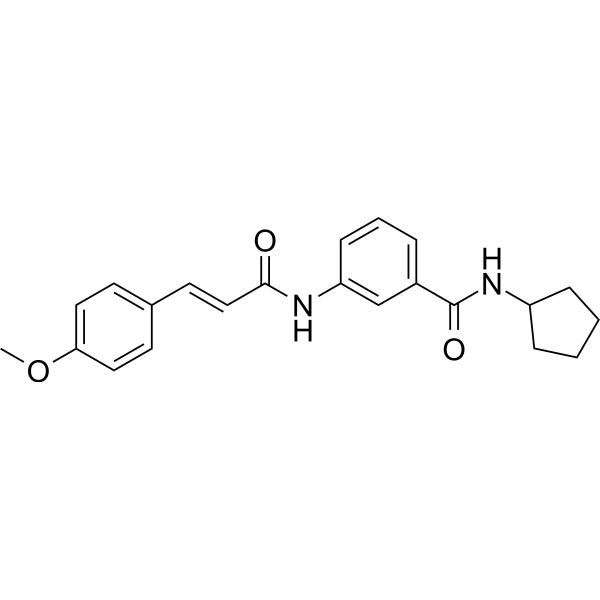
Physicochemical Properties
| Molecular Formula | C22H24N2O3 |
| Molecular Weight | 364.44 |
| Exact Mass | 364.178 |
| CAS # | 2348795-14-0 |
| PubChem CID | 165412786 |
| Appearance | Off-white to light yellow solid powder |
| Density | 1.20±0.1 g/cm3(Predicted) |
| Boiling Point | 636.1±55.0 °C(Predicted) |
| LogP | 3.7 |
| Hydrogen Bond Donor Count | 2 |
| Hydrogen Bond Acceptor Count | 3 |
| Rotatable Bond Count | 6 |
| Heavy Atom Count | 27 |
| Complexity | 520 |
| Defined Atom Stereocenter Count | 0 |
| SMILES | COC1=CC=C(C=C1)/C=C/C(=O)NC2=CC=CC(=C2)C(=O)NC3CCCC3 |
| InChi Key | TZERIKHLXBOLFD-SDNWHVSQSA-N |
| InChi Code | InChI=1S/C22H24N2O3/c1-27-20-12-9-16(10-13-20)11-14-21(25)23-19-8-4-5-17(15-19)22(26)24-18-6-2-3-7-18/h4-5,8-15,18H,2-3,6-7H2,1H3,(H,23,25)(H,24,26)/b14-11+ |
| Chemical Name | N-cyclopentyl-3-[[(E)-3-(4-methoxyphenyl)prop-2-enoyl]amino]benzamide |
| HS Tariff Code | 2934.99.9001 |
| Storage |
Powder-20°C 3 years 4°C 2 years In solvent -80°C 6 months -20°C 1 month Note: Please store this product in a sealed and protected environment (e.g. under nitrogen), avoid exposure to moisture and light. |
| Shipping Condition | Room temperature (This product is stable at ambient temperature for a few days during ordinary shipping and time spent in Customs) |
Biological Activity
| ln Vitro | TGFβ1-IN-1 (compound 42) (0-20 μM, 72 h) has an IC 50 of 105 μM and suppresses the viability of LO2 cells and the proliferation of TGF-β1 (5 ng/mL)-treated LX-2 cells[1]. |
| ln Vivo | TGFβ1-IN-1 (compound 42) (po, 15 or 30 mg/kg, daily, 3 weeks) improves the immune microenvironment of CCl4-induced liver fibrosis and CCl4-induced systemic toxicity in C57BL/6J mice[1]. It also prevents CCl4-induced liver injury and fibrosis and inhibits the activation of hepatic stellate cells (HSC) and epithelial-mesenchymal transition (EMT). |
| Cell Assay |
Cell Viability Assay[1] Cell Types: HSCs (LX-2) cells Tested Concentrations: 20 μM Incubation Duration: 24 or 72 hrs (hours) Experimental Results: demonstrated the survival rate of 77.5% and the inhibition rate of 30.3% for LX-2 cells. Dramatically inhibited fibronectin and α-SMA protein expression. |
| Animal Protocol |
Animal/Disease Models: Liver fibrosis C57BL/6J mice induced by CCl4[1] Doses: 15 or 30 mg /kg Route of Administration: Oral administration; daily; 3 weeks Experimental Results: Dramatically prevented CCl4-induced liver injury and decreased liver weight factor, serum ALT, AST, CHO and TG levels. Dramatically improved structural damage and inflammatory cell infiltration in the liver, and decreased collagen deposition in liver tissue. decreased accumulation of CCl4-induced immune cells, such as hepatic macrophages (F4/80+ CD11b+), Th1 cells (CD69+ CD4+), and Th2 cells (CD69+ CD8+) so on. |
| References |
[1]. Discovery and evaluation of phenacrylanilide derivatives as novel potential anti-liver fibrosis agents. Eur J Med Chem. 2022 Nov 15;242:114685. |
Solubility Data
| Solubility (In Vitro) | DMSO: 100 mg/mL (274.39 mM) |
| Solubility (In Vivo) |
Solubility in Formulation 1: ≥ 2.5 mg/mL (6.86 mM) (saturation unknown) in 10% DMSO + 90% Corn Oil (add these co-solvents sequentially from left to right, and one by one), clear solution. For example, if 1 mL of working solution is to be prepared, you can add 100 μL of 25.0 mg/mL clear DMSO stock solution to 900 μL of corn oil and mix evenly. (Please use freshly prepared in vivo formulations for optimal results.) |
| Preparing Stock Solutions | 1 mg | 5 mg | 10 mg | |
| 1 mM | 2.7439 mL | 13.7197 mL | 27.4394 mL | |
| 5 mM | 0.5488 mL | 2.7439 mL | 5.4879 mL | |
| 10 mM | 0.2744 mL | 1.3720 mL | 2.7439 mL |