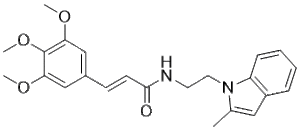
TG4-155 is a novel, potent and brain penetrant EP2 antagonist (KB = 2.4 nM) that is over 1000-fold less effective at EP4 (KB = 11.4 µM) and a panel of other receptors and channels. It prevents microglial cells treated with LPS and IFNγ or the selective EP2 agonist butaprost alone from expressing inflammatory markers. In a mouse model of pilocarpine-induced status epilepticus, TG4-155 dramatically lessens neurodegeneration. It prevents butaprost-treated cancer cells from proliferating, invading, or expressing inflammatory cytokines.
Physicochemical Properties
| Molecular Formula | C23H26N2O4 |
| Molecular Weight | 394.463546276093 |
| Exact Mass | 394.189 |
| Elemental Analysis | C, 70.03; H, 6.64; N, 7.10; O, 16.22 |
| CAS # | 1164462-05-8 |
| PubChem CID | 5886965 |
| Appearance | Light yellow to yellow solid powder |
| LogP | 4.196 |
| Hydrogen Bond Donor Count | 1 |
| Hydrogen Bond Acceptor Count | 4 |
| Rotatable Bond Count | 8 |
| Heavy Atom Count | 29 |
| Complexity | 541 |
| Defined Atom Stereocenter Count | 0 |
| SMILES | O=C(/C=C/C1C=C(C(=C(C=1)OC)OC)OC)NCCN1C(C)=CC2C=CC=CC1=2 |
| InChi Key | YBHUXHFZLMFETJ-MDZDMXLPSA-N |
| InChi Code | InChI=1S/C23H26N2O4/c1-16-13-18-7-5-6-8-19(18)25(16)12-11-24-22(26)10-9-17-14-20(27-2)23(29-4)21(15-17)28-3/h5-10,13-15H,11-12H2,1-4H3,(H,24,26)/b10-9+ |
| Chemical Name | (E)-N-[2-(2-methylindol-1-yl)ethyl]-3-(3,4,5-trimethoxyphenyl)prop-2-enamide |
| Synonyms | TG4155; TG4-155; TG-4-155; TG-4155; TG 4-155; TG 4155 |
| HS Tariff Code | 2934.99.9001 |
| Storage |
Powder-20°C 3 years 4°C 2 years In solvent -80°C 6 months -20°C 1 month |
| Shipping Condition | Room temperature (This product is stable at ambient temperature for a few days during ordinary shipping and time spent in Customs) |
Biological Activity
| Targets | PTGER2 ( Ki = 9.9 nM ) |
| ln Vitro |
TG4-155 suppresses the hERG (human Ether-à-go-go-Related Gene) at IC50=12 µM and the serotonin 5-HT2B receptor at IC50=2.6 µM[1]. PGE2 (0.1-10 μM) stimulation dramatically increases the growth of the human prostate cancer cell line PC3 cell in a concentration-dependent manner, with a maximal response occurring at about 1 µM. TG4-155 (0.01-1μM; 48 hours) dramatically suppresses this PGE2-induced cancer cell proliferation in a concentration-dependent manner[1]. |
| ln Vivo |
TG4-155 (5 mg/kg, i.p.; at 1 and 12 h) administration significantly lowers the neurodegeneration scores caused by status epilepticus (SE) TG4-155 (5 mg/kg, i.p.; at 1 and 12 h) administration significantly lowers the neurodegeneration scores caused by status epilepticus (SE)[3]. TG4-155 (3 mg/kg; intraperitoneal; i.p.) exhibits a plasma half-life (t1/2) of 0.6 h, a brain/plasma ratio of 0.3, and a bioavailability of 61% (i.p. route relative to i.v.) in C57BL/6 mice[3]. |
| Cell Assay |
Cell Line: PC3 cells Concentration: 48 hours Incubation Time: 0.01, 0.1, and 1 μM Result: Significantly suppressed PGE2-induced cancer cell proliferation in a concentration-dependent manner. |
| Animal Protocol |
C57BL/6 mice (8-12 wk old) 5 mg/kg I.p.; at 1 and 12 h |
| References |
[1]. Role of prostaglandin receptor EP2 in the regulations of cancer cell proliferation, invasion, and inflammation. J Pharmacol Exp Ther. 2013 Feb;344(2):360-7. [2]. Ganesh T. Prostanoid receptor EP2 as a therapeutic target. J Med Chem. 2014 Jun 12;57(11):4454-65. [3]. Small molecule antagonist reveals seizure-induced mediation of neuronal injury by prostaglandin E2 receptor subtype EP2. Proc Natl Acad Sci U S A. 2012 Feb 21;109(8):3149-54. |
Solubility Data
| Solubility (In Vitro) |
DMSO: 79~125 mg/mL (200.3~316.9 mM) Ethanol: ~5 mg/mL |
| Solubility (In Vivo) |
Solubility in Formulation 1: ≥ 2.08 mg/mL (5.27 mM) (saturation unknown) in 10% DMSO + 40% PEG300 + 5% Tween80 + 45% Saline (add these co-solvents sequentially from left to right, and one by one), clear solution. For example, if 1 mL of working solution is to be prepared, you can add 100 μL of 20.8 mg/mL clear DMSO stock solution to 400 μL PEG300 and mix evenly; then add 50 μL Tween-80 to the above solution and mix evenly; then add 450 μL normal saline to adjust the volume to 1 mL. Preparation of saline: Dissolve 0.9 g of sodium chloride in 100 mL ddH₂ O to obtain a clear solution. Solubility in Formulation 2: ≥ 2.08 mg/mL (5.27 mM) (saturation unknown) in 10% DMSO + 90% Corn Oil (add these co-solvents sequentially from left to right, and one by one), clear solution. For example, if 1 mL of working solution is to be prepared, you can add 100 μL of 20.8 mg/mL clear DMSO stock solution to 900 μL of corn oil and mix evenly. Solubility in Formulation 3: 5%DMSO + Corn oil: 4.0mg/ml (10.14mM) (Please use freshly prepared in vivo formulations for optimal results.) |
| Preparing Stock Solutions | 1 mg | 5 mg | 10 mg | |
| 1 mM | 2.5351 mL | 12.6756 mL | 25.3511 mL | |
| 5 mM | 0.5070 mL | 2.5351 mL | 5.0702 mL | |
| 10 mM | 0.2535 mL | 1.2676 mL | 2.5351 mL |