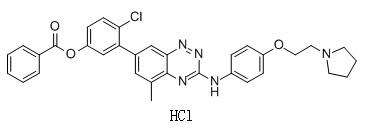
TG 100801 HCl (TG-100801; TG100801), the hydrochloride salt of TG100801, is an ester prodrug of TG-100572 (TG 100572). TG100801 is a novel and potent dual inhibitor of VEGFr2 and the Src family (Src/YES) kinases with the potential to be used for the treatment of AMD (age-related macular degeneration). It can be topically administered, and can inhibit RTK (receptor tyrosine kinases) and Src kinases such as VEGFR1, VEGFR2, FGFR1, FGFR2, PDGFRβ, Fgr, Fyn, Hck, Lck, Lyn, Src, and Yes with IC50s of 2, 7, 2, 16, 13, 5, 0.5, 6, 0.1, 0.4, 1, 0.2 nM, respectively.
Physicochemical Properties
| Molecular Formula | C33H30N5O3CL.HCL |
| Exact Mass | 615.18 |
| CAS # | 1018069-81-2 |
| Related CAS # | TG 100801;867331-82-6 |
| PubChem CID | 24823568 |
| Appearance | Typically exists as solid at room temperature |
| LogP | 7.903 |
| Hydrogen Bond Donor Count | 2 |
| Hydrogen Bond Acceptor Count | 8 |
| Rotatable Bond Count | 10 |
| Heavy Atom Count | 43 |
| Complexity | 848 |
| Defined Atom Stereocenter Count | 0 |
| SMILES | O=C(C1=CC=CC=C1)OC2=CC=C(Cl)C(C3=CC(C)=C(N=C(NC(C=C4)=CC=C4OCCN5CCCC5)N=N6)C6=C3)=C2.Cl |
| InChi Key | VLWKPMDUDFMWBO-UHFFFAOYSA-N |
| InChi Code | InChI=1S/C33H30ClN5O3.ClH/c1-22-19-24(28-21-27(13-14-29(28)34)42-32(40)23-7-3-2-4-8-23)20-30-31(22)36-33(38-37-30)35-25-9-11-26(12-10-25)41-18-17-39-15-5-6-16-39;/h2-4,7-14,19-21H,5-6,15-18H2,1H3,(H,35,36,38);1H |
| Chemical Name | [4-chloro-3-[5-methyl-3-[4-(2-pyrrolidin-1-ylethoxy)anilino]-1,2,4-benzotriazin-7-yl]phenyl] benzoate;hydrochloride |
| HS Tariff Code | 2934.99.9001 |
| Storage |
Powder-20°C 3 years 4°C 2 years In solvent -80°C 6 months -20°C 1 month |
| Shipping Condition | Room temperature (This product is stable at ambient temperature for a few days during ordinary shipping and time spent in Customs) |
Biological Activity
| ln Vitro | As eye drops, TG 100801 is a prodrug that is applied topically and quickly changes into active TG 100572 in the eye. It was demonstrated that TG 100572 inhibited the growth of hRMVEC cells at an IC50 of 610±72 nM[1]. Derivatizing the phenolic moiety in TG100572 to yield an ester yields TG 100801. It demonstrates a superb equilibrium between hydrolysis rate and stability (chemical and physical). Because the ester group prevents important interactions with the kinase active site, TG 100801 by itself does not demonstrate significant antikinase activity. However, exposure to esterases, which are prevalent in mammalian tissues, quickly releases active TG 100572. Subnanomolar action is demonstrated by TG 100572 against the Src family and RTKs, including VEGFR1 and R2, FGFR1 and R2, and PDGFRβ. TG 100572 prevents VEGF-induced extracellular signal-regulated kinase phosphorylation and reduces the proliferation of vascular endothelial cells (ED50=610±71 nM). While quiescent endothelial cell cultures are immune to TG 100572, they are susceptible to apoptosis when endothelial cell cultures proliferate quickly [2]. |
| ln Vivo | In a laser-induced choroidal neovascularization model, TG 100801 demonstrates promising efficacy and demonstrates poor systemic circulation along with excellent ocular pharmacokinetics. The concentration of TG 100572 in the choroid and sclera increases over 30 minutes (Tmax) = 0.5 hours to 23.4 µM (Cmax). TG 100572 levels in the retina are, nevertheless, comparatively low. Because TG 100572 has a brief half-life in ocular tissue, the compound must be applied topically with little time intervals in order to keep the right amount of medication in the eye. In formulations utilizing TG 100572, the highest concentration that can be achieved is 0.7% w/v[1]. TG 100801 or TG100572 was detectable in plasma after topical administration, and even with prolonged dosing regimens, no adverse safety signals (like weight loss) were noted. Topical TG 100801 significantly reduces retinal vein occlusion or fluorescein leakage in the vasculature, as well as laser-induced choroidal neovascularization in mice and rat models. It also thickens the retina. In a laser-induced mouse model, systemic administration of TG 100572 to choroidal neovascularization (CNV) resulted in a significant inhibition of CNV; however, the weight loss that accompanied the CNV development suggested systemic toxicity [2]. |
| References |
[1]. Development of prodrug 4-chloro-3-(5-methyl-3-{[4-(2-pyrrolidin-1-ylethoxy)phenyl]amino}-1,2,4-benzotriazin-7-yl)phenyl benzoate (TG100801): a topically administered therapeutic candidate in clinical trials for the treatment of age-related macular degeneration. J Med Chem. 2008 Mar 27;51(6):1546-59. [2]. Topical administration of a multi-targeted kinase inhibitor suppresses choroidal neovascularization and retinal edema. Journal of Cellular Physiology (2008), 216(1), 29-37. |
Solubility Data
| Solubility (In Vitro) | DMSO : ~5 mg/mL (~8.11 mM) |
| Solubility (In Vivo) |
Note: Listed below are some common formulations that may be used to formulate products with low water solubility (e.g. < 1 mg/mL), you may test these formulations using a minute amount of products to avoid loss of samples. Injection Formulations (e.g. IP/IV/IM/SC) Injection Formulation 1: DMSO : Tween 80: Saline = 10 : 5 : 85 (i.e. 100 μL DMSO stock solution → 50 μL Tween 80 → 850 μL Saline) *Preparation of saline: Dissolve 0.9 g of sodium chloride in 100 mL ddH ₂ O to obtain a clear solution. Injection Formulation 2: DMSO : PEG300 :Tween 80 : Saline = 10 : 40 : 5 : 45 (i.e. 100 μL DMSO → 400 μLPEG300 → 50 μL Tween 80 → 450 μL Saline) Injection Formulation 3: DMSO : Corn oil = 10 : 90 (i.e. 100 μL DMSO → 900 μL Corn oil) Example: Take the Injection Formulation 3 (DMSO : Corn oil = 10 : 90) as an example, if 1 mL of 2.5 mg/mL working solution is to be prepared, you can take 100 μL 25 mg/mL DMSO stock solution and add to 900 μL corn oil, mix well to obtain a clear or suspension solution (2.5 mg/mL, ready for use in animals). Injection Formulation 4: DMSO : 20% SBE-β-CD in saline = 10 : 90 [i.e. 100 μL DMSO → 900 μL (20% SBE-β-CD in saline)] *Preparation of 20% SBE-β-CD in Saline (4°C,1 week): Dissolve 2 g SBE-β-CD in 10 mL saline to obtain a clear solution. Injection Formulation 5: 2-Hydroxypropyl-β-cyclodextrin : Saline = 50 : 50 (i.e. 500 μL 2-Hydroxypropyl-β-cyclodextrin → 500 μL Saline) Injection Formulation 6: DMSO : PEG300 : castor oil : Saline = 5 : 10 : 20 : 65 (i.e. 50 μL DMSO → 100 μLPEG300 → 200 μL castor oil → 650 μL Saline) Injection Formulation 7: Ethanol : Cremophor : Saline = 10: 10 : 80 (i.e. 100 μL Ethanol → 100 μL Cremophor → 800 μL Saline) Injection Formulation 8: Dissolve in Cremophor/Ethanol (50 : 50), then diluted by Saline Injection Formulation 9: EtOH : Corn oil = 10 : 90 (i.e. 100 μL EtOH → 900 μL Corn oil) Injection Formulation 10: EtOH : PEG300:Tween 80 : Saline = 10 : 40 : 5 : 45 (i.e. 100 μL EtOH → 400 μLPEG300 → 50 μL Tween 80 → 450 μL Saline) Oral Formulations Oral Formulation 1: Suspend in 0.5% CMC Na (carboxymethylcellulose sodium) Oral Formulation 2: Suspend in 0.5% Carboxymethyl cellulose Example: Take the Oral Formulation 1 (Suspend in 0.5% CMC Na) as an example, if 100 mL of 2.5 mg/mL working solution is to be prepared, you can first prepare 0.5% CMC Na solution by measuring 0.5 g CMC Na and dissolve it in 100 mL ddH2O to obtain a clear solution; then add 250 mg of the product to 100 mL 0.5% CMC Na solution, to make the suspension solution (2.5 mg/mL, ready for use in animals). Oral Formulation 3: Dissolved in PEG400 Oral Formulation 4: Suspend in 0.2% Carboxymethyl cellulose Oral Formulation 5: Dissolve in 0.25% Tween 80 and 0.5% Carboxymethyl cellulose Oral Formulation 6: Mixing with food powders Note: Please be aware that the above formulations are for reference only. InvivoChem strongly recommends customers to read literature methods/protocols carefully before determining which formulation you should use for in vivo studies, as different compounds have different solubility properties and have to be formulated differently. (Please use freshly prepared in vivo formulations for optimal results.) |