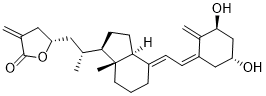
TEI-9647 (TEI9647) is a vitamin D receptor (VDR) antagonist with immunomodulatory effects. It prevents the production of osteoclasts from pagetic bone marrow cells that are brought on by 1,25-dihydroxyvitamin D3.
Physicochemical Properties
| Molecular Formula | C27H38O4 |
| Molecular Weight | 426.5882 |
| Exact Mass | 426.277 |
| Elemental Analysis | C, 76.02; H, 8.98; O, 15.00 |
| CAS # | 173388-20-0 |
| Related CAS # | TEI-9648;173388-21-1 |
| PubChem CID | 9547692 |
| Appearance | White to yellow solid powder |
| Boiling Point | 618.492ºC at 760 mmHg |
| Flash Point | 204.543ºC |
| Vapour Pressure | 0mmHg at 25°C |
| Index of Refraction | 1.567 |
| LogP | 5.025 |
| Hydrogen Bond Donor Count | 2 |
| Hydrogen Bond Acceptor Count | 4 |
| Rotatable Bond Count | 4 |
| Heavy Atom Count | 31 |
| Complexity | 821 |
| Defined Atom Stereocenter Count | 7 |
| SMILES | O1C(C(=C([H])[H])C([H])([H])[C@]1([H])C([H])([H])[C@@]([H])(C([H])([H])[H])[C@@]1([H])C([H])([H])C([H])([H])[C@@]2([H])/C(=C(\[H])/C(/[H])=C3\C(=C([H])[H])[C@]([H])(C([H])([H])[C@@]([H])(C\3([H])[H])O[H])O[H])/C([H])([H])C([H])([H])C([H])([H])[C@]12C([H])([H])[H])=O |
| InChi Key | SAODSJHDCZTVAT-CZADFQNYSA-N |
| InChi Code | InChI=1S/C27H38O4/c1-16(12-22-13-17(2)26(30)31-22)23-9-10-24-19(6-5-11-27(23,24)4)7-8-20-14-21(28)15-25(29)18(20)3/h7-8,16,21-25,28-29H,2-3,5-6,9-15H2,1,4H3/b19-7+,20-8-/t16-,21-,22+,23-,24+,25+,27-/m1/s1 |
| Chemical Name | (5S)-5-[(2R)-2-[(1R,3aS,4E,7aR)-4-[(2Z)-2-[(3S,5R)-3,5-dihydroxy-2-methylidenecyclohexylidene]ethylidene]-7a-methyl-2,3,3a,5,6,7-hexahydro-1H-inden-1-yl]propyl]-3-methylideneoxolan-2-one |
| Synonyms | TEI 9647; TEI9647; TEI-9647 |
| HS Tariff Code | 2934.99.9001 |
| Storage |
Powder-20°C 3 years 4°C 2 years In solvent -80°C 6 months -20°C 1 month Note: (1). This product requires protection from light (avoid light exposure) during transportation and storage.(2). Please store this product in a sealed and protected environment (e.g. under nitrogen), avoid exposure to moisture. |
| Shipping Condition | Room temperature (This product is stable at ambient temperature for a few days during ordinary shipping and time spent in Customs) |
Biological Activity
| ln Vitro |
TEI-9647 (100 nM; 24 hours) treatment distinctly reduces the expression of the p21WAF1,CIP1 gene that is triggered by 1α,25(OH)2D3[1]. TEI-9647 (10-1000 nM; 96 hours) blocks in a dose-dependent manner the reciprocal changes in CD11b and CD71 expression linked to 1α,25(OH)2D3-induced HL-60 cell differentiation. At 100 nM, TEI-9647 totally inhibits both the rise in CD11b and the fall in CD71 expression[1]. TEI-9647 blocks the luciferase reporter's activation in COS-7 cells transfected with the human vitamin D nuclear receptor and rat 25(OH)D3-24-hydroxylase gene's DRE, as well as 1α,25(OH)2D3-mediated HL-60 cell differentiation[1]. TEI-9647 cannot bring about cell differentiation in HL-60 cells, not even after treatment at 1 μM. TEI-9647 is unable to activate α-NB esterase or NBT-reducing activity on its own. On the other hand, 1α,25(OH)2D3 (0.1 nM)-induced up-regulation in HL-60 cells is significantly suppressed by TEI-9647[1]. TEI-9647 (0.001-1 μM; for 10 days) inhibits bone resorption caused by 1α,25(OH)2D3 (1 nM) in a dose-dependent manner. Even at 1 μM, TEI-9647 by itself never causes bone resorption[2]. TEI-9647 (10 nM; 12 h) significantly reduces the expression of the genes TAFII-17 and 25-OH-D3-24-hydroxylase that are brought on in bone marrow cells by 1α,25(OH)2D3 (0.1 nM)[2]. |
| References |
[1]. Antagonistic action of novel 1α,25-dihydroxyvitamin D3-26, 23-lactone analogs on differentiation of human leukemia cells (HL-60) induced by 1α,25-dihydroxyvitamin D3. J Biol Chem. 1999 Jun 4;274(23):16392-9. [2]. Vitamin D antagonist, TEI-9647, inhibits osteoclast formation induced by 1α,25-dihydroxyvitamin D3 from pagetic bone marrow cells. J Steroid Biochem Mol Biol. 2004 May;89-90(1-5):331-4. [3]. Synthesis and structure-activity relationships of TEI-9647 derivatives as Vitamin D3 antagonists. J Steroid Biochem Mol Biol. 2004 May;89-90(1-5):31-4. |
Solubility Data
| Solubility (In Vitro) | DMSO: ~100 mg/mL (~234.4 mM) |
| Solubility (In Vivo) |
Solubility in Formulation 1: 2.5 mg/mL (5.86 mM) in 10% DMSO + 40% PEG300 + 5% Tween80 + 45% Saline (add these co-solvents sequentially from left to right, and one by one), clear solution; with sonication. For example, if 1 mL of working solution is to be prepared, you can add 100 μL of 25.0 mg/mL clear DMSO stock solution to 400 μL PEG300 and mix evenly; then add 50 μL Tween-80 to the above solution and mix evenly; then add 450 μL normal saline to adjust the volume to 1 mL. Preparation of saline: Dissolve 0.9 g of sodium chloride in 100 mL ddH₂ O to obtain a clear solution. Solubility in Formulation 2: 2.5 mg/mL (5.86 mM) in 10% DMSO + 90% (20% SBE-β-CD in Saline) (add these co-solvents sequentially from left to right, and one by one), clear solution; with ultrasonication. For example, if 1 mL of working solution is to be prepared, you can add 100 μL of 25.0 mg/mL clear DMSO stock solution to 900 μL of 20% SBE-β-CD physiological saline solution and mix evenly. Preparation of 20% SBE-β-CD in Saline (4°C,1 week): Dissolve 2 g SBE-β-CD in 10 mL saline to obtain a clear solution. Solubility in Formulation 3: 2.5 mg/mL (5.86 mM) in 10% DMSO + 90% Corn Oil (add these co-solvents sequentially from left to right, and one by one), clear solution; with ultrasonication. For example, if 1 mL of working solution is to be prepared, you can add 100 μL of 25.0 mg/mL clear DMSO stock solution to 900 μL of corn oil and mix evenly. (Please use freshly prepared in vivo formulations for optimal results.) |
| Preparing Stock Solutions | 1 mg | 5 mg | 10 mg | |
| 1 mM | 2.3442 mL | 11.7209 mL | 23.4417 mL | |
| 5 mM | 0.4688 mL | 2.3442 mL | 4.6883 mL | |
| 10 mM | 0.2344 mL | 1.1721 mL | 2.3442 mL |