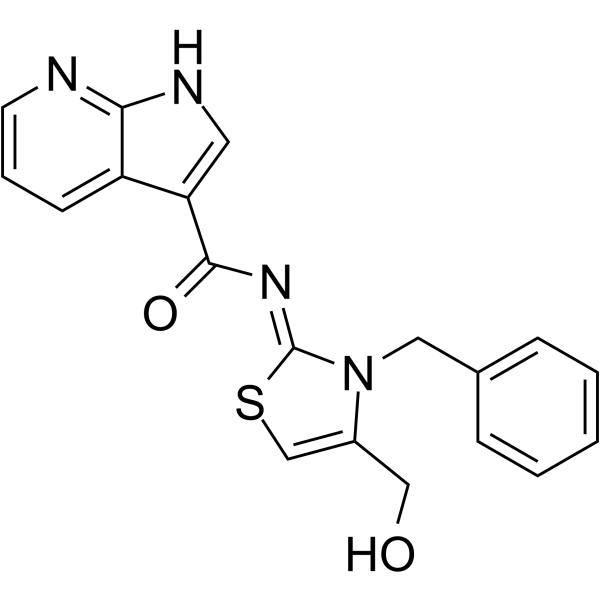
Physicochemical Properties
| Molecular Formula | C19H16N4O2S |
| Molecular Weight | 364.42 |
| Exact Mass | 364.099 |
| CAS # | 2687970-96-1 |
| PubChem CID | 156824399 |
| Appearance | White to off-white solid powder |
| LogP | 2.2 |
| Hydrogen Bond Donor Count | 2 |
| Hydrogen Bond Acceptor Count | 4 |
| Rotatable Bond Count | 4 |
| Heavy Atom Count | 26 |
| Complexity | 588 |
| Defined Atom Stereocenter Count | 0 |
| SMILES | C1(C(=O)/N=C2\SC=C(CO)N\2CC2=CC=CC=C2)=CN=C2NC=CC=C12 |
| InChi Key | LJNPGPUDPDQGLE-UHFFFAOYSA-N |
| InChi Code | InChI=1S/C19H16N4O2S/c24-11-14-12-26-19(23(14)10-13-5-2-1-3-6-13)22-18(25)16-9-21-17-15(16)7-4-8-20-17/h1-9,12,24H,10-11H2,(H,20,21) |
| Chemical Name | N-[3-benzyl-4-(hydroxymethyl)-1,3-thiazol-2-ylidene]-1H-pyrrolo[2,3-b]pyridine-3-carboxamide |
| HS Tariff Code | 2934.99.9001 |
| Storage |
Powder-20°C 3 years 4°C 2 years In solvent -80°C 6 months -20°C 1 month |
| Shipping Condition | Room temperature (This product is stable at ambient temperature for a few days during ordinary shipping and time spent in Customs) |
Biological Activity
| ln Vitro | In human propulsion organoids, TDI-011536 (3 μM; 24 hours) decreases Yap phosphorylation and (3 μM; 5 days) increases Müller astrocyte proliferation [1]. |
| ln Vivo | TDI-011536 (200 mg/kg; intraperitoneal; once) lowers pYap levels in all three organs for at least 4 hours following injection and offers prolonged inhibition in the skin, heart, and heart over a 4-hour period [1]. Cardiomyocytes exhibit proliferative effects when exposed to TDI-011536 (100 mg/kg; intraperitoneal injection; once daily for 2 or 3 days) [1]. |
| Cell Assay |
Cell Proliferation Assay[1] Cell Types: human retinal Organoids Tested Concentrations: 3 µM Incubation Duration: 24 hrs (hours), 5 days Experimental Results: Inhibited Yap phosphorylation and promoted Müller glial cell proliferation. |
| Animal Protocol |
Animal/Disease Models: Live mice (immediate immunoblot analysis of heart, liver and skin) after injection) [1]. Doses: 200 mg/kg Route of Administration: intraperitoneal (ip) injection; once. Experimental Results: pYap amounts were diminished for at least 4 hrs (hrs (hours)) after injection in all three organs, with levels returning to control values within a day. Animal/Disease Models: 8weeks old male mice (frozen model) [1]. Doses: 100 mg/kg Route of Administration: intraperitoneal (ip) injection; one time/day for 2 or 3 days Experimental Results: Promote cardiomyocyte proliferation. |
| References |
[1]. Development of an improved inhibitor of Lats kinases to promote regeneration of mammalian organs. Proc Natl Acad Sci U S A. 2022 Jul 12;119(28):e2206113119. |
Solubility Data
| Solubility (In Vitro) | DMSO : ~125 mg/mL (~343.01 mM) |
| Solubility (In Vivo) |
Solubility in Formulation 1: ≥ 2.08 mg/mL (5.71 mM) (saturation unknown) in 10% DMSO + 40% PEG300 + 5% Tween80 + 45% Saline (add these co-solvents sequentially from left to right, and one by one), clear solution. For example, if 1 mL of working solution is to be prepared, you can add 100 μL of 20.8 mg/mL clear DMSO stock solution to 400 μL PEG300 and mix evenly; then add 50 μL Tween-80 to the above solution and mix evenly; then add 450 μL normal saline to adjust the volume to 1 mL. Preparation of saline: Dissolve 0.9 g of sodium chloride in 100 mL ddH₂ O to obtain a clear solution. Solubility in Formulation 2: ≥ 2.08 mg/mL (5.71 mM) (saturation unknown) in 10% DMSO + 90% Corn Oil (add these co-solvents sequentially from left to right, and one by one), clear solution. For example, if 1 mL of working solution is to be prepared, you can add 100 μL of 20.8 mg/mL clear DMSO stock solution to 900 μL of corn oil and mix evenly. (Please use freshly prepared in vivo formulations for optimal results.) |
| Preparing Stock Solutions | 1 mg | 5 mg | 10 mg | |
| 1 mM | 2.7441 mL | 13.7204 mL | 27.4409 mL | |
| 5 mM | 0.5488 mL | 2.7441 mL | 5.4882 mL | |
| 10 mM | 0.2744 mL | 1.3720 mL | 2.7441 mL |