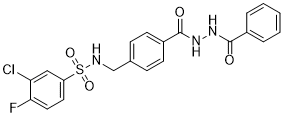
TCN-201 is a novel, potent, non-competitive and selective antagonist of NMDA receptors containing the NR2A subunit with a pIC50 of 6.8. TCN 201 selectively blocks GluN2A-containing NMDARs in a GluN1 co-agonist dependent but non-competitive manner.
Physicochemical Properties
| Molecular Formula | C21H17N3O4FSCL |
| Molecular Weight | 461.89378 |
| Exact Mass | 461.061 |
| CAS # | 852918-02-6 |
| Related CAS # | 852918-02-6; |
| PubChem CID | 4787937 |
| Appearance | White to off-white solid powder |
| Density | 1.4±0.1 g/cm3 |
| Index of Refraction | 1.625 |
| LogP | 4.13 |
| Hydrogen Bond Donor Count | 3 |
| Hydrogen Bond Acceptor Count | 6 |
| Rotatable Bond Count | 6 |
| Heavy Atom Count | 31 |
| Complexity | 719 |
| Defined Atom Stereocenter Count | 0 |
| InChi Key | FYIBXBFDXNPBSF-UHFFFAOYSA-N |
| InChi Code | InChI=1S/C21H17ClFN3O4S/c22-18-12-17(10-11-19(18)23)31(29,30)24-13-14-6-8-16(9-7-14)21(28)26-25-20(27)15-4-2-1-3-5-15/h1-12,24H,13H2,(H,25,27)(H,26,28) |
| Chemical Name | N-[[4-(benzamidocarbamoyl)phenyl]methyl]-3-chloro-4-fluorobenzenesulfonamide |
| HS Tariff Code | 2934.99.9001 |
| Storage |
Powder-20°C 3 years 4°C 2 years In solvent -80°C 6 months -20°C 1 month Note: (1). Please store this product in a sealed and protected environment (e.g. under nitrogen), avoid exposure to moisture and light.(2). This product is not stable in solution, please use freshly prepared working solution for optimal results. |
| Shipping Condition | Room temperature (This product is stable at ambient temperature for a few days during ordinary shipping and time spent in Customs) |
Biological Activity
| ln Vitro | Compound 1, TCN 201, has a pIC50 of <4.3 and 6.8, respectively, making it more selective for GluN1/GluN2A NMDAR than GluN1/GluN2B NMDAR [1]. In oocytes, TCN 201 (10 μM) only modestly suppresses GluN1/GluN2B NMDAR-mediated currents [2]. In oocytes, TCN 201 (10-30 μM) exhibits a more powerful antagonistic effect on NMDAR-mediated responses, which is dependent on isoform and glycine [2]. In oocytes, NMDAR-mediated responses are not entirely blocked by TCN 201 (0.1-100 μM) [2]. In rat cortical neurons, TCN 201 (10 μM) antagonistic activity against NMDAR-mediated currents is inversely linked with its ifenprodil sensitivity [2]. In chick retina, cortical spreading depression (CSD) is inhibited by TCN 201 (1-9 μM) [3]. |
| ln Vivo | Rats with CSD exhibit an insufficient response to TCN-201 (10 mg/kg; intraperitoneal injection) regarding the blood oxygenation level-dependent (BOLD) response [4]. |
| References |
[1]. Identification and characterization of novel NMDA receptor antagonists selective for NR2A- over NR2B-containing receptors. J Pharmacol Exp Ther. 2010 Dec; 335(3): 636-44. [2]. TCN 201 selectively blocks GluN2A-containing NMDARs in a GluN1 co-agonist dependent but non-competitive manner. Neuropharmacology. 2012 Sep; 63(3): 441-9. [3]. NR2A contributes to genesis and propagation of cortical spreading depression in rats. Sci Rep. 2016 Mar 22;6:23576. [4]. Involvement of NMDA receptor subtypes in cortical spreading depression in rats assessed by fMRI. Neuropharmacology. 2015 Jun; 93:164-70. |
Solubility Data
| Solubility (In Vitro) | DMSO : ~250 mg/mL (~541.25 mM) |
| Solubility (In Vivo) |
Solubility in Formulation 1: ≥ 2.08 mg/mL (4.50 mM) (saturation unknown) in 10% DMSO + 40% PEG300 + 5% Tween80 + 45% Saline (add these co-solvents sequentially from left to right, and one by one), clear solution. For example, if 1 mL of working solution is to be prepared, you can add 100 μL of 20.8 mg/mL clear DMSO stock solution to 400 μL PEG300 and mix evenly; then add 50 μL Tween-80 to the above solution and mix evenly; then add 450 μL normal saline to adjust the volume to 1 mL. Preparation of saline: Dissolve 0.9 g of sodium chloride in 100 mL ddH₂ O to obtain a clear solution. Solubility in Formulation 2: ≥ 2.08 mg/mL (4.50 mM) (saturation unknown) in 10% DMSO + 90% (20% SBE-β-CD in Saline) (add these co-solvents sequentially from left to right, and one by one), clear solution. For example, if 1 mL of working solution is to be prepared, you can add 100 μL of 20.8 mg/mL clear DMSO stock solution to 900 μL of 20% SBE-β-CD physiological saline solution and mix evenly. Preparation of 20% SBE-β-CD in Saline (4°C,1 week): Dissolve 2 g SBE-β-CD in 10 mL saline to obtain a clear solution. Solubility in Formulation 3: ≥ 2.08 mg/mL (4.50 mM) (saturation unknown) in 10% DMSO + 90% Corn Oil (add these co-solvents sequentially from left to right, and one by one), clear solution. For example, if 1 mL of working solution is to be prepared, you can add 100 μL of 20.8 mg/mL clear DMSO stock solution to 900 μL of corn oil and mix evenly. (Please use freshly prepared in vivo formulations for optimal results.) |
| Preparing Stock Solutions | 1 mg | 5 mg | 10 mg | |
| 1 mM | 2.1650 mL | 10.8251 mL | 21.6502 mL | |
| 5 mM | 0.4330 mL | 2.1650 mL | 4.3300 mL | |
| 10 mM | 0.2165 mL | 1.0825 mL | 2.1650 mL |