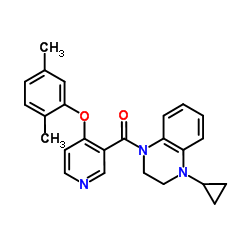
TC-G 1005 (TC-G-1005; TCG1005) is a novel, oral and potent TGR5 (GPBAR1) agonist with glucose-lowering effects. It has EC50s of 0.72 and 6.2 nM for human TGR5 and mouse TGR5, respectively, indicating that it inhibits the BA receptor Takeda G protein-coupled receptor 5 (TGR5).
Physicochemical Properties
| Molecular Formula | C25H25N3O2 |
| Molecular Weight | 399.49 |
| Exact Mass | 399.195 |
| Elemental Analysis | C, 75.16; H, 6.31; N, 10.52; O, 8.01 |
| CAS # | 1415407-60-1 |
| PubChem CID | 71450251 |
| Appearance | Off-white to yellow solid powder |
| Density | 1.3±0.1 g/cm3 |
| Boiling Point | 564.5±50.0 °C at 760 mmHg |
| Flash Point | 295.2±30.1 °C |
| Vapour Pressure | 0.0±1.5 mmHg at 25°C |
| Index of Refraction | 1.653 |
| LogP | 4.44 |
| Hydrogen Bond Donor Count | 0 |
| Hydrogen Bond Acceptor Count | 4 |
| Rotatable Bond Count | 4 |
| Heavy Atom Count | 30 |
| Complexity | 609 |
| Defined Atom Stereocenter Count | 0 |
| SMILES | O=C(C1C=NC=CC=1OC1C=C(C)C=CC=1C)N1C2C=CC=CC=2N(CC1)C1CC1 |
| InChi Key | JQULIQJSYPZQMA-UHFFFAOYSA-N |
| InChi Code | InChI=1S/C25H25N3O2/c1-17-7-8-18(2)24(15-17)30-23-11-12-26-16-20(23)25(29)28-14-13-27(19-9-10-19)21-5-3-4-6-22(21)28/h3-8,11-12,15-16,19H,9-10,13-14H2,1-2H3 |
| Chemical Name | (4-cyclopropyl-2,3-dihydroquinoxalin-1-yl)-[4-(2,5-dimethylphenoxy)pyridin-3-yl]methanone |
| Synonyms | TC-G-1005; TCG1005; TC-G 1005; TCG 1005; TC G 1005 |
| HS Tariff Code | 2934.99.03.00 |
| Storage |
Powder-20°C 3 years 4°C 2 years In solvent -80°C 6 months -20°C 1 month |
| Shipping Condition | Room temperature (This product is stable at ambient temperature for a few days during ordinary shipping and time spent in Customs) |
Biological Activity
| Targets | hTGR5 ( IC50 = 0.72 nM ); mTGR5 ( IC50 = 6.2 nM ) |
| ln Vitro | TC-G 1005 induces mouse TGR5 with EC50 of 0.72 nM and 6.2 nM respectively[1]. |
| ln Vivo |
TC-G 1005 (25-100 mg/kg; single oxygen dose) activates GLP-1 in the imprinted control region (ICR)[1] TC-G 1005 (50 mg/kg; single po) can lower blood pressure AUC0-120 minutes by 49% in ICR mice.[1] TC-G 1005 (50 mg/kg; oral single dose) lowered blood pressure at 4, 6, 10, and 24 hours using db/db electrodes.[1] TC-G 1005 (5 mg/kg; po) showed a fairly low toxic exposure in FX, with a t1/2 of 1.5 and a Cmax of 56 ng/mL.[1] |
| Animal Protocol |
Male ICR mice 25, 50, 100 mg/kg A single p.o. |
| References |
[1]. Design, synthesis, and antidiabetic activity of 4-phenoxynicotinamide and 4-phenoxypyrimidine-5-carboxamide derivatives as potent and orally efficacious TGR5 agonists. J Med Chem. 2012 Dec 13;55(23):10475-89. [2]. Bile acids inhibit cholinergic constriction in proximal and peripheral airways from humans and rodents. Am J Physiol Lung Cell Mol Physiol. 2020 Feb 1;318(2):L264-L275. |
Solubility Data
| Solubility (In Vitro) | DMSO: ~33.3 mg/mL (~83.4 mM) |
| Solubility (In Vivo) |
Solubility in Formulation 1: ≥ 2.5 mg/mL (6.26 mM) (saturation unknown) in 10% DMSO + 40% PEG300 + 5% Tween80 + 45% Saline (add these co-solvents sequentially from left to right, and one by one), clear solution. For example, if 1 mL of working solution is to be prepared, you can add 100 μL of 25.0 mg/mL clear DMSO stock solution to 400 μL PEG300 and mix evenly; then add 50 μL Tween-80 to the above solution and mix evenly; then add 450 μL normal saline to adjust the volume to 1 mL. Preparation of saline: Dissolve 0.9 g of sodium chloride in 100 mL ddH₂ O to obtain a clear solution. Solubility in Formulation 2: ≥ 2.5 mg/mL (6.26 mM) (saturation unknown) in 10% DMSO + 90% Corn Oil (add these co-solvents sequentially from left to right, and one by one), clear solution. For example, if 1 mL of working solution is to be prepared, you can add 100 μL of 25.0 mg/mL clear DMSO stock solution to 900 μL of corn oil and mix evenly. (Please use freshly prepared in vivo formulations for optimal results.) |
| Preparing Stock Solutions | 1 mg | 5 mg | 10 mg | |
| 1 mM | 2.5032 mL | 12.5160 mL | 25.0319 mL | |
| 5 mM | 0.5006 mL | 2.5032 mL | 5.0064 mL | |
| 10 mM | 0.2503 mL | 1.2516 mL | 2.5032 mL |