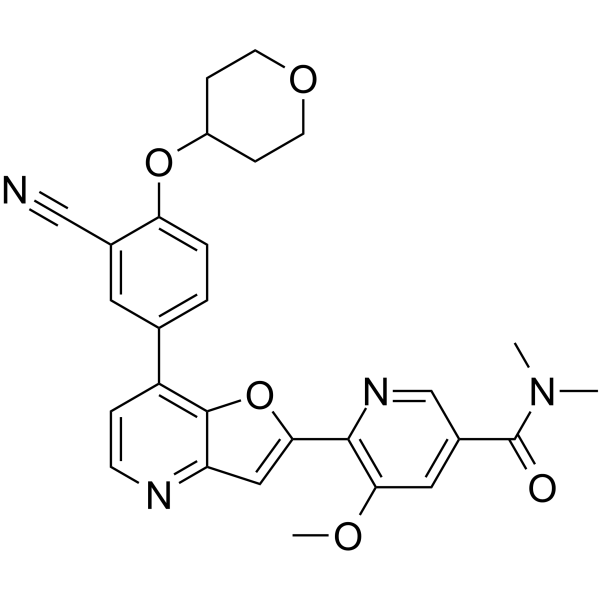
Physicochemical Properties
| Molecular Formula | C28H26N4O5 |
| Exact Mass | 498.19 |
| CAS # | 2058264-32-5 |
| Related CAS # | 2058264-32-5 |
| PubChem CID | 124156234 |
| Appearance | Typically exists as solid at room temperature |
| LogP | 3.1 |
| Hydrogen Bond Donor Count | 0 |
| Hydrogen Bond Acceptor Count | 8 |
| Rotatable Bond Count | 6 |
| Heavy Atom Count | 37 |
| Complexity | 827 |
| Defined Atom Stereocenter Count | 0 |
| InChi Key | QHZNENVHULXUOO-UHFFFAOYSA-N |
| InChi Code | InChI=1S/C28H26N4O5/c1-32(2)28(33)19-13-24(34-3)26(31-16-19)25-14-22-27(37-25)21(6-9-30-22)17-4-5-23(18(12-17)15-29)36-20-7-10-35-11-8-20/h4-6,9,12-14,16,20H,7-8,10-11H2,1-3H3 |
| Chemical Name | 6-[7-[3-cyano-4-(oxan-4-yloxy)phenyl]furo[3,2-b]pyridin-2-yl]-5-methoxy-N,N-dimethylpyridine-3-carboxamide |
| Synonyms | TBK1/IKKε-IN-1 |
| HS Tariff Code | 2934.99.9001 |
| Storage |
Powder-20°C 3 years 4°C 2 years In solvent -80°C 6 months -20°C 1 month |
| Shipping Condition | Room temperature (This product is stable at ambient temperature for a few days during ordinary shipping and time spent in Customs) |
Biological Activity
| Targets | TBK1 (IC50 = 100 nM); IKKε(IC50 = 100 nM) |
| ln Vitro | TBK1/IKKε-IN-5(compound 1) efficiently prevents CT26 cell line spheroids from producing immune suppressive cytokines while having no cytotoxic effects. It also increases the secretion of IL-2 and IFN-γ from purified CD4+ and CD8+ T cells from healthy human donors as well as IL-2 from Jurkat human T-cell leukemia cells. Ex vivo addition of TBK1/IKKε-IN-1(compound 1) to PD-1 blockade improves killing of CT26 MDOTS and is accompanied by a reduction in CCL4, CCL3, and IL-1β levels and an induction of cytokines involved in activated innate immune responses. [1] |
| ln Vivo | TBK1/IKKε-IN-1(compound 1) ± anti-PD-L1 is administered to Balb/c mice bearing CT26 tumors. Greater tumor control and longer survival are evident with TBK1/IKKε-IN-1(compound 1) + anti-PD-L1 compared to TBK1/IKKε-IN-1(compound 1) or anti-PD-L1 alone, which is in line with MDOTS profiling data. Reimplantation of CT26 into mice with exceptional responses to combination therapy causes no growth, whereas EMT-6 implanted tumors grow normally. This finding suggests that mice treated with TBK1/IKKε-IN-1(compound 1) + anti-PD-L1 have CT26 cells that have been induced to form an immunologic memory. Because of this, MDOTS profiling successfully mimics the in vivo response to PD-1 blockade +/− TBK1/IKKε inhibition, highlighting the potential of ex vivo screening in MDOTS to create combination immunotherapies. [1] |
| Cell Assay | Interleukin-2 and interferon gamma analysis— Human CD4+ and CD8+ T cells that have recently been isolated are spun down, resuspended in serum-free X-vivo15 media, and incubated overnight at 37°C. A 2 μg/mL anti-CD28 solution is added before plating the cells on anti-CD3 coated plates. For the 24 hours necessary to produce IL-2 and 96 hours necessary to produce IFNγ, cells are treated in replicate plates with TBK1/IKKε-IN-1(compound 1) . Using single- or multi-plex immunoassays, the levels of IL-2 and IFNγ in the supernatant are determined. We treated Jurkat T cell leukemia cells with a dose titration of TBK1/IKKε-IN-1(compound 1) for 24 hours after plating them on anti-CD3 coated plates. |
| Animal Protocol |
11-12 week old female Balb/c mice implanted with 1×10⁶ CT26 colon carcinoma cells. 40 mg/kg Oral gavage |
| References |
[1]. Cancer Discov . 2018 Feb;8(2):196-215. |
Solubility Data
| Solubility (In Vitro) | DMSO: ~5 mg/mL (~9.7 mM) |
| Solubility (In Vivo) |
Note: Listed below are some common formulations that may be used to formulate products with low water solubility (e.g. < 1 mg/mL), you may test these formulations using a minute amount of products to avoid loss of samples. Injection Formulations (e.g. IP/IV/IM/SC) Injection Formulation 1: DMSO : Tween 80: Saline = 10 : 5 : 85 (i.e. 100 μL DMSO stock solution → 50 μL Tween 80 → 850 μL Saline) *Preparation of saline: Dissolve 0.9 g of sodium chloride in 100 mL ddH ₂ O to obtain a clear solution. Injection Formulation 2: DMSO : PEG300 :Tween 80 : Saline = 10 : 40 : 5 : 45 (i.e. 100 μL DMSO → 400 μLPEG300 → 50 μL Tween 80 → 450 μL Saline) Injection Formulation 3: DMSO : Corn oil = 10 : 90 (i.e. 100 μL DMSO → 900 μL Corn oil) Example: Take the Injection Formulation 3 (DMSO : Corn oil = 10 : 90) as an example, if 1 mL of 2.5 mg/mL working solution is to be prepared, you can take 100 μL 25 mg/mL DMSO stock solution and add to 900 μL corn oil, mix well to obtain a clear or suspension solution (2.5 mg/mL, ready for use in animals). Injection Formulation 4: DMSO : 20% SBE-β-CD in saline = 10 : 90 [i.e. 100 μL DMSO → 900 μL (20% SBE-β-CD in saline)] *Preparation of 20% SBE-β-CD in Saline (4°C,1 week): Dissolve 2 g SBE-β-CD in 10 mL saline to obtain a clear solution. Injection Formulation 5: 2-Hydroxypropyl-β-cyclodextrin : Saline = 50 : 50 (i.e. 500 μL 2-Hydroxypropyl-β-cyclodextrin → 500 μL Saline) Injection Formulation 6: DMSO : PEG300 : castor oil : Saline = 5 : 10 : 20 : 65 (i.e. 50 μL DMSO → 100 μLPEG300 → 200 μL castor oil → 650 μL Saline) Injection Formulation 7: Ethanol : Cremophor : Saline = 10: 10 : 80 (i.e. 100 μL Ethanol → 100 μL Cremophor → 800 μL Saline) Injection Formulation 8: Dissolve in Cremophor/Ethanol (50 : 50), then diluted by Saline Injection Formulation 9: EtOH : Corn oil = 10 : 90 (i.e. 100 μL EtOH → 900 μL Corn oil) Injection Formulation 10: EtOH : PEG300:Tween 80 : Saline = 10 : 40 : 5 : 45 (i.e. 100 μL EtOH → 400 μLPEG300 → 50 μL Tween 80 → 450 μL Saline) Oral Formulations Oral Formulation 1: Suspend in 0.5% CMC Na (carboxymethylcellulose sodium) Oral Formulation 2: Suspend in 0.5% Carboxymethyl cellulose Example: Take the Oral Formulation 1 (Suspend in 0.5% CMC Na) as an example, if 100 mL of 2.5 mg/mL working solution is to be prepared, you can first prepare 0.5% CMC Na solution by measuring 0.5 g CMC Na and dissolve it in 100 mL ddH2O to obtain a clear solution; then add 250 mg of the product to 100 mL 0.5% CMC Na solution, to make the suspension solution (2.5 mg/mL, ready for use in animals). Oral Formulation 3: Dissolved in PEG400 Oral Formulation 4: Suspend in 0.2% Carboxymethyl cellulose Oral Formulation 5: Dissolve in 0.25% Tween 80 and 0.5% Carboxymethyl cellulose Oral Formulation 6: Mixing with food powders Note: Please be aware that the above formulations are for reference only. InvivoChem strongly recommends customers to read literature methods/protocols carefully before determining which formulation you should use for in vivo studies, as different compounds have different solubility properties and have to be formulated differently. (Please use freshly prepared in vivo formulations for optimal results.) |